
A no-see-ums rash has four properties that almost nobody states out loud. It sits at a certain depth. It runs on a clock. It adds up in a way that is not proportional to the number of bites. And its size depends more on the person than on the insect. Those four facts decide most of what a reasonable person can do about it. They decide, for instance, which of the products on the bathroom shelf can physically reach the layer where the itch is being built, and which cannot.
Most pages answer this search with a list of creams. This page does something narrower and more useful. It works from the bottom of the bite upward, and prices each option against what it has to reach. Then it deals with the situations people routinely confuse: more bites, an infected bite, and a rash that has left the bites behind. Nothing here is a diagnosis. A lesion that spreads, heats up, drains, or comes with a fever belongs to a clinician, and the last section says so precisely.
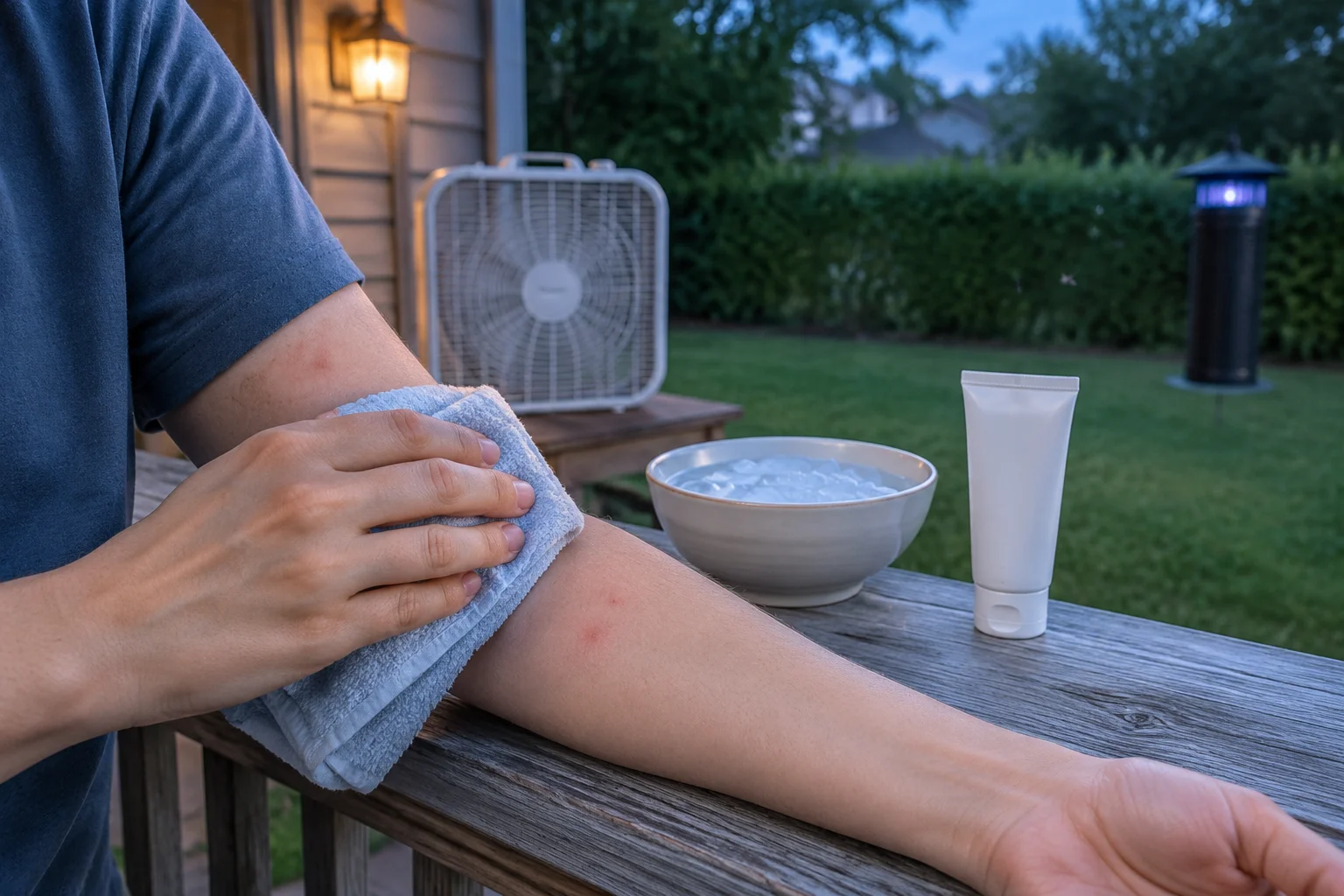
No-See-Ums Rash: The Short Version For Someone Reading This At Night
Biting midge saliva contains enzymes, and those enzymes are not only digesting. Some of them switch on a receptor that lives in the topmost working layer of your epidermis, and that receptor can produce itch without any histamine involved at all (Fan M, Fan X, Lai Y, et al., Frontiers in Immunology, 2024). That single fact explains why an antihistamine sometimes finishes the job and sometimes does not touch it, and it explains why the useful question is not which cream, but how deep it has to go and against which messenger it is working.
The practical ranking that follows from the published evidence is short. Cool the skin. Cover the skin. Reduce the number of bites. Everything else is aimed at a messenger, and only some of the messengers are the ones running in your skin tonight. The table in the penultimate section puts all of it in one view.
How Deep A No-See-Ums Rash Actually Starts
The wound from a midge is a cut rather than a needle stroke, and the saliva goes in first. That much is settled, and our page on what a bite does to skin follows the consequences through the immune system in detail (see biting no-see-ums). What matters here is the next question: where in the skin does the itch get assembled?
Part of it is assembled in the epidermis itself. The review of protease-activated receptor 2 in skin disease states that in healthy adult human skin the receptor is located mainly in the stratum granulosum, the granular layer of epidermal keratinocytes (Fan et al., 2024). That is not a deep structure. It sits inside the epidermis, a few cell widths under the surface you can wash, which is why the depth of a treatment is a real question rather than a technicality.
The same receptor is switched on by having its protein chain cut. The review names the enzymes that do it as serine proteases, and gives trypsin, tryptase and neutrophil elastase as examples. Once it is switched on, it feeds two things at once: inflammation of the allergic Th2 kind, slower repair of the barrier, and an itch route that the same paper describes as histamine-independent. Its own summary of the experimental evidence is that overexpressing the receptor in keratinocytes and immune cells induces IL-6, ICAM-1 and TSLP, and that PAR2 signalling activates histamine-independent itching.
Then there is the nerve. Human microneurography work – inserting a fine electrode into a nerve fibre in a living person’s arm and listening to a single fibre fire – has shown that several itch qualities in humans do not need histamine at all. That study reports three things worth having plainly. Sensitising the nociceptors beforehand with prostaglandin E2 increased the pain component of one non-histaminergic itch model but not of the others tested. A-fibres contributed only to the itch produced by one of the three substances, leaving the rest to unmyelinated C-fibres. And the mode of delivery changed the outcome: the same pruritogen spread onto the skin on a plant spine rather than injected beneath it shifted the balance of the sensation, because the two routes do not reach the same fibres (Fiebig A, Leibl V, Oostendorf D, et al., Journal of Translational Medicine, 2023).
Put plainly, the anatomy is this. The cut is in the epidermis. The receptor that reads salivary protein sits in the granular layer of the epidermis. The nerves that report it are of more than one kind, and at least one of those kinds ignores histamine. Any product you apply has to cross the outermost barrier and arrive at a living layer underneath it, in sufficient amount, while the messenger you mean to interrupt is the one actually running.
The Barrier Is On A Clock, And So Are You
People treat a bite rash as if the skin in front of them were the same tissue at 9 a.m. and at 11 p.m. It is not, and the difference has been measured. A study of twenty healthy daytime-active volunteers, tracked with laser Doppler imaging, a transepidermal water loss probe and a skin thermometer across 24 and 28 hour sessions, found circadian and 12-hour ultradian rhythms in skin blood flow. It also found that skin temperature correlated with skin blood flow, while neither correlated with the water-loss measure of barrier function. The rhythms survived treatment with both high-potency and mid-potency topical corticosteroids, and they persisted even when the stratum corneum was deliberately disrupted (Yosipovitch G, Sackett-Lundeen L, Goon A, et al., Journal of Investigative Dermatology, 2004).
Three things follow, and the third is the one that embarrasses the standard advice.
- The skin you are creaming at midnight is better perfused than the skin you are creaming mid-morning. Whatever is in the cream is being carried away at a different rate depending on the hour.
- Blood flow and temperature move together, but blood flow does not track the barrier’s water loss. Warm, flushed, itchy skin is not automatically dry skin, which is why the standard advice to reach for a richer cream because it must be dryness is a guess rather than a reading.
- A steroid does not switch the clock off. If a regimen fails at week two, the answer is not necessarily a stronger steroid.
Where the method fails: this was twenty healthy adults with no bite reaction at all, measured on ordinary skin under laboratory conditions. It tells you the terrain changes with the hour. It does not tell you the best hour to apply anything, and no study we found has tested that for a midge lesion. Treat it as a reason to doubt confident timing advice, including advice that says apply at night because night is when skin repairs.
Why Fifteen Bites Hurt Far More Than Three
Anyone whose no-see-ums rash has arrived in a cluster has noticed that it does not scale with the bites. A dozen marks can produce an evening that is categorically worse than a single mark, and there is a name for the mechanism: summation.
A 2026 experiment in healthy volunteers tested this directly, using histamine and cowhage as the two provocation models, precisely because one is histaminergic and the other is not. In the spatial arm, the same pruritogen was applied to one area, to two areas on the same arm, or to two areas on different arms. Itch intensity and the total itch experienced were significantly increased by applying the stimulus to more than one area, and this happened for both pruritogens and both when the second site was on the same arm and when it was on the other arm.
In the temporal arm, reapplying a stimulus at 180-second intervals increased the itch experienced compared with a single application. Both arms also measured alloknesis – itch produced by a light, non-itchy touch such as clothing – and hyperknesis, a lowered threshold for itch (Aliotta GE, Lo Vecchio S, Tanaka R, et al., The Journal of Dermatology, 2026).
The interpretation the authors give is about the nervous system rather than the skin: summation is a way the itch system encodes magnitude, and the effects appeared whether or not histamine was the route. Practically, four consequences matter to a person with a rash.
- Adding bites does not add itch; it multiplies it. The difference between an itchy evening and an unbearable one can be a handful of extra marks that all arrive in the same two hours.
- The itch you feel is broader than the wounds. Skin that was never bitten can start to itch, and touching unaffected skin nearby can produce the sensation, because the system is turned up rather than because new bites appeared.
- Re-stimulation matters as much as load. Repeated input at short intervals is what built the temporal effect. Rubbing, towelling, a hot shower and a wool sleeve are all re-applications.
- Scratch-induced itch is not a failure of willpower. It is the same circuit being fed. The published model explains the behaviour; it does not moralise it.
Whose Rash Is It: The Person Variable
Two people stand in the same grass, get the same number of bites, and one of them sleeps badly for three nights. The gap is not imagination, and it has been measured in a couple of different ways.
The first is allergic background. In a study of 180 children at a paediatric allergy clinic – 94 with a confirmed mosquito-bite allergy and 86 matched controls – atopy was present in 35.1 percent of the reaction group against 11.6 percent of controls, and grass-pollen sensitisation in 28.7 percent against 8.1 percent. Bullae, fluid-filled blisters on top of the bite, were significantly more common in the children who also had asthma: 41.7 percent against 15.9 percent.
The same study carries a number that should qualify a great deal of confident advice about no-see-ums rash: skin-prick testing with mosquito allergen was positive in only 6 of the 94 children, which is 6.4 percent (Yavuz ST, Akin O, Koc O, et al., Allergologia et Immunopathologia, 2021). A negative allergy test does not establish that the reaction is not real.
The second is age, and the direction is the opposite of what most households assume. Using enzyme-linked assays against Aedes vexans saliva in 402 children aged one month to eighteen years, with 23 never-exposed infant sera as controls, antibody levels fell as the children got older. Saliva-specific IgE peaked between six and twelve months of age, and IgG peaked earlier still, between one and six months. Correlation with age was significantly inverse for both classes, and levels fell gradually after the age of five. The authors’ own conclusion was that natural desensitisation may occur (Peng Z, Ho MK, Li C, Simons FE, Annals of Allergy, Asthma and Immunology, 2004). Severity in the same direction: in a study of children with papular urticaria, 58.9 percent scored as high severity, and high severity was significantly associated with having first had symptoms before the age of two (Tschoepke Aires R, Goudouris ES, Pinto-Mariz F, et al., European Annals of Allergy and Clinical Immunology, 58:147-156).
| Host factor | What was measured | What it changes about the rash |
|---|---|---|
| Atopy | 35.1 percent of children with bite allergy versus 11.6 percent of matched controls | Larger, stranger, longer reactions; blisters cluster with asthma |
| A negative allergy test | Skin-prick test positive in only 6.4 percent of children with the diagnosis | Proves nothing. The rash is still the rash. |
| Age | Saliva-specific IgE and IgG falling with age across 402 children | Why the youngest bites hardest and the teenager does not notice |
| Age at first symptoms | High-severity papular urticaria associated with onset before two years | Identifies the children who will need the serious version of this plan |
| Heat and season | Bite consultations peaking with air temperature; impetigo one to two four-week periods behind it | The reason one bad week keeps producing cases into next month |
The operational reading for a household is uncomfortable but useful. The child is not being precious, and the adult who shrugs it off is not tougher. The immune system’s price for a season of bites depends partly on history, and in most people that history improves with years. This is also why a control programme judged on one adult’s opinion will mislead you; see our guide to stopping no-see-ums from biting for the counting method instead.
What A Topical Can Reach Into A No-See-Ums Rash
Why Depth Decides Everything
Here is the arithmetic that decides whether a cream is a treatment or a ritual. The receptor that reads the salivary proteases is in the granular layer of the epidermis. The outermost layer of the epidermis – the layer you can actually feel – is dead, densely packed, and built specifically to stop things getting in. That is the barrier, and it is the whole reason topical medicine is a delivery problem rather than a painting problem. The clinical review that frames this for practitioners puts it plainly: given how central topical medicines are to treating skin disease, the delivery system has to be understood as part of the treatment (Rudy SJ, Parham-Vetter PC, Percutaneous Absorption of Topically Applied Medication).
Three consequences follow directly.
| What you assume | What the delivery logic says |
|---|---|
| Applying more cream to one spot is better | A thicker layer does not make the active arrive faster in useful amounts. It makes a mess, and it rubs the spot more. |
| Any cream is roughly as good as any other | The vehicle is part of the medicine. Occlusive bases hold water against the barrier and change how much gets through; a watery lotion mostly does not. |
| If it does not work, the diagnosis must be wrong | It may simply be that the messenger running in your skin is not the one the cream acts on. Histamine is not the only route to the nerve. |
| A cream that stings is working | On skin whose barrier is already broken by scratching, a stinging product is often reporting the break rather than treating it. |
Cooling Is A Receptor Signal, Not A Moisturiser
Cooling is the one non-drug measure with a randomised trial behind it, and the trial is instructive because of what it did not show.
Seventy patients with dry, itchy skin and an itch score of three or more were randomised to a lotion carrying two TRPM8 cooling agonists or to the identical lotion without them, applied twice daily for four weeks. Itch improved significantly more with the cooling lotion: 79.2 percent against 47.1 percent on a global score, and the quality-of-life measure moved with it.
Here is the part that matters. Skin roughness, dryness and hydration improved significantly in both groups, with no significant difference between them. The moisturising did not separate the arms. The cooling receptor did. Up to 84 percent of treated patients reported a long-lasting cooling effect that was, in the authors’ own words, sometimes too strong (Stander S, Augustin M, Roggenkamp D, et al., Journal of the European Academy of Dermatology and Venereology, 31:1064-1068, 2017).
And Where Cooling Did Not Beat Its Own Lotion
That is not a law of nature, and it is worth saying so. A blinded, split-body pilot in nine atopic dogs with foot pruritus applied a 2 percent TRPM8-agonist cream to one paw and the plain vehicle to the other for seven days. Nothing separated the two: median change in pruritus score was 47 percent on the drug and 75 percent on the vehicle, and the differences were not significant (Tamamoto-Mochizuki C, Murphy KM, Olivry T, Veterinary Dermatology, 29:29-e14, 2018). Cooling is a signal to a receptor, and whether it beats its own lotion depends on the model. On the human evidence, an ice pack or a cool wet cloth is a reasonable thing to try and an unreasonable thing to be angry about if it under-delivers.
The Three Rashes That Get Mistaken For Each Other
Almost every bad decision about a no-see-ums rash is a category error between four states that look similar in a photograph. The distinction is not academic: one of the four is treated with antibiotics, one is made worse by them, and one has nothing to do with what bit you.
| State | What it looks like | Timing | What it is |
|---|---|---|---|
| Plain bite reaction | Small firm red bumps, each at a bite site, on skin that was uncovered | Minutes for a wheal; a day or two for the firm bump; several days to fade | Your reaction to salivary protein. Nothing to grow. |
| Impetigo | Red plaque with a yellow crust; may itch or hurt; spreads to nearby skin and to other people | Arrives after the scratching, not after the bite | A bacterial infection of the superficial epidermis, which classically takes hold at an abrasion, laceration, insect bite or other trauma (Nardi NM, Schaefer TJ, Impetigo, StatPearls, PMID 28613693) |
| Spreading infection | Growing redness, heat, tenderness, swelling, sometimes pus, sometimes red tracking, sometimes fever | Getting worse day over day rather than plateauing | A clinician problem, not a shelf problem. Antibiotics are the wrong tool if the diagnosis is wrong and the right tool if it is right. |
| Id reaction | A fresh eczematous eruption at skin that was never bitten; patches rather than punctate bumps | Days after the primary focus is established | Autosensitisation: “an acute secondary dermatitis develops at a location distant from a primary inflammatory focus” (Ferree SD, Yang C, Kourosh AS, JAAD Case Reports, 5:410-412, 2019) |
The One That Has Nothing To Do With What Bit You
The id reaction deserves one more sentence, because it is the least suspected of the four. It is not rare in the populations where it has been counted: in venous stasis, an estimated 37 percent of patients have at least one episode of dermatitis distant from the legs (Ferree et al., 2019). The classic teaching example is a foot fungal infection producing an eczematous eruption on the hands. Substitute an infected, scratched bite for the fungal focus and you have the same trap: the person treats the new rash, the original focus carries on, and the rash keeps reappearing somewhere else.
What The Rash Costs, And Who Is Paying
If you are a parent, the useful question is what to do tonight. If you run a camp, a beach club, a marina or a lettings portfolio, the useful question is what a cluster of rashes means. The published record answers the second question better than most people expect.
A quality-improvement study across ten general practices in England and Wales tracked every patient presenting for the first time with an insect bite between April and September 2021. A combined list size of 161,346 produced 355 consultations. Nearly two-thirds were female, ages three to eighty-nine, with July as the peak month and a mean weekly incidence of eight per 100,000. Over 40 percent presented between day one and day three.
The common complaints were redness, itch, pain and heat – which is exactly the picture that gets read as infection on a no-see-ums rash page, and exactly the picture that a clinician has to separate from real infection.
Vital-sign recording was uncommon. Only 22 percent of patients were already taking an antihistamine, while 45 percent complained of itch. Antibiotics were prescribed to nearly three-quarters, mainly oral flucloxacillin. Reattendance ran at 12 percent and hospital referral at 2 percent. Bite-related flucloxacillin reached a peak of 10.7 percent of a practice’s entire flucloxacillin prescribing in July. The authors’ conclusion was blunt: antibiotics are likely overused for insect bites in their practices, and patients could make more use of antihistamines for itch before consulting (Wilcock J, Hawthorne K, Reeve J, et al., Family Practice, 40:753-759, 2023).
The second study is the one that changes a property manager’s mind. It used a sentinel general-practice network in England and Wales, recording clinical diagnoses across 1999 to 2003. Over those five years impetigo ran at a mean weekly rate of 84 per 100,000 in children aged nought to four and 54 per 100,000 in those aged five to fourteen, while insect-bite consultations varied only between 3 and 5 per 100,000 for males and 5 and 9 per 100,000 for females. The decisive observation is the phase difference: insect bites peaked almost coincidentally with air temperature, whereas impetigo lagged by one to two four-week periods. The authors’ own closing line was that better management of patients consulting with insect bites, and better use of antiseptic treatments, might reduce the incidence of impetigo in the community (Elliot AJ, Cross KW, Smith GE, et al., Family Practice, 23:490-496, 2006).
What To Write Down If More Than One Person Was Bitten
Read those two together and the shape of the problem is clear. The bites are immediate and under-treated for what they are. The skin infections arrive a month or two later, and get treated as the emergency. A venue that counts bites in July is doing surveillance on something that will show up in its first-aid log in September.
| Field | Why it is the field that matters |
|---|---|
| Number of marks per person | Summation makes this a nonlinear input to suffering, not a count of wounds |
| Body sites involved | Covered versus exposed skin separates the arrival question from the bedding question |
| Site and hour, to the nearest hour | Activity in these animals is clock-driven, so a time is a habitat reading |
| Who is affected and their age | Two households on one property can disagree completely and both be correct |
| What was applied, and when | Because the treatment is one of the differential diagnoses, not a neutral act |
| Any yellow crust, weeping or new lesion at day 28 or later | This is the line at which a nuisance becomes an infection control problem for a licensed venue |
The One Number That Moves All Three
Depth, clock, person: none of those are cheap to change about a no-see-ums rash on a wet evening. The number of bites is. It is the only input that improves the reaction, the sleep, the secondary-infection risk and the antibiotic prescription at the same time, and it is the reason this subject belongs on a site about outdoor equipment rather than on a pharmacy page.
The honest version of the exposure ladder, however, has to be honest about its rungs. Permethrin-treated clothing is sold as a general bite shield, and the best real-world test we found of long-lasting treated uniforms says something narrower. Thirteen park employees in North Carolina wore treated uniforms for three months through a summer; biomonitoring urine samples were taken at one week, one month and three months. Bioactive permethrin survived in every swatch tested, with large variability. Tick kill held up – 78 percent of trouser swatches and 88 percent of sock swatches knocked down at least 85 percent of ticks.
Mosquito mortality was low. Absorbed dose averaged 4 micrograms per kilogram of body weight per day (Sullivan KM, Poffley A, Funkhouser S, et al., Parasites and Vectors, 12:52, 2019).
Insect bite was also one of the factors associated with outpatient treatment failure in a prospective multicentre study of 599 adults with uncomplicated skin and soft-tissue infections across 24 departments in Turkiye, alongside higher body-mass index, chronic kidney disease, immunodeficiency and smoking; 167 of the 599 needed admission after outpatient therapy had already begun (Ozcelik MN, Sayar MS, Aydin NN, et al., BMC Infectious Diseases, 25:1744, 2025).
| Lever | What it acts on | What has been measured | What it will not do |
|---|---|---|---|
| Cool water, then a cool compress | The cooling receptor on the same nerves that carry itch | Cooling agonists beat their own lotion in a 70-patient human RCT; hydration gains came from the lotion, not the actives | Nothing about tomorrow’s bites. Cooling also under-performed its vehicle in a dog pilot. |
| Fine mesh on the seating area | Landing, at the last few centimetres | Mesh aperture and enclosure geometry are the reason a barrier works at all; see no-see-um net | Will not fix a mesh that is coarse, torn or not tucked. Bugs go through the gap, not around it. |
| Air movement over the chairs | Final approach and landing flight | Weak fliers are stopped by airflow rather than by chemistry; see what repels no-see-ums | Does nothing about the marsh, and stops the moment the fan stops. |
| Treated clothing | Contact after landing | Held tick kill for three months of real wear; mosquito mortality was low | Cannot be assumed to work on biting midges. Nobody has tested that properly. |
| Larval habitat work | Production, upstream | See biting midge life cycle for what actually breeds them | Worthless if your source is four fields away, on someone else’s land. |
| A CO2 suction trap | Host-seeking insects in the band where you stand | A mosquito device: 4,000 square meters effective range, outdoor only, quoted on enquiry | Not a midge control claim, and not an indoor device. Its honest jobs are measurement and interception. |
That last row is where an equipment maker should be most careful, and it repeats what we say on whether CO2 traps work: catches happen, control is a different measurement. The placement logic is on where to place a trap in a yard, and for a rash problem the placement question has a specific answer. Put the device between the source habitat and the seating area, treat what it collects as a reading of pressure, and judge success by the bite count on a person sitting in the chair, which is the only endpoint the household actually pays for.
Stop Treating It Yourself If
Everything above is household-level judgement about a no-see-ums rash that is still behaving itself. Five findings end that conversation, and none of them are about how bad the itch feels.
- A yellow crust, or lesions that are weeping and spreading to other people in the house. That is the impetigo picture, it is contagious, and it is treated with antibiotics rather than with a barrier cream.
- Redness that is enlarging between one look and the next, with heat and tenderness. Mark the edge with a pen and look again in six hours; a line that has advanced is information.
- Red streaking away from the lesion, or a fever, or feeling unwell. Not a self-care situation at any hour of any night.
- An eruption on skin that was never exposed. Either the rash has left the bites behind, or the bites were never the cause.
- Anything still active after about two weeks, or any lesion that has opened into a wound. That is a clinician looking at it rather than another product tried on it.
There is a sixth, rare and different: whole-body symptoms after being bitten. That is an emergency, not a dermatology question. And one caution the other direction – a lesion that never itches, never fades, or keeps returning to exactly the same spot is not a bite at all, whatever the season suggests.
What This Page Will Not Claim
- No clinical diagnosis, and no dosing instruction for any medicine. The trials quoted here are quoted as evidence about mechanisms, not as a prescription for you.
- No published trial exists that we could find on no see ums rash specifically, on a midge lesion, or on any topical product for a midge bite. The human bite-reaction literature is dominated by mosquito and bed bug work, and we have used it as mosquito and bed bug work.
- No claim that a CO2 suction trap reduces biting midges, midge bites, midge populations or midge rashes. The product is an airflow-suction carbon dioxide mosquito trap for outdoor areas up to 4,000 square meters, and it is quoted on request.
- No claim that cooling, mesh, fans or any repellent stops all bites, or works in every weather, at every site, on every person.
- No claim that reducing bites prevents any disease. For most readers in most of the United States and Europe, the practical cost of midges is itch, lost sleep and lost outdoor hours.
- We do not name a best product, and we do not recommend a steroid strength. That judgement needs a person looking at the skin.
Sources Consulted And Method Note
Sixteen published records carry the argument: fifteen research papers and reviews, plus the clinical reference on impetigo. A seventeenth, older nursing review is cited in the body for the delivery principle and has no DOI. Each was retrieved through Europe PMC and read in full or in its published abstract, and each was checked against Crossref for journal, year and pagination before it was cited here. Where a number appears in the body, the study that measured it is named at the point of use, and any figure taken from a mosquito, tick or dog model is labelled as such rather than quietly transferred to midges.
- Where the itch receptor sits in human skin, and how it signals without histamine: Fan M, Fan X, Lai Y, et al. Protease-Activated Receptor 2 in inflammatory skin disease. Frontiers in Immunology, 15:1448952, 2024
- The microneurography evidence for non-histaminergic itch in people: Fiebig A, Leibl V, Oostendorf D, et al. Peripheral signaling pathways contributing to non-histaminergic itch in humans. Journal of Translational Medicine, 21, 2023
- Spatial and temporal summation, alloknesis and hyperknesis in human volunteers: Aliotta GE, Lo Vecchio S, Tanaka R, et al. Spatial and Temporal Summation of Histaminergic and Non-Histaminergic Itch. The Journal of Dermatology, 53:518-523, 2026
- Circadian and 12-hour rhythms in skin blood flow, and their survival under corticosteroids: Yosipovitch G, Sackett-Lundeen L, Goon A, et al. Journal of Investigative Dermatology, 122:824-829, 2004
- Atopy, blisters and a 6.4 percent positive prick-test rate in children with bite allergy: Yavuz ST, Akin O, Koc O, et al. Allergologia et Immunopathologia, 49:67-72, 2021
- Saliva-specific antibody falling with age across 402 children: Peng Z, Ho MK, Li C, Simons FE. Annals of Allergy, Asthma and Immunology, 93:553-556, 2004
- Papular urticaria severity and immunoglobulin G4 in children: Tschoepke Aires R, Goudouris ES, Pinto-Mariz F, et al. European Annals of Allergy and Clinical Immunology, 58:147-156
- Cooling-receptor lotion against its own vehicle, in 70 people: Stander S, Augustin M, Roggenkamp D, et al. Journal of the European Academy of Dermatology and Venereology, 31:1064-1068, 2017
- The same receptor agonist failing to beat its vehicle, in atopic dogs: Tamamoto-Mochizuki C, Murphy KM, Olivry T. Veterinary Dermatology, 29:29-e14, 2018
- Insect bite inflammation mistaken for cellulitis, and the antibiotic bill that follows: Wilcock J, Hawthorne K, Reeve J, et al. Family Practice, 40:753-759, 2023
- Impetigo lagging insect bites by one to two four-week periods: Elliot AJ, Cross KW, Smith GE, et al. Family Practice, 23:490-496, 2006
- Impetigo as an infection that takes hold at an insect bite: Nardi NM, Schaefer TJ. Impetigo. StatPearls, PMID 28613693
- Autosensitisation, and the 37 percent figure for eruptions distant from a venous stasis focus: Ferree SD, Yang C, Kourosh AS. JAAD Case Reports, 5:410-412, 2019
- What three months of treated uniforms actually did, and did not, kill: Sullivan KM, Poffley A, Funkhouser S, et al. Parasites and Vectors, 12:52, 2019
- Insect-bite aetiology among the factors predicting outpatient treatment failure: Ozcelik MN, Sayar MS, Aydin NN, et al. BMC Infectious Diseases, 25:1744, 2025
- The delivery principle: topical medication has to be understood as a delivery system, not a coating: Rudy SJ, Parham-Vetter PC. Percutaneous absorption of topically applied medication
- Broad clinical reference for bite reactions and their management: Singh S, Mann BK. Insect bite reactions. Indian Journal of Dermatology, Venereology and Leprosy, 79:151-164, 2013
Related reading on this site: what the bite marks themselves tell you, no-see-ums versus chiggers, what no-see-ums are, no-see-ums in the house, spraying for no-see-ums, the outdoor CO2 trap range and the trap FAQ, or request a quote for a specific site.