
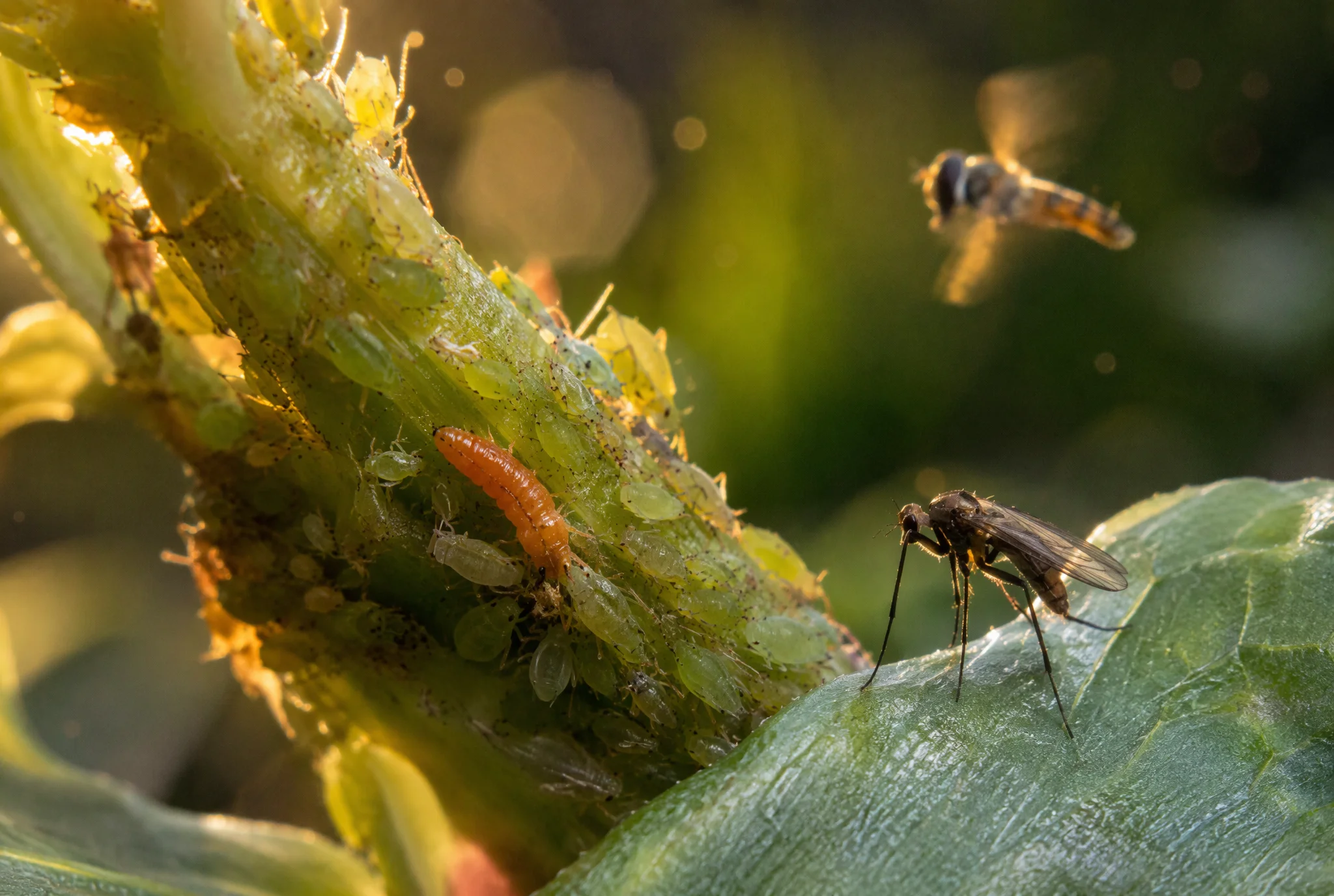
Short answer: one size class, five larval diets
Somebody photographs a speck on the windowsill, a haze over the pool deck, an insect the size of a full stop on a thumb, and the search box gets the words gnat like insect. The phrase records a size and an hour of the day. It does not record an animal. Around an ordinary house and garden the phrase can land on several dozen families of insects, and the families do not share a menu, a breeding site, a season, or a reason to be near you.
The sort that survives contact with reality is not wing or colour. It is the menu of the immature stage, because that is where the animal’s address, its vulnerability and its usefulness all live. Five larval diets explain almost everything a gnat like insect can be, and each diet carries its own action.
The five camps, stated plainly:
- Blood-seekers. Female mosquitoes, biting midges (Ceratopogonidae) and black flies (Simuliidae) raise their young in water or wet substrate, and the mated females of the biting species fly toward a breath plume. This is the only camp with a stake in you personally.
- Hunters. The predatory gall midges and the aphidophagous hoverflies look like gnats at rest and hunt like micro-raptors as larvae. Their young develop inside aphid colonies and spider-mite webs, not on your skin.
- Slime-eaters. The moth flies and drain flies (Psychodidae) – plus, indoors, the fungus gnats already covered on our gnat comparison page – raise their young in the organic film inside drains and wet corners. They do not bite.
- Fungus-eaters that never fly. Booklice and barklice (Psocodea) are the crawling, pale, two-millimetre specks of humid pantries and paper bags. They are not flies at all.
- Surface-scrapers that are not insects in the strict sense. Springtails (Collembola, entognathous hexapods) balloon up in damp soil, pots, cellars and bathroom sills. They bite nothing and eat fungi and decaying matter.
Read the list once more with money in mind. A device, a spray, a service call or a night of worry is justified against one of the five camps, and the other four are managed – if at all – with a moisture reading and a ten-minute walk. That is the whole thesis of this page; the sections below bring the published evidence for each camp, and the last section turns it into a five-question protocol you can run in one evening.
Two pages on this site already own adjacent ground, and this page will not re-prove them. The naming basket itself – fourteen names, what each one really denotes – is inventoried on our vocabulary reference, no-see insects. The criterion that tells you whether an indoor sighting is arriving or breeding is worked out on no see ums vs gnats. Everything below assumes you have already ruled out the bite with the simplest field test on record: if nothing bites, three expensive detours become unnecessary, as our non-biting midges page explains.
The basket is far bigger than the bite
Start with scale, because the search for a gnat like insect is usually a search for one suspect, and the crime scene holds hundreds. The most complete single-country answer to how many flies are there is the Canadian checklist of the order Diptera – the true flies, the animals with one pair of wings whose second pair is reduced to the knob-like halteres that every flying dipteran steers with. Its headline number:
“A total of 116 families and 9620 described species of Canadian Diptera are reported, representing more than a 36% increase in species numbers since the last comparable assessment” (Savage et al., 2019, ZooKeys).
Within that inventory, the biting families that motivate most searches are named lines, not whole wings of the shelf: “The Culicidae (82 species in Canada), Simuliidae (164) and Ceratopogonidae (263) are all quite diverse”. Do the arithmetic. Roughly five hundred of some ten thousand described Canadian fly species are host-seekers, and most of those five hundred rarely enter a house. Meanwhile “With 798 named species, the Chironomidae (non-biting midges) currently stand as the most species-rich family of Diptera in Canada, and at least 1000 additional species are expected to occur in the country”. The lake-out swarms that look like an invasion are, in North America as often as anywhere, this family – they do not bite, and the reasons a host-seeking trap does nothing for them are already worked on our non-biting midges page.
The second number comes from air you never see. Britain’s Rothamsted Insect Survey sucks air through tall fixed traps, and a 2026 re-analysis of thirty years of that archive reads almost like a census of the night itself. Of “618,779 arthropods across 71 arthropod families/superfamilies/orders” counted in the re-studied bycatch, “Diptera (82%)” carried the bulk – true flies, overwhelmingly small nematocerans – with beetles at 8% and bees, ants and wasps at 4% (Bourhis et al., 2026, Global Change Biology). The same study notes what its instrument actually samples: “Suction traps measure the aerial abundance of small to medium-sized flying insects.”
Two consequences, both uncomfortable for anyone selling certainty. First: whatever cloud you find over your yard is, by base rate, mostly flies that have no interest in blood – hunters, scavengers and decomposers whose names will never appear in a garden forum. Second: the same thirty-year record is one of the few places where it feels like more midges this year can be checked against data rather than memory, and there “a majority of taxa at these sites showed both earlier phenology (56%-68%) and increasing abundance (55%-77%)” at three of four monitored sites – the season opens earlier, not only louder. Your eyes are honest instruments about timing; they are bad instruments about identity. The arithmetic of what a naked eye can resolve at all is on our no see bugs page, and the instruments that can name an insect sit in no see ums magnified.
So when you search gnat like insect, the correct first answer is: probably a fly, probably not a biter, and the way to know which is to find out what its children eat. The next four sections walk the camps, starting with the ones doing unpaid work in your garden.
Camp one: the hunters – gall midges that live inside aphid colonies
Hold a stem of broad beans or roses with a good aphid colony on it, look closely, and you may see a second population moving among the first: small orange grubs, a millimetre or two long, taking aphids one at a time. Some of those grubs belong to the family Cecidomyiidae, the gall midges – a family of tiny, delicate, long-legged two-winged insects whose adults are the textbook picture of a gnat like insect, and whose most commercially important members are predators. Nobody sprays them. Greenhouses buy them by the bottle.
The flagship species is Aphidoletes aphidimyza, the aphid midge. The chromosome-level genome paper published in Scientific Data in 2024 states its resume in one line: “It is an oligophagous insect that displays remarkable voracity and targets more than 80 species of aphids” (Shen et al., 2024). The same assembly is what a commercial organism deserves: a 185-Mb-scale genome, BUSCO completeness of 97.8%, a chromosome-level reference built from five hundred adult females. A midge that serious is not a pest of your kitchen; it is stock.
What the biology papers add is the timing, because timing is what a gardener can actually observe. From the HSP-gene study in BMC Genomics (2025): “A.aphidimyza undergoes complete metamorphosis, with only the larval stage being predatory on aphids”, and the overwintering plan is a prepupal one – the midge “enters diapause at the prepupal stage after experiencing low temperature and short-day photoperiod treatments during the larval stage.” Their laboratory culture protocol shows the clock: eggs hatched within a day, the generation reaching the prepupal stage in 7 days at 25 degrees C under a 16:8 light cycle, and diapause in the Japanese population induced at 20 degrees C under a short 12.7-hour day. Read those numbers in the field and the season makes sense: the first aphid colonies of late spring have no midge in them; the midges arrive with the colonies, breed through summer in about a week per generation, and their prepupae wait in the soil or litter for next year.
The third trophic level – the plant itself – was tested directly in a 2025 Insects study that fed the midge aphids reared on different pepper and eggplant cultivars. Its summary conclusion: “These findings suggest that elevated secondary metabolite levels on ‘Longo’ negatively impact Myzus persicae performance while benefiting its predators, highlighting the role of host plant chemistry in shaping tritrophic interactions”. A plant chemistry that slows the aphid and speeds the hunter is the quiet reason a garden’s own enemies sometimes win. The practical arithmetic from that paper: aphid midges fed aphids from the well-defended cultivar laid their first eggs days earlier and grew populations faster than on the other cultivars – the predator’s success is partly chosen by the crop you plant.
Aphidoletes has a specialist cousin with the same curriculum vitae aimed at a different pest. The predatory gall midge Feltiella acarisuga is, in the words of its own species abstract, “an acarivorous species that mainly feeds on spider mites”, and the temperature study published in Insects (2021) calls it “one of the most effective natural enemies of the two-spotted spider mite”. The same paper gives the comparison a gardener should know: “Feltiella acarisuga is more predacious and distinctly mobile than the predatory mites commonly used for the biological control of T. urticae” – a midge that hunts faster and further than the commercially popular predatory mites, and whose females each lay about 30 eggs across their lives. Its development window is wide – all stages complete between roughly 11.5 and 32 degrees C, with a lower development threshold near 8.2 degrees C and a thermal constant of about 200 degree-days for the immature stage.
Why greenhouses still lose to aphids anyway
Buying hunters is not the same as having them, and the published failure mode is worth a paragraph because it explains your garden too. A 2026 Insect Science paper on preventive aphid control in sweet pepper opens with the industry’s state of the art: biological control of greenhouse aphids “relies primarily on periodic releases of aphidophagous predators such as the gall midge Aphidoletes aphidimyza (Rondani) (Diptera: Cecidomyiidae), parasitoids of the genera Aphidius and Aphelinus” – and then states why growers still lose: “growers often face economic losses because these programs have limited success, largely due to poor establishment of natural enemies when aphid populations are low.” Predators released before there is prey starve, fly out or fail to lay. The paper’s own candidates survive that gap – the brown lacewing Micromus variegatus established and oviposited after 15 to 30 days with no aphids at all, and where it did establish, “In cages with M. variegatus, aphid densities were reduced by 80%, with an average of 140 aphids per leaf at the end of the experiment.”
Translate that to your yard: the hunters work, but only if a habitat lets them wait out the lean weeks. Flower strips with pollen and nectar for the adults, litter that holds prepupal midges, and restraint with sprays are the whole management plan. Our spraying for no-see-ums page documents the collision from the other side – the same window that is safest for your plants is often when any mist kills most – and the arithmetic of deliberately releasing enemies is worked, for the midges themselves, on noseeum fly predators.
The same family’s other face: a midge that farms galls, not aphids
Fairness requires the counter-example, because Cecidomyiidae is not a hall of saints. The canola flower midge, Contarinia brassicola, was described from the Canadian prairies in 2019 and attacks the crop instead of its pests – the 2022 Journal of Chemical Ecology paper that identified its sex pheromone exists precisely because a 30-billion-dollar Canadian canola industry needs to watch it (Bray et al., 2022). The animal, in its own paper’s words:
- “The canola flower midge, Contarinia brassicola Sinclair (Diptera: Cecidomyiidae), is a newly-described species that induces galls on canola, Brassica napus Linnaeus and Brassica rapa Linnaeus (Brassicaceae).”
- “Females lay eggs on developing canola buds, and, after hatching, larvae feed cryptically within the flower bud resulting in gall formation” – the midge’s young develop out of sight, inside the bud.
- The damage stays below notice: “the damage caused by C. brassicola is discrete and difficult to recognize to the untrained eye.”.
- And the industry it threatens: “$30 billion Canadian canola industry.”.
The lesson of camp one is therefore sharper than good bugs exist. Family membership tells you nothing; the larval address tells you everything. The same few millimetres of body plan can raise an aphid hunter, a spider-mite hunter or a bud-farming pest, and the only reliable question is where the young are feeding. An insect found standing in an aphid colony is very probably a service; an insect whose galls you find in flower buds, or whose swarm coincides with your bloom’s collapse, belongs to a different conversation – and if the question in your yard is actually, what bit me, the wound-side criteria live on our tiny biting gnats page, while the naming overlap between midge and gnat is settled on midge vs gnat.
Camp two: the hoverers – tiny wasp-wannabes that eat your aphids
The second gnat look-alike camp answers to a different flight signature. Where gall midges wobble and run across a leaf, syrphid flies – the hoverfly family, Syrphidae, again one pair of wings and halteres – hold station in mid-air, ticking a few millimetres sideways without beating visibly, then dart. Many wear faint yellow banding that reads like a tiny wasp to a bird; none of them stings. The small dark species of bean fields and lettuce beds are, at a glance and in a phone photo, a gnat like insect – and a large share of them are predators of the same aphids the gall midges hunt, with an appetite that scales to a pest problem.
The evidence for that appetite is now commercial. A 2024 Journal of Economic Entomology study of the American hoverfly Eupeodes americanus – led by a Quebec biocontrol group – opens by noting that “The American hoverfly Eupeodes americanus (Wiedemann) (Diptera: Syrphidae) is an aphidophagous predator during its larval stage and is currently being evaluated for inclusion in biocontrol programs as a new biocontrol agent” (Ouattara et al., 2024), and adds the market milestone: the species “has been commercialized in Canada and represents the first hoverfly species available to growers in North America”. It is “a generalist Nearctic aphid predator”, recorded “feeding on more than 40 different aphid species”, and a single larva over its life “can consume around 2,000 aphid”. It hunts quietly, too – like the aphid midge it can “feed on aphids without triggering a defensive response”, so the colony never scatters – and the same study highlights its ability to “fly, lay eggs and feed on aphids even at low temperatures”.
The comparison experiment inside that paper is the most useful paragraph a gardener will read this season, because it weighs hoverfly against midge directly. Lifetime egg output topped out at “the highest overall number of eggs laid per individual was of 693 for E. americanus” against “The highest total number of eggs laid per A. aphidimyza female was 89” eggs; overall, “Eupeodes americanus had a lifetime fecundity 7.6 times higher than that of A. aphidimyza”, and “Female longevity was approximately 7 times longer for E. americanus than for A. aphidimyza (20.6 and 3.1 days, respectively)”, with oviposition stretching from 5 to 31 days against the midge’s 1 to 3. Read as a garden story: the midge is a fast, short-lived shock troop tied to colony timing; the hoverfly is the slow, deep, long-breeding investor. A yard with aphid and flowers hosts both for free.
The other commercialized species, Episyrphus balteatus – the marmalade hoverfly – carries the strongest numbers in the whole gnat-basket literature. Its 2025 Insects efficacy paper opens its summary with the market fact, “Episyrphus balteatus is the only one hoverfly species among the top 25 biological control agents by adoption across countries”, and its introduction stacks the predation record: “a single third-instar larva can consume up to 60 cabbage aphids (Brevicoryne brassicae) per day, with lifetime consumption exceeding 300 aphids”, the larvae feed “on over 100 species of aphid”, and release trials cut aphid populations hard – against the soybean aphid, “releasing third-instar E. balteatus larvae against soybean aphids at a predator/prey ratio of 1:150 achieved a pest suppression rate of 59.87% after 72 h”, and in greenhouses “releasing newly hatched E. balteatus larvae for aphid control in greenhouses on vegetables and chrysanthemums resulted in aphid population reduction rates exceeding 80%” within three days (Jiang et al., 2025). A separate life-table study of the slender Sphaerophoria macrogaster in Open Life Sciences (2025) puts a larva’s working peak at “the maximum value of the larva predation was 28.3 M. persicae per larva at 28 degrees C, and the average duration of S. macrogaster development was 14.3 days from egg to adult emergence” (Fan et al., 2025).
How to invite the camp that already works for you
Adult hoverflies need sugar – pollen and nectar – before they will lay into your aphid colonies, and this is the one management act the literature rewards directly. A 2025 Ecology and Evolution survey of Quebec lettuce farms planted strips of sweet alyssum (Lobularia maritima) and counted what the strips drew: “Of the 1934 syrphid specimens collected” in the study, “A total of 16 species were collected from flowering plants across three lettuce farms in Quebec”; “Fourteen of the 16 identified species or MOTUs are aphidophagous”; “The most abundant species was Toxomerus marginatus, accounting for 70% of all specimen”; and “of the 16 species recorded, 10 were found exclusively or predominantly (>= 80%) in flower plot” (Kalboussi et al., 2025). The authors’ conclusion is a prescription any yard can copy: alyssum flowers “can successfully attract natural aphid predators in lettuce fields.”. A flower strip at the garden edge is nectar for the adult and a nursery for the larva two metres away.
The honest asterisk on yellow sticky traps
Because readers of this site do buy traps, one data point deserves its exact size. A 2026 Insects pilot from a Northern Italian rapeseed field evaluated yellow sticky-trap barriers as an insecticide-free control and tallied everything the traps caught across surveys: “we also counted a total of 1915 pest insects captured by the surveyed yellow sticky trap” – pollen beetles and flea beetles making most of the sample – beside which “The number of beneficial arthropods captured in sticky traps was low, with 27 ladybird beetles (Coleoptera: Coccinellidae), 15 hoverflies (Diptera: Syrphidae) and 5 lacewings (Neuroptera: Chrysopidae)” (Lami et al., 2026). In that system the cards mostly caught the pests they aimed at, and the authors keep the comparison open for more thorough study. The wider question – what killing devices sweep up the useful community – is already worked for outdoor biting devices on what kills no-see-ums; what is added here is the yellow-card number.
Two handoffs close camp two. Hoverfly adults are themselves part of the weather-sensitive flying fauna counted in Britain’s thirty-year record – biology is probabilistic, sprays are not, and the collision between spray windows and beneficial timing is on spraying for no-see-ums. And a caution against overreading predator: deliberately releasing enemies to control the site’s own pest midges fails on substrate arithmetic, not enthusiasm – that story is kept on its own page.
Camp three: the drain moths – Psychodidae, the slime film, and a myiasis panic that failed its own test
The third camp is the one that lives with you without asking. Moth flies and drain flies – family Psychodidae – are the weak, hairy, moth-looking specks that sit on bathroom tile and kitchen wall, wings folded roofwise over the body, moving in short clumsy hops when disturbed. To a phone camera they are a gnat like insect with the volume turned up; to an entomologist they are a family whose nuisance members are counted in dozens worldwide, not thousands – even in fly-diverse Canada the whole family runs to “three subfamilies, 15 genera and 34 species” (Savage et al., 2019).
The model species is Clogmia albipunctata, the drain fly, and the fullest short account of it is a 2022 Diagnostics review that asks in its title whether the creature actually is what the case reports claim (Akhoundi et al., 2022). The facts it establishes:
- It is “a non-hematophagous insect of the Psychodidae family with worldwide distribution”.
- The adult you squash is “small (3-5 mm)” and completes “a four-stage life cycle including egg, larva (four instars), pupa, and adult” in about a month at room temperature.
- “a female can lay from 200 to 300 eggs in her lifetime in sludge around sewage and drainage areas”, into the sludge of a drain.
- The larvae are “copro-saprophagous with chewing mouthparts living in aquatic environments, feeding mainly on organic decaying matters”.
- The reason you see them is urban life itself – they are “commonly found in anthropogenic dwellings such as bathrooms, kitchens, toilets, sewage, poorly maintained drains, or waste dumps”.
- And the worry the review does record is carriage: “Clogmia albipunctata may act as a potential mechanical vector of 45 bacterial species mainly associated with nosocomial infections” – carried on the body from slime to surface, the way a shoe carries mud. Nobody is bitten by any of this.
Two hospital-side studies sharpen the carriage finding without inflating it. In a Brazilian sewage-adjacent survey published in Microorganisms (2024), “a total of 26 drain flies were collected” at five sites and “75 Gram-negative bacteria and one sample of fungus (Table 1) were isolated from 11 of the 23 flies” – including, as the paper’s headline, the first record of the emerging opportunistic yeast Trichosporon asahii from the species (Vieira-Alcantara et al., 2024). In an Iranian teaching-hospital survey in the Journal of Arthropod-Borne Diseases (2026), “50 fungal isolates (including 36 filamentous fungi and 14 yeasts)” came off moth flies, “the filamentous fungi included Aspergillus niger (n=17), A. flavus (n=7), A. fumigatus (n=4)”, and “up to 90% of C. albicans exhibited high-level fluconazole resistance”; the authors’ own frame for why this matters is that “house flies have been found to harbour over 100 human pathogens, and moth flies have recently received increased attention due to their persistent presence in moist, organically enriched hospital environments” (Taghizadeh et al., 2026). Carriage, not attack: nothing in either study is a bite or an infection transmitted under observation. The practical lever in both is the one the 2022 review implies – the fly is a symptom of a slime film, and the film, not the fly, is the thing to remove.
The case reports that could not survive a digestion model
Here camp three gets genuinely interesting, because for decades the scarier clinical literature said these larvae were occasionally living inside human intestines – true myiasis – and the same records were doubted as pseudomyiasis, dead-larvae-passing-through or sample contamination. A 2026 PLOS One study ran the test the debate deserved: stomach-and-intestine fluid models plus live mice gavaged with eggs and first-instar larvae (Zhan et al., 2026). What came back:
- Egg hatching that ran near 77 percent in controls fell to zero after simulated digestion, and larval mortality rose from about 19 percent to more than 99 percent after the gastric pass.
- After mice swallowed eggs or larvae, nothing colonized – feces were checked daily for a week, gut tissues at set points.
- “The in vitro digestion model demonstrated that standard simulated gastric fluid acts as a lethal barrier”, “The results support the interpretation that many suspected clinical cases may represent sample contamination or pseudomyiasis rather than true intestinal myiasis”.
- Even the survival of a rare egg through the gut, they add, “represents mechanical passage (pseudomyiasis) rather than true pathological tissue invasion”.
The larvae that kept appearing in old case reports were most plausibly fly larvae that landed in, or crawled into, a sample after it left the body – the drain was in the bathroom, not in the patient. If you want the site’s general rule for telling arrival from production, it is on no see ums vs gnats; the drain-moth version is the same logic applied to a sink.
The same family, doing this to a flower
One more piece of camp three evidence, because it retires the idea that these flies are dirty in any purposeful sense. Arum maculatum – cuckoo-pint, dead-horse-arum – is a European hedgerow plant whose flower is a pitfall for small flies, and a 2026 Ecology and Evolution study of its visitors reads like heist writing. The plant “has a dung-like floral scent that lures mainly dipteran pollinators (Psychodidae, Sphaeroceridae)” and “temporarily trap them, without offering a reward”; visitors eventually “slip and fall into the floral chamber”, and “in the chamber, the insects remain trapped until the following day, when the pollen is released (i.e., male stage) and dusted onto their bodies while the spathe and the sterile flowers wither, allowing them to escape” (Laina et al., 2026). The study counts “651 sphaerocerid individuals” collected from the chambers across ten populations, and notes the main psychodid visitor’s own status – “flies that lack functional mouthparts and, therefore, cannot feed”. A fly that cannot even eat, deceived overnight by a smell of dung, dusted with pollen, and released: the pest of your bathroom tile is on this planet mostly as someone else’s customer.
Action for camp three is one sentence long and owes nothing to chemistry: find and scrub the gelatinous lining of the drain, the overflow channel, the gap under the bath rim – the breeding site dries out in a week of scrubbing and the imago disappear within a generation. If your bathroom cloud instead runs more than flies across sills and counters, that behaviour points at a different substrate and is worked out, with the sticky-card test, on why gnats swarm, and the house-bite audit (which rules this camp out in one evening) lives on biting midges in house.
Camp four: the crawlers – booklice, and the damp corner they mean
Some gnat like insect sightings never fly. The speck is on the window frame, the paper bag, the shelf behind the jar, the skirting board of a spare room – pale or greyish, a millimetre or two, running in a quick fussy way, and there is no wing beat at all. The usual answer is Psocodea: barklice and booklice, relative of the chewing lice, most of them a few millimetres at adult size. The garden vocabulary page on this site already lists them, without dwelling, under the names that should never be in the biting basket – see no-see insects. The literature says what they are, and it also says, importantly, what they are not.
What they are, in the sentence a 2025 BMC Genomics paper on olfactory genes opens with: “Booklice, belonging to the genus Liposcelis (Psocodea: Liposcelididae), commonly known as psocids, infest a wide range of stored products and are implicated in the transmission of harmful microorganisms such as fungi and bacteria” (Sun et al., 2025). The economic framing in a 2024 Scientific Data genome paper is harsher – “Booklice, a stored-product pest of significant economic importance within the order Psocoptera, pose a serious threat to global grain and food security” – because these are warehouse animals: the same paper’s Liposcelis tricolor assembly, “determined to be 229.33 Mb, anchored to 9 pseudo-chromosomes”, exists because grain stores lose crops to them. And the management literature is blunt about the usual reflex: “many psocid species have natural tolerance and rapidly develop high levels of resistance” to the storage insecticides (Bosomtwe et al., 2026). The parthenogenetic booklouse reproduces without males entirely; the BMC Genomics group counts it as the reason its olfactory receptor repertoire is the shrunken one they had to explain – “This reduction is possibly due to its parthenogenetic reproduction, which reduces dependence on pheromone exchange between males and females”.
What booklice are not: a fly, a biter, or a target for any outdoor device. They are a reading – specifically a humidity reading. The same group’s 2025 Insects study of the predator-prey game in stored grain runs its whole experiment on a dial of temperature and relative humidity (20 to 32 degrees C, 63 to 85% RH), because the psocid’s boom condition and the predator’s best condition both sit on that dial – the pirate bug’s progeny production was greatest at 28 degrees C in the favourable humidity band (Bosomtwe et al., 2025). Nature’s own lever against them is documented in the same paper: “All three predators effectively reduced L. decolor populations”, the warehouse pirate bug Xylocoris flavipes among them – a two-millimetre minute pirate bug that does what the spray increasingly cannot.
The homeowner translation is short. Booklice in the kitchen mean a humid microclimate and a food of microscopic fungi: an open flour bag gone soft, the paper lining of a shelf that drinks damp, the wicker basket that never fully dries. They do not bite people or pets; the published record this page uses treats them as stored-product pests and microbial hangers-on, nothing more. The fix is the humidity and the bag, not the baseboard: drop the air above the surfaces they sit on below the damp line, find the infested packet, and the population leaves with its weather. No outdoor device of ours, it is worth saying plainly, addresses this camp at all – none of these animals seeks a breath plume, so a carbon dioxide trap is not a lever here in either direction.
Camp five: the jumpers – springtails, which are not insects in the strict sense
The last camp outranks the others on the strangeness scale. A blue-grey haze of pinhead insects on a compost bag, a bathroom windowsill, a potato box in a cellar – disturbed, they all jump at once, though no one saw legs load or wings open. Springtails (Collembola) are entognathous hexapods: six-legged, close to insects, technically not insects in the strict sense, with mouthparts tucked inside a pouch in the head and, in most of the jumping kinds, a furcula – a forked trap-door under the body that snaps down against the substrate to throw them a few centimetres.
The published record keeps finding them in exactly your situations. A 2026 ZooKeys paper describing three new species of indoor entomobryid springtails from Romania opens with one of the best specimen localities in the literature: “During routine examination of microarthropods associated with household environments, a distinct species of Willowsia was discovered in a cardboard box containing potatoes in an apartment in Bucharest, Romania” – the new species, Willowsia solanella, “appears to be a synanthropic species inhabiting indoor environments where moisture, organic particles, and fungal growth are present”; the trigger in that flat: “Slight humidity and localized fungal growth created favourable conditions, providing both moisture and nutritional resources (fungal hyphae, bacteria, and decaying plant material)” (Jordana et al., 2026). The same paper generalises: “Several species are strongly synanthropic, frequently occurring in buildings, warehouses, and storage facilities where humidity and organic debris are present”, and the scaly genus it works on, Willowsia, now numbers “44 species with a worldwide distribution”.
Outdoors, the urban-rural springtail literature does something almost nobody’s pest literature does: it treats the jumper as an instrument. A second 2026 ZooKeys study, working on the common house and garden species Isotomiella minor across city parks, woodland and industrial sites, found that “the body size of the Isotomiella populations decreased significantly with increasing soil temperature” and that “Significantly higher cold resistance was observed in the natural populations of I. minor compared to the populations from urban sites” – warming soil and paved heat are written into the animal’s body and its season limits, one degree at a time (Raschmanova et al., 2026). It sits within a wider observation from the same literature: “several springtails are commonly found in urban areas”.
So the springtail report card: no biting, no device relevance, no damage to structures in the published record used here – and a clean signal function. A springtail bloom indoors is a damp reading of the room (sill, sump, planter tray, the wall behind the fridge); outdoors it is a soil-litter reading after rain. The right response is the same one as for booklice – move the water, and the animal’s address moves with it.
One evening’s sorting: five questions, and what each answer changes
Everything above compresses into a protocol you can run tonight without instruments. The questions are deliberately ordered so that the expensive answer – it bites me – is tested first, because it is the only answer that changes what money should do next about any gnat like insect in the yard.
- Does anything bite? Sit still in the suspect air, at the suspect hour, arms and ankles bare, for ten minutes. Nothing felt, nothing new on the skin by morning: the biter camp is out, and the rest of this protocol is about habitats, not protection. The logic of this cheap test – and why a negative result rules out three costly detours – is spelled out on our non-biting midges page; if the test is positive, the wound-side criteria (midge against flea, chigger, bed bug, mosquito) live on tiny biting gnats, and the address of the breeding habitat on where do no-see-ums live.
- Fly or crawl? A gnat like insect that launches off the surface when you approach and is suddenly elsewhere is most likely a hexapod with a jumping fork – a springtail, camp five. One that runs in jerks across paper, a frame or a shelf, with no wings visible at all, is most often a booklouse, camp four. Both answers point the same instrument: a moisture meter, not a pesticide.
- Where are the young actually raised? This is the larval-diet sort doing its work. Tap a leaf with a distorted tip and look for the orange grub inside the aphid colony – camp one or two, working; leave it alone. Hover counts at a flower strip – hoverflies, camp two. A cloud lifting off a sink when you run water, moths sitting on tile – slime film, camp three; the fix is the drain lining. A low cloud at ankle height over lawn at dusk that hunts your breath – camp one’s blood-seekers, and the only cloud this site sells hardware against. The arrival-versus-production question underneath all of this – did they come in, or are they made here – is settled on no see ums vs gnats, with the fungus-gnat half of the basket.
- What does the sighting predict? Each camp carries a forecast. Booklice predict a humid corner and a damp packet. Springtails predict wet soil or a leaking sill. Moth flies predict a film in a drain nobody has scrubbed this month. Aphid midges and hoverflies predict, cheerfully, that your aphid problem is already being eaten. Blood-seekers predict standing or seeping water within flight range of you, and the range arithmetic is the subject of no see ums magnified and the large-area page linked below.
- What does doing nothing cost? For four of the five camps, nothing you would want to spend. For the fifth, see the next two paragraphs, which stay inside this site’s published facts.
The whole sort on one card, for the fridge door or the service van:
| Camp | One-line tell | Larval address | Does it hunt your breath? | Right action |
|---|---|---|---|---|
| 1. Blood-seekers (mosquitoes, biting midges, black flies) | lands on skin and stays | water, seeps, stream film, tidal mud | Yes – breath and carbon dioxide | Remove or avoid the water seam; a CO2 device covers the outdoor air layer |
| 2a. Gall-midge hunters (Aphidoletes, Feltiella) | adult looks gnat-like at rest; orange grub in the colony | inside aphid colonies and mite webs | No | Nothing. Do not spray the colony you want eaten |
| 2b. Hoverflies (Eupeodes, Episyrphus, Sphaerophoria) | holds station in mid-air, then darts | aphid colonies; adults on flowers | No | Plant the flower strip; leave the colony as their nursery |
| 3. Drain moths (Psychodidae) | fuzzy, roof-folded wings, hops on tile | the gelatinous film inside drains | No | Scrub the lining; the swarm ends with the film |
| 4. Booklice (Psocodea) | runs on frames and paper; no flight | damp starch, paper, grain, mold film | No | Dry the room, bin the packet |
| 5. Springtails (Collembola) | jumps as one when disturbed | wet soil, leaf litter, damp pots | No | Fix the leak or the drainage; harmless meanwhile |
Now the device question, answered inside the published facts. The carbon dioxide suction units on this site are outdoor equipment, published at an effective area of 4,000 square meters, and their lure is the cue one camp of the basket follows: a breath plume. The operating logic is on how a CO2 trap works, the honest efficacy discussion – including what the catch cup does and does not prove – is on are CO2 mosquito traps effective, the sizing decision between the two units is on M3000 vs MM4200, and placement for wide ground is worked on controlling mosquitoes in a large outdoor area. The hunters, moth flies, booklice and springtails of this page do not steer to breath, which means two things at once: they will not clutter your catch cup, and no claim of any kind is made here that a device helps or harms them. The device is a sampler and suppressor of the blood column; everything else on this page is a household-moisture or habitat conversation, and a vendor who promises otherwise is selling you the wrong box.
For dealers and buyers weighing the range as a product line: the honest sales frame follows the same sort. Reduces biting flies is a claim about one of five larval diets, and every pitch should name which one. The census of the other four is the objection a good customer will bring, and it is now written down in their language – which is also, conveniently, the language of the the applications pages and the product line. Wholesale and distribution inquiries route through contact.
The page, in numbers
| Number | What it counts | Where it came from |
|---|---|---|
| 9,620 species | described Canadian Diptera – the fly shelf your gnat sits on | the 2019 national checklist (Zookeys) |
| 82 percent | of 618,779 arthropods in thirty years of British suction-trap air were flies | the 2026 re-analysis (Global Change Biology) |
| more than 80 | aphid species the aphid midge takes as prey | the genome paper (Scientific Data, 2024) |
| about 2,000 | aphids eaten by one American hoverfly larva | the fecundity trial (J. Econ. Entomol., 2024) |
| zero percent | hatching of drain-fly eggs after simulated gastric fluid | the myiasis test (PLOS One, 2026) |
| 229.33 Mb | the genome of a booklouse – sequenced because grain stores lose to it | the genome note (Scientific Data, 2024) |
| one of five | larval diets that any outdoor CO2 device addresses | every product fact page on this site |
Questions people ask when the photo is bad
What is the tiny gnat-like insect in my house that does not bite?
Statistically one of four things, and the camps above are the four answers in order of how the animal moves:
- A moth fly – sits on wall tile, hop-flies, wings folded roofwise – answered by the drain film (camp three).
- A fungus gnat – weak flier hovering around a pot – answered by the pot soil; the full pot case is argued on no see ums vs gnats.
- A booklouse – crawls along frames and paper, never flies (camp four).
- A springtail – crawls, then jumps en masse when disturbed (camp five).
All four are moisture-and-substrate animals; none of the four is a reason to buy an outdoor device, and a gnat like insect from any of these four camps should never be answered with one.
How do I tell a fungus gnat from a biting midge?
The one-move test is behavior, not anatomy: biting midges hunt your bare skin in open air at low light, and the bite test on our non-biting midges page settles it in ten minutes; fungus gnats hover around pots and windows, never land to feed, and their whole life is the pot. The anatomical ladder – what a hand lens, then a microscope, actually shows – is walked on no see ums magnified, and the family map of who bites and who only looks like it is Ceratopogonidae.
Do moth flies, booklice or springtails bite people or pets?
Nothing in the published record this page uses says so. The drain-fly review’s own words are that the species is “a non-hematophagous insect”, and the 2026 digestion study concluded the gastric track is a lethal barrier rather than a doorway; booklice are stored-product grain pests and fungal hangers-on; the synanthropic springtail literature treats them as damp indicators, not pests of persons. Non-biting here is a statement about the documented biology of these families, not a promise about every individual in your bathroom.
Are drain flies dangerous in a hospital or a home?
Dangerous is the wrong word; measurable is the right one. They carry what their slime lives in – the Iranian hospital survey grew drug-resistant fungi off them, the Brazilian survey grew Gram-negative bacteria and one yeast off eleven of twenty-three flies – and the correct reading of carriage data like this is hygiene: the fly marks the unscrubbed surface. The 2022 review’s honest position is that the mechanical-carriage list exists while the true-infection list could not survive its own digestion-model test.
Will my CO2 trap catch the beneficial insects?
Not by design, and mostly not at all, because the device’s lure – carbon dioxide in a breath-shaped plume – is a cue only the host-seeking blood column follows. Adult hoverflies and aphid midges are nectar drinkers that hunt aphid colonies; moth flies, booklice and springtails do not fly breath at all. The honest boundary is the one this site publishes everywhere: an outdoor suction device samples and reduces the biters that answer the plume, at its published 4,000-square-meter area, outdoors; its catch cup is a census of that column only, not of the gnat basket – which is exactly why the cup can be read without panic. The bycatch and non-target question, worked honestly for the killing options generally, is on what kills no-see-ums.
It swarms at my window at dusk but never bites. Springtails or a mating cloud?
If the haze sits low, drifts with the wind, and thickens where air is still over grass or water, it is most often non-biting midges or chironomids raising a mating cloud – the swarm’s weather and timing are on why gnats swarm, and why neither spray nor trap moves it is worked there. If instead the swarm is a dust of individuals running across sills and counters indoors, the cloud is a substrate report, and the sticky-card test in the same article names which damp film is the factory. Either way, this kind of gnat like insect is a schedule of the house, not an army.
What this page does not do
- It does not guarantee an identity. Nothing here replaces mounting a specimen under a lens or, for the tiny and the economically consequential, a DNA barcode; the magnification ladder and its costs are on no see ums magnified, and the same caution applies to phone photos at this size.
- It does not generalize its counts. The census evidence is Canadian and British because those are the completed whole-fauna inventories and thirty-year air archives; the larval-diet logic travels, the species lists do not. The midge you call a gnat in Florida is not the midge these census numbers describe, and the site’s Florida and Gulf pages carry the local fauna.
- It does not give medical advice. The carriage studies cited are environmental surveys; nothing here is advice about an infection, an allergy, or a bite reaction – that is a clinician’s desk.
- It does not stretch its products. The carbon dioxide devices on this site address one camp of five, outdoors, within their published area; every other camp on this page is a household-moisture or habitat conversation, decided with a dry corner, a scrubbed drain and a flower strip instead of a box.
Sources Consulted
- Shen X et al. (2024). “The chromosome-level genome assembly of Aphidoletes aphidimyza Rondani (Diptera: Cecidomyiidae)..” Scientific Data 11(1): 785; doi.org/10.1038/s41597-024-03614-4
- Wang Z et al. (2025). “Genome-wide identification and multi-level analysis of the HSP gene superfamily in Aphidoletes aphidimyza: sHSP gene family expansion and its role in diapause regulation..” BMC Genomics 26(1): 968; doi.org/10.1186/s12864-025-12163-y
- Golparvar Z et al. (2025). “Phytochemical-Mediated Tritrophic Interactions: Effects of Pepper and Eggplant Cultivars on the Green Peach Aphid Myzus persicae (Sulzer) and Its Predators..” Insects 16(10): 1050; doi.org/10.3390/insects16101050
- Choi YS et al. (2021). “Effect of Temperature on the Development and Survival of Feltiella Acarisuga (Vallot) (Diptera: Cecidomyiidae) Preying on Tetranychus Urticae (Koch) (Acari: Tetranychidae)..” Insects 12(6): 508; doi.org/10.3390/insects12060508
- Perez-Rodriguez J et al. (2026). “A preventive strategy for the control of aphids in sweet pepper using lacewings and micrococcinelid beetles..” Insect Science 33(4): 1663-1674; doi.org/10.1111/1744-7917.70099
- Bray DP et al. (2022). “Components of the Female Sex Pheromone of the Newly-Described Canola Flower Midge, Contarinia brassicola..” Journal of Chemical Ecology 48(5-6): 479-490; doi.org/10.1007/s10886-022-01369-z
- Ouattara TY et al. (2024). “Reproductive parameters of a new biocontrol agent, Eupeodes americanus (Diptera: Syrphidae) and comparison with the commercialized Aphidoletes aphidimyza (Diptera: Cecidomyiidae)..” Journal of Economic Entomology 117(5): 1760-1768; doi.org/10.1093/jee/toae133
- Kalboussi M et al. (2025). “Syrphid Diversity in Sweet Alyssum Flower Strips in Quebec’s Lettuce Fields: Molecular Identification and Delimitation of the Sphaerophoria Complex..” Ecology and Evolution 15(9): e72145; doi.org/10.1002/ece3.72145
- Jiang S et al. (2025). “Evaluation on Biocontrol Efficacy of Episyrphus balteatus De Geer (Diptera: Syrphidae) Against Aphis craccivora , Myzus persicae, and Megoura crassicauda ..” Insects 16(8): 774; doi.org/10.3390/insects16080774
- Fan J et al. (2025). “Temperature-dependent development, predation, and life table of Sphaerophoria macrogaster (Thomson) (Diptera: Syrphidae) feeding on Myzus persicae (Sulzer) (Homoptera: Aphididae)..” Open Life Sciences 20(1): 20251183; doi.org/10.1515/biol-2025-1183
- Lami F et al. (2026). “Advantages and Limitations of Yellow Sticky Traps as a Pest Control Method in Pollinator-Friendly Rapeseed Agroecosystems: A Pilot Study in Northern Italy..” Insects 17(10): 1035; doi.org/10.3390/insects17101035
- Zhan H et al. (2026). “Clogmia albipunctata fails to induce true intestinal myiasis: Evidence from in vitro and in vivo digestive models..” PLOS One 21(8): e0356742; doi.org/10.1371/journal.pone.0356742
- Akhoundi M et al. (2022). “Clogmia albipunctata (Nematocera; Psychodidae) as the Etiologic Agent of Myiasis: True or False?.” Diagnostics 12(9): 2129; doi.org/10.3390/diagnostics12092129
- Vieira-Alcantara K et al. (2024). “First Identification of Emerging Pathogenic Yeast in Clogmia albipunctata (Diptera: Psychodidae) at a Brazilian Hospital..” Microorganisms 12(12): 2520; doi.org/10.3390/microorganisms12122520
- Taghizadeh K et al. (2026). “Drug Resistance Patterns of Fungi Isolated from Hospital-Associated Moth Flies (Diptera: Psychodidae) in Babol, Iran..” Journal of Arthropod-Borne Diseases 20(2): 196-204; doi.org/10.18502/jad.v20i2.22401
- Laina D et al. (2026). “Floral Scents of Deceptive Arum maculatum L. (Araceae) Shape a Taxonomically Diverse Visitor Community of Lesser Dung Flies (Sphaeroceridae) That Affects Its Reproductive Success..” Ecology and Evolution 16(8): e74139; doi.org/10.1002/ece3.74139
- Sun J et al. (2025). “The expansion and loss of specific olfactory genes in relatives of parasitic lice, the stored-product psocids (Psocodea: Liposcelididae)..” BMC Genomics 26(1): 41; doi.org/10.1186/s12864-025-11231-7
- Jiang SD et al. (2024). “Chromosome-level genome assembly of a stored-product psocid, Liposcelis tricolor (Psocodea: Liposcelididae)..” Scientific Data 11(1): 1310; doi.org/10.1038/s41597-024-04179-y
- Bosomtwe A et al. (2025). “Effects of Different Thermo-Hygrometric Conditions on Ecological Interactions Between the Warehouse Pirate Bug, Xylocoris flavipes (Hemiptera: Anthocoridae), and Its Prey, Liposcelis decolor (Psocodea: Liposcelididae)..” Insects 16(9): 888; doi.org/10.3390/insects16090888
- Bosomtwe A et al. (2026). “Comparative Assessment of the Potential of Xylocoris flavipes (Hemiptera: Anthocoridae) and Two Cheyletus spp. (Trombidiformes: Cheyletidae) for Managing Liposcelis decolor (Psocodea: Liposcelididae)..” Insects 17(3): 332; doi.org/10.3390/insects17030332
- Jordana R et al. (2026). “Three new species of Entomobryidae (Collembola) from Romania, including a synanthropic Willowsia species..” ZooKeys 1282(): 17-35; doi.org/10.3897/zookeys.1282.194867
- Raschmanova N et al. (2026). “Temperature shapes the cold tolerance and body size of the springtail Isotomiella minor (Hexapoda, Collembola) in contrasting environments..” ZooKeys 1277(): 57-78; doi.org/10.3897/zookeys.1277.172390
- Savage J et al. (2019). “Diptera of Canada..” ZooKeys 819(819): 397-450; doi.org/10.3897/zookeys.819.27625
- Bourhis Y et al. (2026). “Cinderella Biodiversity: Three Decades of Monitoring Reveal Earlier Emergence and Increasing Abundance in Undervalued and Sparsely Recorded Flying Insects and Ballooning Spiders..” Global Change Biology 32(10): e71137; doi.org/10.1111/gcb.71137