
A black gnat insect is rarely identified by looking at it. The specimen is one to three millimetres long, dark, unremarkable, and gone in a second. What identifies it is the date. In the same week in which one property is swarm-tested for biting midges and another is complaining about mosquitoes, a third property beside a cold creek is being bitten by black flies at two in the afternoon. The guests are in jackets, and there are no mosquitoes anywhere in the county yet. Those three complaints are not the same insect, and they do not respond to the same plan, because each one runs on a different thermal clock.
This page treats the black gnat insect as a calendar problem. It sets out what actually decides the week the small black biting flies appear, why that week moves by as much as a month between one year and the next, why some sites are bad for three weeks and some for four months. It also covers what a property manager or a pest-control contractor can do with that information before spending money on equipment. The visual identification pages on this site are listed where they belong; nothing here repeats them.
Quick answer
- The onset date is set by accumulated warmth, not by the weather on the day. Thirteen years of river data from Lithuania put the start of larval development for one black fly species anywhere between day 105 and day 127 of the year, and between day 110 and day 140 for a second. The water temperature measured on the day the larvae appeared averaged 12.9 C but ranged from about 10 C to 17 C between years.
- The length of the bad season is set by generation number. A univoltine species gives one flush and stops. A species with four or five generations gives a long, refillable season. Two species can share a stream and be worst in different halves of the year.
- The black gnat of early spring is a cold-adapted animal. Its larvae need flowing water and can develop at water temperatures that keep mosquitoes out of the picture, which is why biting black flies are active weeks before the first mosquito season peak.
- Cold does not reliably end the season. A 2026 laboratory study found substantial cold tolerance in every life stage of a temperate biting midge, and third and fourth instar larvae have been recorded surviving in partially frozen habitat.
- What you can change is the temperature exposure of the habitat and the timing of your own actions, not the climate. A property with a spring-fed creek, a culvert and a shaded run has three different emergence dates inside its fence.
- A carbon dioxide suction device is a mosquito instrument. It is not a black fly control measure, and the honest way to use the calendar is to decide which weeks deserve which tool.
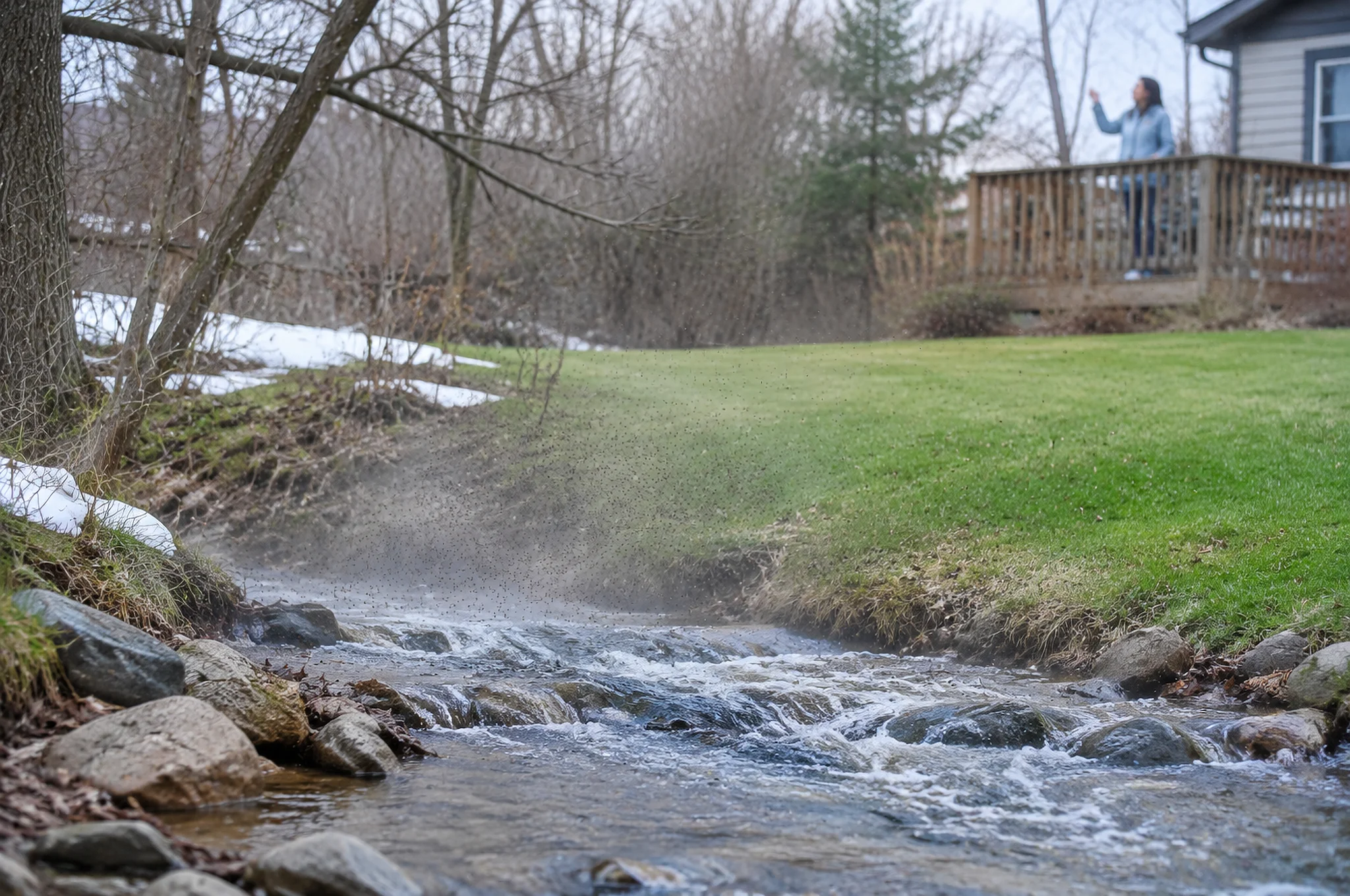
Three clocks behind every black gnat insect
People type black gnat insect into a search box when the insect is too small to describe and too numerous to ignore. The word gnat carries no taxonomic commitment, and this site has already mapped where the names collide: the reason gnat and no-see-um are not two cleanly separable groups, what a no-see-um actually is, and how black fly and buffalo gnat name the same family. What those pages do not cover is the timing dimension, which is where the practical decisions live.
Three clocks matter, and they run independently.
- The production clock lives in the habitat: water temperature for black flies, substrate moisture and temperature for biting midges, and potting-compost temperature for the fungus gnats that breed indoors. This clock decides how many insects exist and when they are released.
- The exposure clock lives in the air: whether a female is actively host-seeking at that hour, which depends on temperature, light and wind at the height she is flying. This clock decides how many of the insects that exist actually reach you.
- The immigration clock lives outside the property boundary. A site can have a perfect production habitat and still be quiet for weeks, or have no habitat at all and be stripped bare by a wind-borne arrival. The arriving versus producing test settles which case you are in.
The reason a calendar beats a photograph is that all three clocks are temperature-driven, and temperature is the one variable a property records every day whether anyone looks at it or not.
Development is an integrator, not a switch
Insect development is not triggered by reaching a temperature on a given day. It proceeds at a rate that depends on temperature, so the insect accumulates development as the days pass. Two consequences follow, and both are visible in the black fly literature.
First, a cold spring delays emergence and a warm spring advances it, by roughly the amount of warmth missed or gained. Second, and less intuitively, the temperature on the day of emergence tells you almost nothing, because emergence is the end of a running total rather than a response to a condition. The Lithuanian river study tested exactly this and reported it plainly: “Water temperature on the day of larval eclosion had no statistically significant impact on the beginning of development in any of the three species studied.”
The practical effect is that an emergence date is a prediction you can make in advance from a temperature record, and a late frost in April does not undo it. The cohort is already committed; it is simply waiting out the arithmetic.
The size of the thermal window
A useful generalisation comes from a synthesis of published thermal requirements across 66 insect species in eight orders. The range of temperature between the point where development rate is at its minimum and where it is at its maximum averaged 19.8 C per species. That is a narrow band for an animal that a homeowner expects to survive anything.
It explains most of the seasonal behaviour described below. The low end sets when a season can start. The high end sets when it can continue. Those two ends are close enough that both are crossed every year in a temperate climate.
Black flies sit at the cold end of that band, and the laboratory evidence is unusually direct. Raising Simulium bidentatum at eight constant temperatures from 7 C to 28 C produced a smooth compression of every interval in the cycle: “The median time required for female flies to complete oocyte maturation after blood feeding decreased from 8 to 1.5 d and the median time from blood feeding to oviposition decreased from 16 to 3 d as air temperature increased from 7 to 28 degrees C.” Egg development behaved the same way against water temperature, falling from 17 days at 7 C to 4.5 days at 19 C and 3.5 days between 22 and 28 C. Larval and pupal development proceeded from 13 C upward.
| Interval | Cold condition | Warm condition | What it means for a calendar |
|---|---|---|---|
| Blood meal to oocyte maturation | 8 days at 7 C | 1.5 days at 28 C | One warm week can replace a cold month of egg development |
| Blood meal to egg laying | 16 days at 7 C | 3 days at 28 C | The gap between a bite on a host and the next generation is a temperature reading |
| Egg to hatch | 17 days at 7 C water | 3.5 days at 22 to 28 C water | Cold headwaters hold eggs in suspension; warm tailwaters do not |
| Larva and pupa | Develops from 13 C water upward | Faster as water warms | Below the low teens the stream is not producing, whatever the calendar says |
| Hatching success | “An average of 61.4% of eggs hatched” | Near-total egg survival should not be assumed in any model | |
Read as a calendar, that table says something useful and something uncomfortable. The useful part: a stream that stays below 13 C produces nothing, which is why a shaded spring-fed run can sit beside a warm ditch and stay quiet. The uncomfortable part: every warm spell inside the season compresses the generation time, so a hot June does not shorten the season, it multiplies it.
Overwintering strategy decides the shape of the season
The single most predictive fact about a black gnat population is which stage survives the winter and how many generations the species completes. Field work on three European black fly species in the Nemunas River shows how wide the spread is inside one family, at one site, in one country.
| Species | Overwinters as | Generations per year | Start of larval development | Season shape implied |
|---|---|---|---|---|
| Simulium reptans | egg | one to two | day 105 to 127 of the year | One strong early flush, thin after that |
| Simulium maculatum | egg | one to two | day 110 to 140 of the year | Late, sharp, over in weeks; “is not numerous or is even not found at all” |
| Simulium erythrocephalum | larva | four to five | larvae already in place in late spring | A long refillable season, because the cohort starts ahead |
Two of those three species overwinter as eggs and one overwinters as a larva, and that difference is worth several weeks. A species that survives the winter as an active larva resumes feeding as soon as water temperature allows growth, so it reaches adulthood while the egg-overwintering species is still hatching. This is why the first black flies of the year are not necessarily the worst. The worst week on a property can arrive five or six weeks after the first sighting.
The same logic runs across climates rather than down a single river. In northern Thailand, two abundant black fly species divided the year between them: “majority of S. nodosum (86.7%) were collected in hot season (from mid February to mid May), while most of S. asakoae (74.5%) were collected in rainy season (from mid May to mid October).” A control calendar built around the wrong one of those two species fails for six months of the year.
Why the black gnat insect arrives when it does
Between 1998 and 2010 the start of development in the Lithuanian species moved by three weeks for one species and by a full month for the other. The temperature recorded on the day larvae were found moved with it and then decoupled: it averaged 12.9 C across years while individual years ranged from roughly 10 C to 17 C on that day.
That combination is the whole argument of this page in miniature. The onset is early in some years and late in others; the temperature at the moment of onset is nearly uninformative about why. A manager who watches for a magic water temperature will keep missing the date, because the date is produced by the integral of warmth over weeks, and the instantaneous reading is the same whether the spring was fast or slow.
The variables that do move it
- Spring air temperature over several weeks. Warmth accumulated in March and April advances the flush; a cold April delays it proportionally.
- How the water body is fed. Groundwater and spring inflow hold a nearly constant temperature year round, so a spring-fed reach warms late and stays cool into summer. Runoff-fed and lake-outlet reaches swing hard and early.
- Shade and channel width, and the altitude that sets both. A shaded, narrow, wooded run is thermally buffered; a wide, bare, shallow reach is a solar collector. Two reaches of the same creek can differ by months in peak week. Altitude works the same way on a larger scale: a monthly survey of preimaginal black flies across eighteen streams in Peninsular Malaysia, 432 collections over two years, was mounted precisely because stream conditions shift along an altitudinal gradient.
- Artificial warmth. Treated effluent, cooling discharge, a culvert that concentrates flow, or a roof drip that keeps a run wet and warm all winter can create a site that is not on any natural calendar and never fully closes.
- Whether winter killed anything. Overwintering stage matters: eggs in the egg-overwintering species tolerate desiccation and cold differently from active larvae, and a winter with little snow cover exposes larvae directly to air temperature.
Cold does not reliably close the season
The comfortable assumption is that a hard frost resets the problem. The evidence is less comfortable. A 2026 laboratory study exposed eggs, first-instar larvae, fourth-instar larvae, pupae and adults of a temperate biting midge to temperatures from -1 C to -18 C, for one hour and for six and twenty-four hours. It reported substantial cold tolerance in all life stages. Its own framing is the useful part: cold weather in temperate regions is assumed to limit midge activity and pathogen transmission, and the tolerance of the taxa involved had not been measured stage by stage.
The same paper notes that field evidence already points the same way for the late larval instars, which “can persist through winter under certain conditions, even in partially frozen habitats”. Adult longevity is the other soft edge: “Adult survival typically ranges from several days to multiple weeks in nature.” A population does not need to survive the cold at all in order to resume quickly once the warmth returns.
For a property, the conclusion is narrow but firm. Winter reduces numbers; it does not define a closed season. The boundary that matters is not the first frost but the point at which the habitat stops permitting development. For a protected or buffered watercourse, that point may never arrive in a way a guest would notice.
The clock inside the day
Season sets whether insects exist. Hour sets whether they reach you, and the two black gnat groups split on this as sharply as they split anywhere else.
Black flies are daytime biters in the cool part of the year, which is precisely why they are mistaken for something else by people who associate biting flies with dusk. Biting midges are the reverse: crepuscular, wind-gated, tied to the hour around sunset. This site already covers what a no-see-um is, the hourly activity gates and the weather thresholds that decide whether they can fly tonight. The point added here is narrower. A mid-day biting problem in April is almost never a midge problem. A dusk problem in August is almost never a black fly problem.
Field studies that measure biting hour by hour exist for both groups, and their structure matters more than their peaks. In Sudanese foci, collections ran across two non-consecutive years specifically to separate monthly from hourly variation, because the two are used for different decisions: the monthly biting rate describes the season, the hourly curve describes when to be elsewhere. In Cameroon, the year proved bimodal rather than single-peaked: “the highest monthly biting rates were recorded from June to August (early rainy season) and again from December to February (dry season).” Sites more than two kilometres away, in the affluents, peaked between August and December. A study a generation later used the cleanest design available for the same question, in which “Black flies were collected for three consecutive days each month between July 2016 and June 2017” at two riverside villages and two inland sites 4.9 and 7.9 km back from the bank. A single calendar cannot serve all of those places.
What the calendar changes on a property
Timing information is only worth collecting if it changes an action. These are the actions it changes.
| Decision | Early season, before the flush | Inside the flush | After the flush |
|---|---|---|---|
| Source work on moving water | The only window in which in-stream work is defensible; access is easy and the cohort is small | No value; adults already emerged | Repair the channel features that refilled the population |
| Habitat inspection after rain | Walk the reach and map warm and shallow sections | Record where adults are densest; it marks the emergence points | Assume the map is stale after any scouring flood |
| Guest and staff communication | Say the season has not started and give the expected window | Set expectations to weeks, not days, and publish the hours that matter | Stop promising relief; the pressure is arriving from outside |
| Screening and air movement | Install before the first warm week, not during it | Verify mesh condition and gaps; a fine screen with a gap is a fine screen | Keep it up for the immigrant wave |
| Buying equipment | The correct time to specify and site anything | Too late to matter this year | The time to plan next year with your own records in hand |
| Escalating to a public programme | Approach before their season starts; treatment calendars are set in advance | Their calendar is committed | Report and document for next season |
Where a public or contracted programme does treat habitat, the chemistry is measured rather than assumed. Laboratory and semi-natural assays on river-dwelling black fly larvae in Germany and northern Cameroon reported both larvicide classes in use, with the bacterial agent and the organophosphate each characterised by concentration and exposure time rather than by label claim, and with the African populations reacting at lower concentrations than the European ones.
The row that surprises buyers most is the last one. Black fly suppression in most jurisdictions runs through a public or contracted programme treating larval habitat on a fixed calendar. That calendar is set before the season, not in response to a complaint inside it. A complaint filed in the worst week of May arrives after the decisions were made in March.
Four season shapes, and how to tell which one you have
Once generation number and overwintering stage are known, most black gnat insect seasons fall into one of four shapes. The shape is what a property should be buying: it predicts how long relief must last, and whether an intervention aimed at the current adults can ever work.
| Shape | Driver | What the property experiences | Documented example |
|---|---|---|---|
| Single spring flush | Univoltine; overwinters as egg or larva and develops once | Two to four hard weeks, then it stops almost completely | Overwintering larval cohorts of Prosimulium mixtum and Stegopterna mutata in a first-order Michigan stream, where production was measured for two annual cohorts of the same species |
| Early flush, thin repeat | One to two generations; the second is weak | A main peak in May and a pale echo in July that people misread as a new infestation | The Nemunas species in which “the second generation” is described as not numerous or absent |
| Long refillable plateau | Four to five generations from larvae that overwintered actively | Nearly continuous pressure from late spring to autumn, with spikes after warm spells | The multivoltine Nemunas species, whose generation develops in late spring and then repeats |
| Two-season handover | Different species dominating different seasons | The problem never ends, but it changes species, so control aimed at one fails in the other half of the year | Northern Thailand, where hot-season and rainy-season species split the year; Cameroon, where biting near perennial river peaked twice and inland sites peaked between those peaks |
A fifth possibility is not a season at all. Where a reach is held warm all year, by effluent, by a cooling discharge or by a shallow Sun-exposed culvert, development never stops and the calendar never closes. The published temperature rule for the related biting midges is a useful analogue rather than a black-fly threshold: overwintering was assessed against conditions such as maximum temperatures at or above 13 C on 45 per cent of days or more, and a weighted degree-day value above a stated fraction. The mechanism it encodes is the one that matters on a property. Persistence, not peak, is what an unbuffered warm site delivers.
Building a calendar you actually own
No published model exists for most individual streams, so the calendar has to be local. This is a four-week exercise, not a research programme, and it produces the one asset that makes every later decision cheaper.
- Put a maximum-minimum thermometer where the water is, not where the guest is. One instrument in the shade of the bank at the shallowest productive run, read at the same hour daily. A second on the deck records the exposure side of the problem.
- Count nights, not insects. A fixed five-minute standing count at a fixed point and hour, scored as zero to three, is enough. This is the same counting discipline used for detection thresholds and for comparing sizes of problems.
- Mark the first night of each level. The date the count moves from zero to one, and from one to two, is the datum you will want next spring. The absolute numbers will mislead you; the sequence of dates will not.
- Note the water body beside each jump. If the counts rise when the shaded run is still cold but the culvert reach is warm, the culvert reach is your engine.
- Repeat in a second location if you operate more than one site. Calendars do not transfer between properties, and borrowing another region’s calendar is the most expensive shortcut in this business.
After two seasons you will know your onset week to within about ten days, which is more than any regional generalisation can offer. The published Lithuanian spread was itself 22 to 30 days between years, so expecting better precision from a household record is unrealistic.
Where a carbon dioxide device sits in this
Pittar builds airflow-suction carbon dioxide traps for outdoor areas, rated to 4,000 square metres. The site has been explicit elsewhere that a carbon dioxide trap is not a biting midge control programme and that the honest case for the equipment rests on measured mosquito performance and on placement geometry rather than on promises.
The calendar adds one practical refinement. Carbon dioxide baiting is not a neutral attractant that works equally well on everything dark and flying. It is a specific host-seeking cue, and the taxa lumped together as black gnats differ in how much they use it. There is a real literature on this: black flies have been collected with carbon dioxide-baited mosquito traps from March to November in southern California. Researchers have also tested substitute carbon-dioxide mimics in window traps, precisely because the standard bait is imperfect for these insects. That is a research-grade statement of a practical point.
If the black gnat on your property is a daytime black fly breeding in moving water, the lever with the largest effect is the habitat. The trap’s role is narrower: to reduce host-seeking pressure in the specific hours, and the specific area, where people sit.
Where the device belongs on a seasonal calendar is straightforward. It is started before the exposure window. It is sited between the source habitat and the occupied area. And it is judged on records rather than impressions. Where it does not belong is as a substitute for a habitat programme whose entire value depends on being executed in the four weeks before the flush. For siting mechanics see trap placement in a yard, and for the wider method comparison see carbon dioxide trapping against conventional approaches.
Six seasonal claims, audited
Each claim below is stated as people state it, then marked against the evidence this page used. Where a claim is untested for these insects, that is what is reported.
| Claim | Status | What the evidence actually supports |
|---|---|---|
| They come out when the temperature hits a certain number | Wrong mechanism | Development accumulates over weeks; the temperature on the emergence day had no significant effect on onset in the river study |
| A hard frost kills them all | Overstated | Cold tolerance has been demonstrated across all life stages of a temperate biting midge, and late instars persist in partially frozen habitat; winter reduces, it does not reset |
| A warm winter means a bad spring | Plausible, not established for your site | Warmer winters remove a mortality source and lengthen the period in which development is possible, but the published onset spread is dominated by spring warmth, not winter mildness |
| The ones in April are the same ones as in August | Usually wrong | Daytime biters in April beside moving water and dusk biters in August beside damp ground are different families with different voltinism |
| They bred in my yard | Testable, frequently wrong | Non-biting and indoor-breeding small flies are common look-alikes; the arriving-versus-producing test on this site settles it in an evening |
| Treating the adults now will fix next week | Wrong direction | Adult control acts on the cohort already flying; the cohort arriving next week was determined by water temperature three to five weeks earlier |
Questions people ask when the season starts early
Why are they here in March when it is still cold?
Because the species producing them is adapted to that window. Its larvae develop in cold running water from about 13 C upward, which is warm enough for them weeks before it is warm enough for mosquitoes. An early season is not an anomaly to be explained; for a univoltine black fly it is the normal year.
Does the first sighting tell me when the peak is?
Only loosely. The interval from first emergence to peak depends on how many generations the species has and on how warm the following weeks run. A species with one generation peaks close to its onset; a species with four or five can keep building for months. Record both dates and you will know which pattern your site follows.
The stream on my land dries up most summers. Why am I still bitten?
Two reasons, and they are separable. Either the reach is not the source and adults are arriving from upstream or from a neighbouring property, which the immigration test will show. Or the habitat is not the open channel but a wet seep, a culvert, a leak or a trough that stays wet after the channel stops. The second is far more common on managed land, and it is the reason a seasonal stream can produce black flies in a dry August.
Does a warm winter mean a bad year?
No. It removes one source of mortality and it lengthens the span over which development is possible, both of which push the same direction. But the recorded year-to-year movement in onset across thirteen years was driven by spring warmth accumulation, and no published result lets anyone promise a bad season from a mild winter alone.
How many weeks of warning do I realistically get?
From your own two-year record, roughly ten days of accuracy on the onset week, and rather better on the order of events, which is what a booking calendar and a maintenance roster actually need. The published inter-year spread on a monitored river was between three and four weeks, so a promise of a precise date is a promise nobody can keep.
What should I do first, this week?
Write down today’s date, the water temperature if you have one, and a standing count at one fixed point. That single entry starts the record. Then walk the watercourse and mark every place where water is moving and exposed to sun, because those are the reaches that will run ahead of the rest.
Scope and honest limits
This page is written from published measurement, and its limits are the limits of that measurement. The detailed onset and voltinism figures come from one river system in Lithuania over thirteen years, on three species. The constant-temperature development intervals come from laboratory work on a single Asian species used as an agricultural pest. The seasonal species turnover comes from Thailand and Cameroon, where the target is a disease vector rather than a nuisance. Applying any of those numbers to a garden in another climate is an inference, not a reading, and the correct use of this page is as a method for producing your own local calendar.
Two things are deliberately absent. There is no population forecast for your site, because nobody has one. And there is no claim that carbon dioxide trapping suppresses black fly populations; the published collections showing black flies caught in carbon dioxide-baited traps are evidence about attraction, and attraction is not control. Where product performance is discussed it is limited to what the site has documented elsewhere.
Sources
Peer-reviewed sources cited on this page. Journal, year, volume and pages below are taken from the registered DOI record rather than retyped, and each link resolves to the publisher identifier:
- Rasa Bernotiene, Galina Bartkeviciene (2013). The relationship between water temperature and the development cycle beginning and duration in three black fly species.. Journal of Insect Science, 13(1), 1-15. doi:10.1673/031.013.0101
- Upik Kesumawati Hadi, Hiroyuki Takaoka (1995). Effects of constant temperatures on oviposition and immature development of Simulium bidentatum (Diptera: Simuliidae), a vector of bovine Onchocerca (Nematoda: Onchocercidae) in central Kyushu, Japan.. Journal of Medical Entomology, 32(6), 801-806. doi:10.1093/jmedent/32.6.801
- Anthony F.G. Dixon, Alois Honk, Petr Keil, Mohamed Ali A. Kotela, Arnost L. Sizling, et al (2009). Relationship between the minimum and maximum temperature thresholds for development in insects. Functional Ecology, 23(2), 257-264. doi:10.1111/j.1365-2435.2008.01489.x
- Richard W. Merritt, Douglas H. Ross, Grahame J. Larson (1982). Influence of Stream Temperature and Seston on the Growth and Production of Overwintering Larval Black Flies (Diptera: Simuliidae). Ecology, 63(5), 1322-1331. doi:10.2307/1938860
- R. S. Wotton (1978). Growth, respiration, and assimilation of blackfly larvae (Diptera: Simuliidae) in a lake-outlet in Finland.. Oecologia, 33(3), 279-290. doi:10.1007/bf00348114
- Lucy M Devlin, Ross N Cuthbert, Melanie Nicholls, Archie K Murchie, Connor G G Bamford, et al (2026). Substantial cold tolerance in all life stages of Culicoides nubeculosus (Diptera: Ceratopogonidae).. Journal of Medical Entomology, 63(1), tjag020. doi:10.1093/jme/tjag020
- Y. Ishii, W. Choochote, O. Bain, M. Fukuda, Y. Otsuka, et al (2008). Seasonal and diurnal biting activities and zoonotic filarial infections of two Simulium species (Diptera: Simuliidae) in northern Thailand.. Parasite, 15(2), 121-129. doi:10.1051/parasite/2008152121
- A. Renz (1987). Studies on the dynamics of transmission of onchocerciasis in a Sudan-savanna area of North Cameroon II. Seasonal and diurnal changes in the biting densities and in the age-composition of the vector population.. Annals of Tropical Medicine & Parasitology, 81(3), 229-237. doi:10.1080/00034983.1987.11812116
- R.F. SELLERS, P.S. MELLOR (1993). Temperature and the persistence of viruses in Culicoides spp. during adverse conditions.. Revue Scientifique et Technique de l’OIE, 12(3), 733-755. doi:10.20506/rst.12.3.722
- Pierre Kamtsap, Paguem Archile, Nguemam Flore, Flobert Njiokou, Alfons Renz (2022). Testing the susceptibility of larval stages of Simulium to temephos and Bacillus thuringiensis var israelensis in Germany and Northern Cameroon.. Medical and Veterinary Entomology, 37(2), 286-299. doi:10.1111/mve.12630
- Guilherme G Verocai, Kimberly J Nelson, R Trey Callahan, Joseph Wakoli Wekesa, Hassan K Hassan, et al (2018). A cryptic species of Onchocerca (Nematoda: Onchocercidae) in blackflies (Simulium spp.) from southern California, USA.. Parasites & Vectors, 11(1), 547. doi:10.1186/s13071-018-3133-9
- Monsuru A. Adeleke, Kenneth N. Opara, Hayward B. Mafuyai, Bertram Ekejiuba Bright Nwoke, Olabanji A. Surakat, et al (2024). Improving onchocerciasis elimination surveillance: trials of odour baited Esperanza Window Traps to collect black fly vectors and real-time qPCR detection of Onchocerca volvulus in black fly pools.. Parasites & Vectors, 17(1), 471. doi:10.1186/s13071-024-06554-5
- Isam M. A. Zarroug, Kamal Hashim, Arwa H. Elaagip, Abdallah M. Samy, Ehab A. Frah, et al (2016). Seasonal Variation in Biting Rates of Simulium damnosum sensu lato, Vector of Onchocerca volvulus, in Two Sudanese Foci.. PLOS ONE, 11(3), e0150309. doi:10.1371/journal.pone.0150309
- Adam Hendy, Meryam Krit, Kenneth Pfarr, Christine Laemmer, Jacobus De Witte, et al (2021). Onchocerca volvulus transmission in the Mbam valley of Cameroon following 16 years of annual community-directed treatment with ivermectin, and the description of a new cytotype of Simulium squamosum.. Parasites & Vectors, 14(1), 563. doi:10.1186/s13071-021-05072-y
- Zubaidah Ya’cob, Hiroyuki Takaoka, Pairot Pramual, Van Lun Low, Mohd Sofian-Azirun (2016). Distribution pattern of black fly (Diptera: Simuliidae) assemblages along an altitudinal gradient in Peninsular Malaysia.. Parasites & Vectors, 9(1), 219. doi:10.1186/s13071-016-1492-7