
A search for gnat mosquito normally starts with a small dark biter you never saw land. That phrase is not a species name, and this page will not pretend that it is one. What it usually reports is a behaviour: an insect active in daylight, working low on the body, landing without a warning whine, and leaving marks in a pattern that does not match the mosquitoes your neighbours describe.
Behaviour matters more than the label here, because it breaks the standard mosquito calendar. Dusk spraying, a pond to empty, a device that counts overnight. Every one of those habits assumes a night-flying insect. A mosquito that acts like a gnat ignores all three, and a biting midge ignores them in different ways again.
If your question is naming, that ground is already covered on this site in no-see-ums versus gnats and midge versus gnat. If it is the bite itself, tiny biting gnats handles the skin side. What follows is about clocks, production and measurement, which is where the money goes.
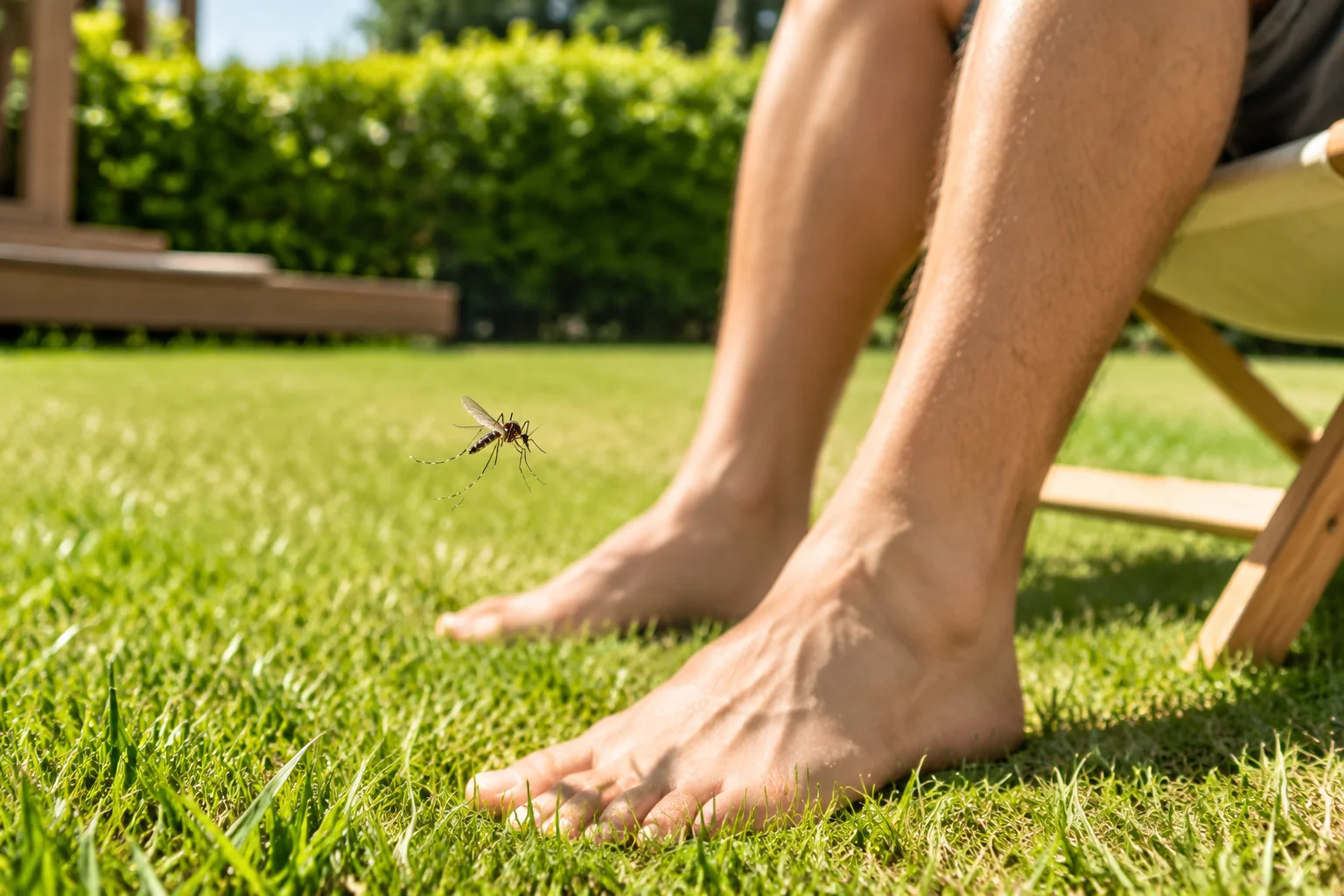
What The Phrase Is Actually Reporting
Three different animals sit behind the words gnat mosquito, and a homeowner can separate them without a microscope by asking when the bite happened and where on the body it landed.
The first is a small daytime mosquito. The second is a night-flying mosquito of ordinary size that you simply did not notice. The third is a biting midge, an animal a fraction of the width of a mosquito that walks straight through mesh ordered for mosquitoes. This site covers the third group at length, starting with what no-see-ums are, so it appears here only where it changes a decision.
The useful move is to stop asking what the insect is and start asking what it does. Hour, height, and the distance between the bite and the nearest water will sort most properties before anyone collects a specimen.
| What you have | Typical hour of the bite | Where on the body | Nearest production site |
|---|---|---|---|
| Day-biting container mosquito | Morning and mid-afternoon, with biting continuing through daylight | Ankles, shins, behind the knees, waistband | Inside the fence: tyres, pots, drains, trash |
| Night-flying house mosquito | After dusk, with a peak in the first hours of darkness | Any exposed skin, indoors and on a porch | Larger shaded water, frequently off the property |
| Biting midge | Dawn and dusk, gated hard by wind | Neck, wrists, any gap between clothing and skin | Wet film over soil or mud, not open water |
Two of those rows are treated elsewhere on this site in more depth than fits here: the flowing-water black flies on buffalo gnat and the swarming non-biters on non-biting midges. This page concentrates on the first row.
Gnat Mosquito Clocks, Stated As Hours
The daytime animal has a clock, and it has been measured more than once. Recording aggression hour by hour in southern Benin, researchers reported “three distinct peaks of aggressive biting activity for both vector species throughout the day: the first occurring between 7:00 and 9:00 AM (sometimes extending to 10:00 AM), the second between 10:00 AM and 12:00 PM (occasionally extending to 1:00 PM), and the third between 4:00 and 7:00 PM” (Konkon et al., 2025).
A separate group in Malaysia caged females with timed access to a host and found the same shape from the other direction: activity was bimodal, with a morning band from 06:30 to 09:30 and an evening twilight band from 18:30 to 20:30 (Muhammad et al., 2020). That paper also quotes field work in Kuala Lumpur where biting ran across the whole day but concentrated between 06:00 and 09:00 and again between 15:00 and 20:00.
Urban traps in Barcelona, run continuously from 2021 to 2024 against hourly weather data, found an afternoon-dominated rhythm for the same species, including “the marked afternoon activity peak (between 15 and 19 h)” and, across twenty years of prediction, “a strong preference for daytime activity, which was mainly concentrated in the early afternoon” (Gonzalez-Perez et al., 2026). That study tracked this mosquito and the northern house mosquito in one city, which is the honest way to state the contrast: two pests on one property, two different hours.
A lunchtime bite on the shin in a garden is therefore not the same event as a bite at ten in a bedroom. Different hour means a different resting place, a different trap behaviour, and a different exposure on the day you treat.
The night clock for comparison
The house mosquito pattern is what most advice is written against, and it is real. In the Tanzania collections described below, night hours produced by far the largest culicine catch, and the same study recorded mean biting rates in the range of “0.04 bites per person per hour” for one vector indoors at night (Mukisa et al., 2024). Night-flying is not a myth. It is simply not the only schedule.
Why A Daylight Bite Is Not An Anomaly
Most people have been told that mosquitoes bite at dusk. That advice summarises what surveys found, and the surveys had a hole in them. Analysing twenty-four hour collections in south-eastern Tanzania, the authors wrote plainly that “the modest but significant daytime and outdoor biting activity observed in our study necessitates a re-evaluation of vector control strategies to include measures that address mosquito activity throughout the entire 24-h period” (Mukisa et al., 2024). They named the reason the older picture looked tidy: current practice “is reinforced by biases in entomological surveys, which largely overlook daytime mosquito activity”.
The same gap sits under ordinary consumer advice, because nuisance for a household lands outdoors and in daylight. Reviewing field trials of repellent products, the authors put it directly: “some malaria vectors, and most arbovirus vectors, bite outdoors and in the early evening” (Roey et al., 2014).
Light also shapes behaviour in ways that matter for a patio. Offering colour patches to three urban species under different lighting, the authors recorded that “complete darkness during the day deactivated the host-seeking activity of both species, regardless of their increasing flight activity driven by internal circadian rhythms” (Hellhammer et al., 2026). A shaded planting bed at noon and an open lawn at noon are not the same habitat for the same insect, even in the same hour.
Why You Never Saw The Thing Land
The complaint behind gnat mosquito is usually invisibility rather than size, and three things combine to produce it. The insect sits below what a naked eye resolves at arm’s length, which this site has already worked through in no see bugs and no-see-um size. It attacks below eye height. A daytime host-seeker also does not announce itself with the high wing whine that a mosquito hovering by an ear at midnight produces.
Height is not decoration in that list. Lowering and raising containers on a pulley rig across a land-use gradient, researchers showed that container-breeding mosquitoes distribute themselves vertically in a way that shifts with how heavily the surrounding landscape has been built over (Schwarz et al., 2020). Where a female searches is not necessarily where a person stands.
The consequence is narrow but real. A count made at one height in one place samples one niche, and a property-level decision inherits that limit.
Where The Day-Biting Mosquito Is Produced
This is where the gnat-like mosquito and the folk model of mosquito control part company most expensively. The folk model says: drain the pond, tip the trough, and the season improves. For a species that bites at noon, production is spread across hundreds of small water-holding objects, most of which are litter.
A field study in southern Mexico counted what actually emerged. From immatures collected around homes in the dry season, the authors reported that “a total of 3063 mosquitoes emerged, with 1818 (59.3%) found in tires, 919 (30.0%) in containers with a capacity of less than 20 L, and 326 (10.6%) in containers with a capacity of 20 to 50 L” (Navarro-Kraul et al., 2024). Nearly three in five emerged from tyres. Their own sampling note explains why programmes miss this: the treated containers were the larger ones, because larvicide was only being applied to vessels of five to ten litres.
A survey along transport routes in West Bengal found the same material at scale. Of that survey, the recorded result was that “a total of 1104 tyres were inspected across all 34 sites, of which 605 (54.80%) were positive for mosquito larvae” (Das et al., 2026). Half the tyres were producing.
Small containers are not the whole story either. Working on urban drain habitats, the authors opened by stating that “in addition to small containers, the urban storm drains serve as an extensive production ground” (Su et al., 2026). A drain is usually municipal, permanent, and absent from a homeowner’s checklist.
The egg counts from the Mexican properties make the same point from the other direction. Deploying ovitraps across 125 backyards, the team recorded that “211 (84.4%) were found to be positive for Aedes eggs”, and that “a total of 7290 eggs were collected from 211 (84.4%) ovitraps” (Navarro-Kraul et al., 2024). They also warned that “many untreated, desiccated, quiescent eggs remain hidden and glued to thousands of small, trash-like containers”.
| Container class | Adults emerged | Share of total | Usual control attention |
|---|---|---|---|
| Discarded tyres | 1,818 | 59.3% | Almost none, unless a collection day is run |
| Containers under 20 L | 919 | 30.0% | Partial; often skipped as too small to treat |
| Containers of 20 to 50 L | 326 | 10.6% | Most of the larvicide budget |
Read against the folk model, the last row is the expensive one. A programme can beat a summer and still lose the following April, because the individuals that survive are in a stage that no spraying schedule touches.
The Egg Bank Runs On A Different Calendar
Container species carry themselves through the bad months as eggs, and those eggs are not merely waiting for warmth. They are waiting for a length of day, and then for a number of days. Both facts change what a season looks like on a calendar, and both explain why a bite in April surprises people who did nothing wrong.
Rearing the Asian tiger mosquito in southern France and reading diapause in the field, the team reported that “the complete shift in the number of eggs entering diapause incidence occurs between a day length of 13.0 and 14.0 hours” (Lacour et al., 2015). The same paper measured the wait that follows: “a period of 25 (in 2010) to 26 weeks (in 2011) was needed between the time when 50% of eggs entered in diapause and the observation of the first viable hatched larva the following year”. Their summary of that first generation is worth reading twice: “with 20 to 26 weeks in the egg stage and about 7 weeks in the larval stages, the first annual generation spends a long time in immature stages”.
A laboratory study of a related invader, the Korean water mosquito, put the same rule as a plain waiting period: “we found that diapausing eggs younger than 3 months have a poor hatching rate, while after about 100 days we observed that almost all eggs hatched” (Marini et al., 2022).
Tolerance to drying is earned rather than automatic, which matters when you decide what counts as a dry container. Testing how long Aedes aegypti eggs survive out of water, the authors desiccated batches “for 3, 6, 9, 12, 15, 18, and 21 days” after 48 hours of moisture, and found that “all eggs with less than 15 h of development before desiccation failed to hatch upon rehydration” (Prasad et al., 2023). Once the embryo had matured, three weeks out of water was survivable.
Cold narrows the bank without emptying it. Overwintering eggs of three geographic strains exposed outdoors on a German Baltic island, the authors recorded that “after 16 weeks outside in the winter 2015/2016, larvae hatched from only 10% of the eggs”, and that “the subtropical strain showed hatching after all time periods while the tropical strain displayed hatching only until two weeks of cold exposure” (Tippelt et al., 2019). A cold snap trims a population. It does not close a season.
| Threshold | Measured value | What it rules out |
|---|---|---|
| Day length that triggers diapause | Complete shift between 13.0 and 14.0 hours of light | Any plan assuming the bank resets with the first frost |
| Waiting period before hatch | About 100 days; 25 to 26 weeks in field conditions | Expecting a treated site to stay quiet the same spring |
| Desiccation tolerance | Survived 21 days dry once the embryo had matured | Treating dry ground as safe ground |
| Hard-winter survival | 10% of eggs still hatching after 16 weeks outdoors | Declaring a species absent after one cold winter |
The Weather Crew: Mass Emergence After Rain
There is a third pattern, and it is the one that produces the phrase gnat mosquito in a comment section. One dry week the yard is quiet. After a heavy rain, an apparently unbounded number of biters appears, and nothing on the property looks like a breeding site. That is a floodwater fauna, and it is produced off-site by weather rather than on-site by a habit.
The mechanism is the same egg bank with a different trigger. The floodwater species Aedes albifasciatus has been studied with eggs “stored for 2, 4, 6, 8 and 10 months” before being wetted (Battista et al., 2020), which is the laboratory version of a season without rain. Field workers in Argentina described the human consequence in one line: “floodwater mosquitoes provoke nuisance due to their mass emergence” (GALLEGO et al., 2024). Their own temperature function put immature development between roughly five and seven weeks at the cool end and a little under a week at the warm end, which is why an eruption can appear inside ten days of a storm.
Two conclusions follow, and they are both about expectations rather than equipment. First, a cloud of biters that arrives after rain is not evidence that your ground is producing them. Second, the same rain can start a container generation at home a week later, so the two waves are easy to confuse and require different responses. This site’s hourly weather-gate treatment for biting midges on Florida no-see-ums covers the wind and temperature side of the same question.
A Gnat Mosquito Sort: Two Evenings In The Garden
The protocol below exists because the phrase gnat mosquito cannot be answered by looking at one insect. It is answered by recording when you were bitten, at what height, and how far from water, and then reading the pattern. Two evenings and one morning are enough, and no collection is required.
- Fix the hour. Sit for thirty minutes in the same outdoor spot at 08:00, at 15:00 and at 21:00. Record bites per half hour, not impressions. Published biting curves for day-biting container species rise in the morning band and again in the late afternoon, while house mosquitoes climb after dark.
- Fix the height. Note where the bites land. Ankles and shins point to a low-flying day biter. Neck and wrist bites at a dusk table point to something that flies with the air and needs a gap in your clothing.
- Count the containers before you count the insects. Walk the perimeter and count water-holding objects under twenty litres. Tyres, pots, saucers, buckets, covers, tarpaulins and blocked drains all qualify. One field study found 59.3% of emerging mosquitoes came from tyres alone.
- Record the rain before the outbreak. Write down the date of the last heavy rain and the date the biting started. A gap of seven to fourteen days fits a container generation; a gap of two to four days with a wide front fits a floodwater hatch.
- Test the neighbours. If only your seats are bitten, the source is close. If everyone on the street is bitten at the same hour, the source is a habitat, not a habit, and it is usually larger than a fence line.
Development speed sets how long you have to wait for the answer. Under laboratory conditions the total preadult time for these two species is measured at days rather than weeks: “the total preadult development time was 9.47 days for Ae. albopictus and 8.76 days for Ae. aegypti” (Maimusa et al., 2016). A container you empty on Monday and refill on Friday can still produce.
What Each Clock Breaks In A Standard Plan
Once the hour and the production mode are known, most mosquito advice sorts itself into what still works and what was never addressed to your insect. The table below is deliberately narrow. It says nothing about products and everything about sequence.
| Default habit | Assumption inside it | Fails when | What replaces it |
|---|---|---|---|
| Spray at dusk | Adults are flying and contacting residue in the next hour | The pest bit at 15:00 and is resting low in shade by dusk | Treat the production list first; time any adulticide to the measured hour |
| Empty standing water | Production is in a few large, obvious vessels | Most emergence comes from tyres and litter under 20 L | A counted container sweep, repeated after rain |
| Judge a trap by its nightly total | One device samples every species on the site | The device is baited and lit for night fliers | Sample in the suspect hour with gear chosen for it |
| Trust a dry summer | No water means no mosquitoes | Embryonated eggs survive weeks dry and hatch on the next rain | Treat the dry season as a storage season, not a gap |
| Install netting against mosquitoes | Screen mesh sized for mosquitoes fits the pest | The pest is a midge, not a mosquito | Measure aperture against the insect, not against the word |
The last row is the boundary with the rest of this site. Sizing mesh against a midge is covered on noseeum netting and how to stop no-see-ums from biting, and it is a different arithmetic from mosquito screen. If the bite is at the neck at dusk, read those pages before buying anything.
Spray Timing, Measured
Timing is where the two clocks turn into a bill. Park managers want daytime control and cannot easily get it, which is the reason a Chinese public-health team tested night operations against a day-biting species at all: as they put it, “daytime adult mosquito control in urban parks may disrupt public activities and constrain equipment movement” (Yi et al., 2026).
Their results are a warning against reading any single spray number as a property. Across three urban green-space sites in Shenzhen and seven strategy combinations, control-adjusted Day 1 efficacy ranged from a negative estimate for ground ultra-low-volume spraying alone to 91.7% for a wind-disturbance-assisted aircraft treatment, while the raw reduction in the best coordinated regimen was 86.4% of counted host-seeking females. The negative figure is the important one. A spray that produces fewer mosquitoes than the untreated comparison plot is not a rare curiosity in this literature. It is what happens when the treated adults are replaced by untreated ones arriving from outside the plot.
Two rules follow. An adulticide number is a number for that hour, that vegetation and that surrounding source. And an unsprayed neighbour is part of your result. The site treats the wider adulticide question on spraying for no-see-ums and what kills no-see-ums instantly.
Reading A Trap Count On A Gnat Mosquito Site
Most disappointment about a gnat-like bite begins with a device that seems to disagree with the skin. The published comparisons explain why, and they are blunt: the gear decides the list.
In a comparison of two sampling methods at the same sites in Benin, relative abundance moved with the method rather than with the mosquito. Eleven species were collected, and the two target species showed relative abundances “from 29.57% to 43.99% and from 16.26% to 45.65%, depending on the sampling method employed” (Konkon et al., 2025).
The largest such comparison available covers a country. Across ten Cambodian provinces, “a total of 1992 collections yielded 181,798 mosquitoes spanning 153 identified species” using a host-cue baited trap and a light trap side by side (Rozier et al., 2025). The light trap was more effective for fifteen species and the host-cue trap for six. Read the direction carefully: neither trap was better in general; each was better for a different list.
Two further limits matter to anyone reading their own counters. Deployment time is not neutral: “for six of 13 primary vector species, we showed that the capture efficiency declines from day one to day three on a three days sampling period”. And the hour of collection is not neutral either, which is why that study ran twelve-hour day and night collections separately.
Against a human collector, machine numbers are also lower and noisier than intuition suggests. In direct comparison for the day-biting species, the human-landing method won: catch per hour “was significantly higher than HDN (14.72 vs 5.90 per h, t (178) = 3.151, P = 0.003)”, where HDN is the double-net device, and hourly density across fifteen sites showed a spread “ranging from 0.33 to 31.33 per h” (Gao et al., 2018). A hundredfold gap between the quietest and busiest site is why one counter in one corner of a large property cannot serve as an abundance estimate. This arithmetic is worked through on no see bugs.
| Question | What the evidence supports | What it does not support |
|---|---|---|
| Which species will this trap show me? | A biased sample chosen by bait, light, height and hour | A census of everything biting on the site |
| Can I compare this week to last week? | Only with the same gear, hour and deployment length | Comparisons across a changed schedule or a fresh device |
| Does a low count mean a low population? | Nothing on its own; day-to-day decay is documented | Any claim that the season is over |
| Does a high count point to my breeding sites? | Only when the species is a short-range flier | Anything about insects arriving on wind |
Where A Carbon Dioxide Suction Device Fits
Once the clocks are separated, an outdoor carbon dioxide suction trap has a clear place in the plan and a clear boundary. Pittar’s equipment is an airflow-suction device that draws host-seeking insects in by mimicking the carbon dioxide a person exhales, and it is built for outdoor ground: the rated effective range is 4,000 square metres, and it is not a device for indoors or for a small patio.
The honest reading of the trap literature above is that carbon dioxide is a strong cue for the crew that hunts mammals after dark, and a weaker one on its own for a small day-biting container species that navigates mostly on close-range host scent and visual contrast. In the British wetland comparison of two devices, the host-cue baited trap and the carbon-dioxide-baited trap each won a different part of the community, and the authors noted that the scent-baited device is generally the first choice against invasive container species (Vaux et al., 2026). That is a placement argument, not a reason to skip the device.
What follows for a large property is a sequence rather than a purchase:
- Run the container sweep first, because the egg bank and the litter containers are upstream of every adult count.
- Site the device between the source and the seats, low and upwind of the living area. Placement is covered properly on where to place a CO2 mosquito trap in a yard.
- Choose the power model by the ground, not by the catalogue: the battery-assisted, gas-run M3000 stands where there is no supply, the mains-fed MM4200 is simpler where there is. The comparison is on M3000 versus MM4200.
- Read the counts as a trend for one device at one hour, and expect them to move with rain, wind and temperature before they move with anything you did.
Two claims this page will not make. A suction trap is not a treatment for biting midges, and no claim of that kind is supported by the registered label scope discussed on biting midges and no-see-ums. And no device removes an egg bank: the eggs survive dry in hundreds of small containers, which is why where these insects live starts with substrate and not with hardware. Realistic expectations, coverage planning and the case for more than one station are set out on controlling mosquitoes in a large outdoor area and are CO2 mosquito traps effective. For the range and for site layouts, see the product overview and the application pages, or request a quote.
When This Sort Fails
The method on this page has three honest failure modes, and a reader is better off knowing them than discovering them in July.
It fails when the hour is wrong because the weather overrode it. A day-biting species stops host-seeking in strong wind and in heat that threatens desiccation, so a shaded, still, cool afternoon can produce the wrong answer for the wrong reason. Barcelona’s modelled activity, for example, showed an August dip attributed to extreme summer temperature rather than to a disappearing population (Gonzalez-Perez et al., 2026).
It fails when two clocks run at once, which is common on large ground with both shade and standing water. Seasonal work in southern Spain found the container species following a single rising curve to a peak in late July and August, while a house mosquito community at the same sites behaved otherwise (Garrido et al., 2025). A property can host both, and a single it is a mosquito answer then explains half the bites.
It fails most often when the source is not on the property at all. Floodwater production, marsh edge and a neighbouring tyre yard are outside your fence line, and no count from inside will locate them. If the biting arrived with a rain that crossed the whole district, this page’s protocol tells you to stop spending and start asking who owns the ground upstream.
Questions To Put To A Supplier Or Contractor
These five questions separate a vendor who has read the literature from one who has read a brochure. They work for a distributor evaluating a product line as well as for a facility manager evaluating a service.
- Which species, sampled by which method, at which hour, produced the numbers you are quoting me?
- What was the untreated comparison, and over how many days after treatment was the count taken?
- Does the product target the egg stage, the larval stage or the adult, and how often must that be repeated after rain?
- What aperture, mesh and height were measured for the barrier you are proposing, and against which insect?
- For a device: what is the rated coverage per unit, what is the maintenance interval, and what is the consumable supply chain?
A specification that cannot answer questions one and two should be treated as a hypothesis. Importers and programme buyers who need the hardware side of that conversation can read the OEM and ODM programmes page.
Frequently Asked Questions
Is a gnat mosquito a baby mosquito?
No. Adult mosquitoes do not pass through a small flying stage that looks like a different insect. The small biter you are seeing is either a full-grown small species, of which there are several, or a different family altogether. Size alone at a distance of half a metre cannot settle it, which is why this page sorts by hour and production instead.
Why am I being bitten at noon and my neighbour is not?
Because the two of you are sitting in different microclimates. Host-seeking in these species is switched on and off by light, wind, shade and temperature, and small differences in planting or exposure change whether a seat is usable. Colour and contrast also matter in choice tests (Hellhammer et al., 2026). The bite-count difference between two people on one property is discussed on biting no-see-ums.
Do the day biters leave at sunset?
They narrow rather than vanish. Measured curves for the Asian tiger mosquito show a morning band and a late-afternoon band, with low but nonzero activity overnight (Muhammad et al., 2020), and season-length work in the southern United States found egg collections spanning most of the warm months at ten sites over twenty-two months (Goddard et al., 2021). Treat daytime only as a description of the peak, not of the window.
I was bitten by something large and fast in a swampy field. Is that a gnat?
Probably not. Some large, aggressive, daytime-biting mosquitoes exist, including predaceous species whose larvae eat other mosquito larvae (Turell et al., 2015). A big daytime biter is a mosquito problem with a daytime clock, and the daytime clock is the part that changes your control timing.
How do I stop arguing about the name?
Write down the hour, the body height and the last heavy rain. Those three facts decide the response, and they can be written on the back of an envelope. Naming can then be delegated to someone with a lens, as the identification pages on this site already explain at no-see-ums versus mosquitoes and small biting gnats.
Sources Consulted
- Alphonse Keller Konkon, David Mahouton Zoungbedji, Rock Aikpon, Isidore Hoyochi, Albert Sourou Salako, Camus Konkon, Antoine Salomon Lokossou, Brice Dangnon, Lamine Baba-Moussa, Martin Codjo Akogbeto, et al. (2025). Bionomics of the primary arbovirus vectors Aedes aegypti and Aedes albopictus in southeastern Benin. Tropical Medicine and Health, 53(1). https://doi.org/10.1186/s41182-025-00794-6 PMC12372330.
- Nor Atikah Farhah Muhammad, Nur Faeza Abu Kassim, Abdul Hafiz Ab Majid, Azimah Abd Rahman, Hamady Dieng, Silas Wintuma Avicor (2020). Biting rhythm and demographic attributes of Aedes albopictus (Skuse) females from different urbanized settings in Penang Island, Malaysia under uncontrolled laboratory conditions. PLOS ONE, 15(11): e0241688. https://doi.org/10.1371/journal.pone.0241688 PMC7657491.
- Maria I. Gonzalez-Perez, Catuxa Cerecedo-Iglesias, Alex Richter-Boix, Laura Barahona, Tomas Montalvo, John R. B. Palmer, Frederic Bartumeus (2026). Unravelling the activity rhythms of urban vector mosquitoes with smart-trap technology. Scientific Reports, 16(1). https://doi.org/10.1038/s41598-026-38795-y PMC12992545.
- Muwonge C. Mukisa, Jibsam J. Kassano, Yohana A. Mwalugelo, Charles Ntege, Najat F. Kahamba, Marceline F. Finda, Betwel J. Msugupakulya, Halfan S. Ngowo, Fredros O. Okumu (2024). Analysis of the 24-h biting patterns and human exposures to malaria vectors in south-eastern Tanzania. Parasites & Vectors, 17(1). https://doi.org/10.1186/s13071-024-06521-0 PMC11526538.
- Karel Van Roey, Mao Sokny, Leen Denis, Nick Van den Broeck, Somony Heng, Sovannaroth Siv, Vincent Sluydts, Tho Sochantha, Marc Coosemans, Lies Durnez (2014). Field evaluation of picaridin repellents reveals differences in repellent sensitivity between Southeast Asian vectors of malaria and arboviruses. PLoS Neglected Tropical Diseases, 8(12): e3326. https://doi.org/10.1371/journal.pntd.0003326 PMC4270489.
- Fanny Hellhammer, Hella Heidtmann, Fritjof Freise, Stefanie C. Becker (2026). Species-Specific Color Preferences During Foraging in Aedes aegypti, Aedes albopictus, and Culex quinquefasciatus Across Varying Light Conditions. Insects, 17(3): 276. https://doi.org/10.3390/insects17030276 PMC13027081.
- Marcelo Schwarz, Brian D. Byrd, Bahjat F. Marayati, Peter W. Blum, Michael B. Wells, Anthony D. Greene, Marissa Taylor, Gideon Wasserberg (2020). Horizontal distribution affects the vertical distribution of native and invasive container-inhabiting Aedes mosquitoes within an urban landscape. Journal of Vector Ecology, 45(1): 16-24. https://doi.org/10.1111/jvec.12369
- Jose Ignacio Navarro-Kraul, Luis Alberto Cisneros Vazquez, Keila Elizabeth Paiz-Moscoso, Rogelio Danis-Lozano, Jesus A Davila-Barboza, Beatriz Lopez-Monroy, Rosa Maria Sanchez-Casas, Marco Antonio Dominguez-Galera, Pedro Christian Mis-Avila, Ildefonso Fernandez-Salas (2024). The Field Assessment of Quiescent Egg Populations of Aedes aegypti and Aedes albopictus during the Dry Season in Tapachula, Chiapas, Mexico, and Its Potential Impact on Vector Control Strategies. Insects, 15(10): 798. https://doi.org/10.3390/insects15100798 PMC11508872.
- Subhajit Das, Abhirup Saha, Prapti Das, Abhinna Tamang, Dhiraj Saha (2026). Systematic survey and spatial mapping of discarded tyres as breeding habitats of Aedes spp. Current Research in Parasitology & Vector-Borne Diseases, 9: 100383. https://doi.org/10.1016/j.crpvbd.2026.100383 PMC13137035.
- Tianyun Su, Joey Yin-Xin Chang, Lu Gan, Ying Zhang (2026). Unveiling the insights of controlling invasive Aedes mosquitoes in simulated urban catch basins by Sumilarv 0.5G Sachet containing pyriproxyfen. Journal of Medical Entomology, 63(1). https://doi.org/10.1093/jme/tjag015
- Guillaume Lacour, Lionel Chanaud, Gregory L’Ambert, Thierry Hance (2015). Seasonal Synchronization of Diapause Phases in Aedes albopictus (Diptera: Culicidae). PLOS ONE, 10(12): e0145311. https://doi.org/10.1371/journal.pone.0145311 PMC4686165.
- Giovanni Marini, Daniele Arnoldi, Enrico Inama, Annapaola Rizzoli (2022). Diapause characterization in the invasive alien mosquito species Aedes koreicus: a laboratory experiment. Parasites & Vectors, 15(1). https://doi.org/10.1186/s13071-022-05376-7 PMC9450311.
- Anjana Prasad, Sreesa Sreedharan, Baskar Bakthavachalu, Sunil Laxman (2023). Eggs of the mosquito Aedes aegypti survive desiccation by rewiring their polyamine and lipid metabolism. PLOS Biology, 21(10): e3002342. https://doi.org/10.1371/journal.pbio.3002342 PMC10597479.
- Lisa Tippelt, Doreen Werner, Helge Kampen (2019). Tolerance of three Aedes albopictus strains (Diptera: Culicidae) from different geographical origins towards winter temperatures under field conditions in northern Germany. PLOS ONE, 14(7): e0219553. https://doi.org/10.1371/journal.pone.0219553 PMC6634406.
- C. M. Di Battista, S. Fischer, R. E. Campos (2020). Susceptibility of the floodwater mosquito Aedes albifasciatus from eggs of different dormancy times to the nematode parasite Strelkovimermis spiculatus. Medical and Veterinary Entomology, 34(4): 432-439. https://doi.org/10.1111/mve.12460
- MARIA ALEJANDRA GALLEGO, MARIA VERONICA SIMOY, DARIO VEZZANI (2024). Citizen complaints in local media as source of mosquito data: the case of Aedes albifasciatus in an intermediate city of temperate Argentina. Anais da Academia Brasileira de Ciencias, 96(4). https://doi.org/10.1590/0001-3765202420240477
- Hamisu A. Maimusa, Abu Hassan Ahmad, Nur Faeza A. Kassim, Junaid Rahim (2016). Age-Stage, Two-Sex Life Table Characteristics of Aedes albopictus and Aedes Aegypti in Penang Island, Malaysia. Journal of the American Mosquito Control Association, 32(1): 1-11. https://doi.org/10.2987/moco-32-01-1-11.1
- Teng Yi, Dou Shengping, Liang Wenqin, He Yinghao, Lin Liangqiang, Xie Qian, Liu Qiyong (2026). Field Efficacy of Seven Nighttime Ultra-Low-Volume Spraying Strategies Against Aedes albopictus in Urban Green Spaces – Shenzhen City, Guangdong Province, China, October-November 2025. China CDC Weekly, 8(33): 1047-1052. https://doi.org/10.46234/ccdcw2026.168 PMC13575572.
- Heloise Rozier, Pierre Gloaguen, Francois Septier, Sebastien Boyer (2025). Evaluating experimental design to sample mosquitoes. Scientific Reports, 15(1). https://doi.org/10.1038/s41598-025-27465-0 PMC12696000.
- Qiang Gao, Fei Wang, Xihong Lv, Hui Cao, Jianjun Zhou, Fei Su, Chenglong Xiong, Peien Leng (2018). Comparison of the human-baited double net trap with the human landing catch for Aedes albopictus monitoring in Shanghai, China. Parasites & Vectors, 11(1). https://doi.org/10.1186/s13071-018-3053-8 PMC6114860.
- Alexander G. C. Vaux, Harrison Hardy, Lucy Crossley, Colin J. Johnston, Anthony J. Abbott, Stephen Findlay-Wilson, Amanda Callaghan, Jolyon M. Medlock (2026). Mosquito and arbovirus surveillance in wetlands of South-East England: Comparison of two adult mosquito traps, use of a novel trap with FTATM cards and arbovirus testing. Medical and Veterinary Entomology, 40(2): 407-421. https://doi.org/10.1111/mve.70053 PMC13140037.
- Mario Garrido, Paula Parra, Jesus Veiga, Marta Garrigos, Guillermo Panisse, Josue Martinez-de la Puente (2025). Mosquitoes and the city: effects of urbanization on Aedes albopictus and Culex pipiens captures in southern Spain. Parasites & Vectors, 18(1). https://doi.org/10.1186/s13071-025-07094-2 PMC12606909.
- Jerome Goddard, Gail M. Moraru, Kristine T. Edwards, Sarah J. McInnis, J. Hunter Deerman, Tina M. Nations, Wendy C. Varnado (2021). Seasonality of Aedes albopictus in North and Central Mississippi. Journal of the American Mosquito Control Association, 37(1): 34-37. https://doi.org/10.2987/20-6942.1
- Michael J. Turell, Seth C. Britch, Robert L. Aldridge, Rui-De Xue, Mike L. Smith, Lee W. Cohnstaedt, Kenneth J. Linthicum (2015). Potential for Psorophora columbiae and Psorophora ciliata Mosquitoes (Diptera: Culicidae) to Transmit Rift Valley Fever Virus. Journal of Medical Entomology, 52(5): 1111-1116. https://doi.org/10.1093/jme/tjv093