
Noseeum netting is sold as a wall. It is not a wall. A square meter of fine insect screen holds about a quarter of a square meter of open space.
In one measured commercial cloth, that figure was 26.3 percent. The panel is mostly hole by any ordinary standard. The midges still cannot get through it.
That fact reorders the purchase. A net does not keep biting midges out by covering a surface.
It works by presenting every approaching insect with an opening narrower than its body. There are several hundred of those openings per square centimeter.
Miss the dimension once, in one seam or one unsealed door edge, and the fabric beside it becomes scenery. So the useful question is not whether noseeum netting works.
It is which four properties decide how well a given installation works, and how many of them appear on the packaging. Almost none do.
The Four Numbers, in the Order They Decide the Result
Biting midges are filtered rather than repelled. A filter has an opening size, a throughput, a defect tolerance and a service condition.
Each maps to one measurable property. Each property carries published numbers of its own.
| Property | What it controls | The published figure | On retail packaging? |
|---|---|---|---|
| Aperture | Whether one insect can pass one opening | Exclusion stated at 0.5 mm or less; one animal trial specified 0.3 mm; the agency ceiling is 1.6 mm2 | Rarely. Cloth is sold by mesh count instead |
| Porosity | How much air still moves through the panel | Commercial cloth measured between 26.3 and 36.0 percent open; ventilation capacity down 26 percent | No |
| Worst opening | The single gap that sets the real outcome | Closing door-edge gaps gave a 14-fold reduction; adding fine mesh was not significant | No |
| Condition | What the first three become after a season | Entry ratio 0.10 with new cloth, 0.25 after twelve months outdoors | No |
Three of those four are installation facts rather than fabric facts. That is why two houses with identical netting report different evenings. It is also why a mesh specification, on its own, is a weak thing to buy.
A Quarter of the Wall Is Open Space, and It Still Works
The animal is smaller than the number you are holding
Start with the insect. Every aperture claim is meaningless without it. In a 2025 morphological description of Culicoides grisescens, the female wing measured “1.86-2.15 mm” in length and “0.74-0.96 mm” across.
That is the entire animal. About two millimeters of wing, and under one millimeter in the dimension that has to fold through a hole.
Florida’s other biters are smaller again. A description of human-biting Leptoconops from the Andaman and Nicobar Islands records “Body length = 1.70-2.13 mm”.
In the same description, wing breadth was 0.56 to 0.63 mm. Two Leptoconops species in a Mediterranean survey were separated by “wing length: 1.0-1.3 vs 0.9-1.0 mm”. The species that bite people are counted in tenths of a millimeter.
The consequence is blunt. The dimension that decides passage is sub-millimeter.
The difference between neighboring species is smaller than the manufacturing tolerance of a woven cloth. Anyone specifying a midge barrier in holes per inch is specifying in the wrong unit.
The engineering rule is dimensional, not behavioral
Horticultural entomology solved this decades ago and wrote it down as a rule. In a wind-tunnel study of insect-proof screens, the authors cite a whitefly finding.
Screens “lower than twice the width of the insect’s thorax were effective in not allowing whitefly to pass through.”
A greenhouse review states the same principle in one line. “An insect net is theoretically effective when the width of its pores is equal or less than the thorax width of the insect to be excluded.”
Two things follow from that rule. The controlling measurement on the animal’s side is a cross-section, not a length.
That is why a two-millimeter insect is stopped by a hole three times smaller. The controlling measurement on the cloth’s side is hole width in millimeters, not holes per inch.
The exception that should keep everyone honest
The rule has a documented failure, and it is a good one. In the same wind-tunnel paper, the authors note that the target insect “can fold its wings”. It had also been recorded passing screens with a mean pore value of 118.5 micrometers.
That is 0.12 millimeters. It is finer than any aperture anyone sells for midges, and an insect still got through. A published aperture figure is therefore a strong tendency, not a wall.
Any product page promising that a mesh keeps midges out absolutely is selling a certainty the primary literature does not contain. What the literature contains is thresholds, effect sizes and honest null results. This article stays inside those.
The Mesh-Number Trap
Ask a supplier for noseeum netting and you will be offered a count. The horticultural review describes the convention exactly.
“Insect nets available on the market are described by mesh number, representing the number of holes per inch in each direction.”
A count is not an aperture. Two cloths with the same number of holes per inch can differ in opening width.
The thread itself occupies part of that inch. A thicker thread leaves a smaller hole at the same count.
The count is also silent on thread shape, coating and weave stability. All three change what the hole does once the panel is stretched into a frame. That is the difference between a specification and a description.
Standards bodies specify the other way round. ASTM E11, the woven wire sieve cloth specification, defines itself by aperture rather than count. It applies to cloth “having a nominal aperture size ranging from 125 millimeters (mm) down to 20 micrometers”.
Sieve technology is sold as a measured hole. Insect screening is sold as a count of holes.
Buying across that boundary means buying in a unit that was never designed to certify the dimension you care about. The market range shows how loose the convention is.
Commercial insect netting mesh varies “from 0.2 to 3.1 mm, depending on the insect size to be excluded.”
That is a fifteen-fold spread inside one category. It is sold under one word: fine.
What a Florida entomology group found when the mesh mattered
This is not a hypothetical purchasing problem. A University of Florida group working on Culicoides furens in Indian River County had to solve it experimentally before it could run field cages.
It reports that stainless steel mesh and no-see-um netting were chosen because preliminary observations “indicated they could prevent escape of C. furens”. Of the third cloth tested, ordinary mosquito cage mesh, the paper states that it “has openings too large to contain Culicoides”.
The same paper carries the practical verdict. It “determined that no-see-um netting is an effective mesh for field cage trials”. That is a research-grade endorsement of this exact product class, from people handling the exact species that bites people on Florida’s east coast.
It also has a limit that must be stated. The authors published no aperture or mesh count for the three cloths. They label the containment observation as preliminary and unpublished.
The finding supports the sentence “no-see-um netting contains midges where mosquito mesh does not”. It supports no millimeter figure whatsoever. Anyone quoting a number while citing this study is quoting a number that is not in it.
Number One: The Aperture Ledger
Four published aperture figures matter for netting against biting midges. They disagree. The disagreement is instructive rather than confusing, because each number belongs to a different job.
| Figure | Source and setting | What it was doing |
|---|---|---|
| 0.3 mm hole | Knitted monofilament HDPE mesh over jet-stall ventilation openings, South Africa, horses | Specified protection in a small, mechanically ventilated volume |
| 0.5 mm or less | Discussion of UK stable trials, Parasites & Vectors, 2025 | The aperture at which midge mesh is described as effectively excluding Culicoides |
| 1.6 mm2 | EFSA bluetongue opinion, 2017; also the aperture of the UK polyester screen tested in 2015 | An agency ceiling for protecting openings, printed as a maximum mesh size |
| 1 x 2 mm | Insecticide-treated fences around bull pens in Germany, cited by EFSA | A pen fence that produced no significant difference against control |
Read the bottom row first, because it kills the naive reading. A treated fence of 1 by 2 millimeter mesh, 180 centimeters high, was erected around bull pens in Germany.
Traps inside the pens “showed no significant difference with control.”
That result is not proof that mesh fails. It is proof that mesh fails in some configurations.
Configuration is a variable independent of the hole. The pens were open above 180 centimeters, and midges arrive from above and from every direction.
A barrier whose top is missing does not have an aperture problem. It has an envelope problem.
Why 1.6 mm is a reduce number, not an exclude number
The EFSA opinion on bluetongue control states the agency position. It recommends “all openings protected by filters or mesh impregnated with insecticide (ITNs) and with a maximum mesh size no greater than 1.6 mm2.”
Now put that next to the physical test of the same size class. A UK study of netting for equids reports that “Culicoides can pass through untreated insect screens with mesh sizes of 1.6 mm2”.
The same screens “did reduce Culicoides entry rates by 56 %.”
Midges pass the hole. Half of them do not.
This is the single most useful sentence in the midge-netting literature. A screen is a filter with a passage probability, not a switch with two positions.
Anyone selling netting on the promise that the animal is smaller than the hole is describing the wrong mechanism. The right mechanism is slower, less quotable, and true.
That 56 percent figure has to be attributed precisely. It comes from a 2015 Parasites & Vectors study citing an earlier trial by Porter.
It is a secondary citation. The original species mix and trial design are not restated in the citing paper.
One more caution. Both the EFSA opinion and the citing study print 1.6 mm2 as an area-like notation. Neither resolves it into a mesh count or a linear aperture.
Quote it as printed. Do not convert it.
Where the aperture has to go for a real exclusion claim
The UK stable paper names its own threshold in the discussion. “The use of midge mesh with aperture at most 0.5 mm will effectively exclude Culicoides.”
Read that sentence for what it is. It appears in a discussion, not as a controlled comparison of a 0.5 mm cloth against a control. The same study also fitted its own fine mesh.
“There was an additional effect of installing fine mesh over slatted windows, but this was not significant.”
So 0.5 mm is the figure those authors are prepared to name. It is not a figure their own trial established. That distinction is the difference between a specification and a sales page.
The tightest specification actually used in an animal-protection study sits lower. A South African jet-stall trial sought protection against African horse sickness virus vectors. Its report states that “one stall was treated with a black, 400 denier, knitted monofilament HDPE mesh”, with a “0.3 mm hole size”.
That is a purchasable description: knitted monofilament, 400 denier, 0.3 millimeter hole, custom-cut “in a tent-like fashion, with zip connectors for access”. Notice the closure detail in the specification itself. The authors treated the zip as part of the barrier, because it is.
Now compare the two working cases with the null case. The bull pens were open-topped and large.
The jet stall was a small, closed, mechanically ventilated volume, with mesh over the openings it actually used. Between those designs sits the second most important number in this article, and it is not an aperture.
Number Two: The Worst Opening Wins
Researchers at Whipsnade Zoo vector-proofed four identical horse stables and counted what came inside. The headline result belongs to a material nobody markets as midge protection.
Sealing the door edge did the heavy lifting. The paper states that finding in one sentence.
“The use of brushes around closed doors resulted in a 14-fold reduction in the number of Culicoides collected from indoor traps.”
The mesh came second. Dedicated midge mesh was fitted over the windows.
The statistics could not detect what it added: “there was an additional effect of installing fine mesh over slatted windows, but this was not significant.”
The paper draws the commercial conclusion itself. “Readily available, cheap materials can be used to significantly reduce entry of Culicoides, and specialised midge mesh does not afford greater protection.”
The geometry of that result is transferable
The failures were documented in centimeters, which is what makes them useful. “Stable 3 was vector-proofed such that gaps, up to around 5 cm in size, around doors were closed up using garage door brushes.”
The same stable had “large gaps in the eaves” blocked “up with expanding foam.” Read those two sentences as a defect map. The failures ran along door edges and eave lines.
They were linear. The remedy was to close a line, not to filter a field.
What the 14-fold figure is, and what it is not
That number will be quoted at you by salespeople, so read it carefully. It echoes an earlier result recorded in the EFSA opinion.
“Gauzing windows and closing doors in horse stables in South Africa reduced by 14-fold the presence of C. imicola and Culicoides bolitinos inside the stable.”
Both figures describe a package in which an opening was closed. Neither one isolates the mesh. In the UK trial the package was tested across four stables over one season, using CDC light traps, in livestock accommodation rather than a dwelling.
The brush arm bundles several gap-closing actions together. No single one of them can be credited with the 14-fold result.
And the study’s own null result warns against treating mesh as interchangeable with sealing. They are different interventions, and only one of them was measured at 14-fold.
The open door erases the building
The clearest boundary condition is stated plainly, and it is a null. Being indoors with an open door “had no effect on the number of Culicoides collected compared to outside.” That was worth nothing measurable.
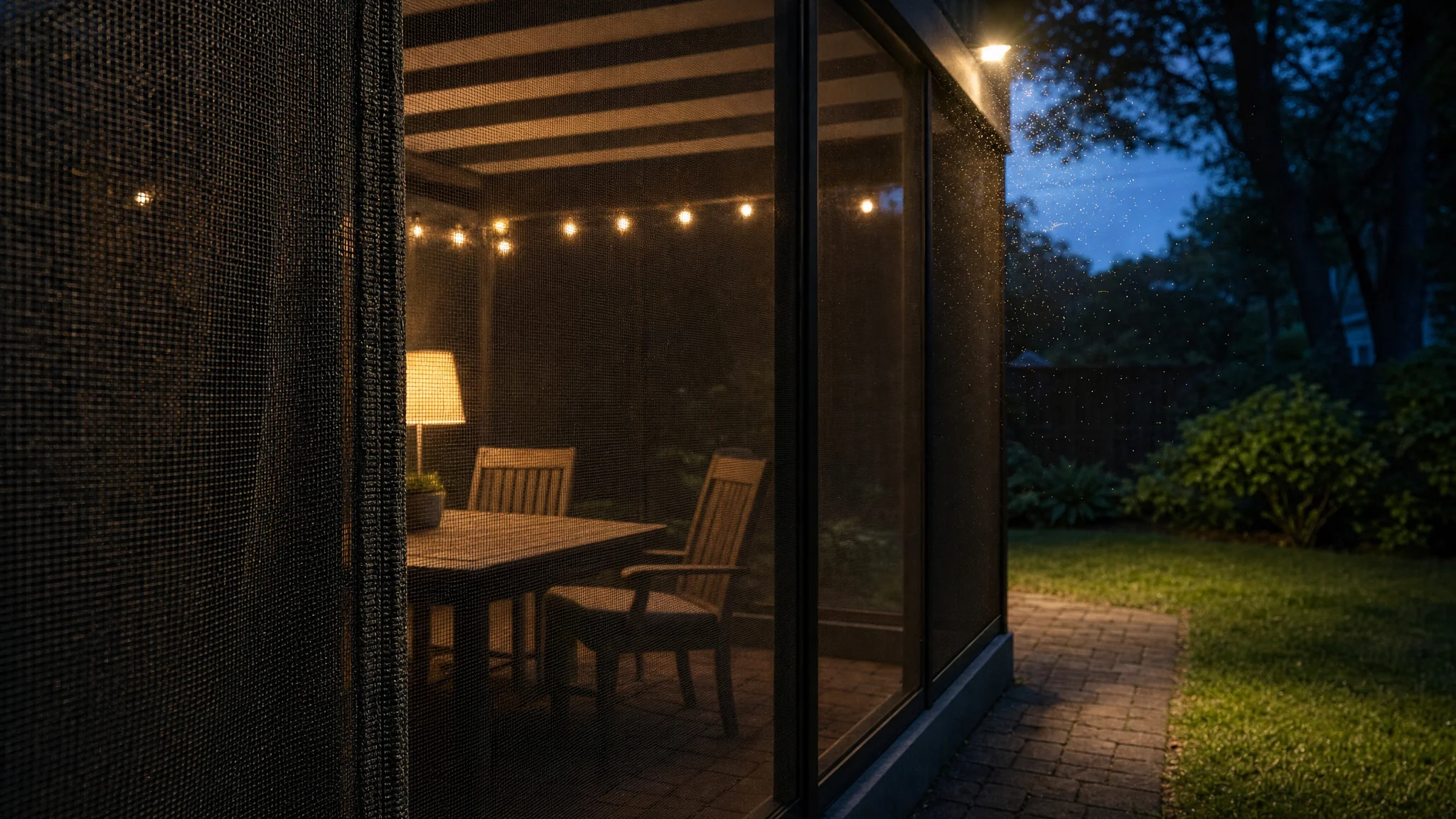
Transferred to a patio, that is the difference between an enclosure and a shade structure. A net roof with an open side is an open stable door in nicer fabric. So is a netted side with a gap where a person walks through.
The mosquito literature points at the same two lines of a building. “Gaps in unimproved house structures, especially in eaves and windows, allow mosquito entry.”
Those are the two lines to audit on any netted structure you own. The head line, where cloth meets the top plate or eave. And every perimeter edge where cloth meets a frame, a door or the ground.
Number Three: Porosity, and the Bill You Pay Every Evening
Aperture decides whether a midge gets through. Porosity decides whether you can stand inside the netting. The two pull in opposite directions, and the trade is measured rather than guessed.
The engineering quantity is the discharge coefficient. It is how much air an opening actually moves, against what an ideal opening would move. A greenhouse review reports the scale of the loss.
A bare vent sits at 0.60 to 0.90. Once netting covers it, the same opening can fall to as low as 0.05.
In plain terms, the cloth is not a screen you look through. It is a flow restriction you live inside.
The review puts the consequence directly: “low-porous nets drastically decrease the ventilation rate, resulting in higher relative humidity and temperature gradients.”
How the penalty was measured, screen against screen
A 2016 study characterized three commercial insect-proof screens from photographs, tested them in a low-velocity wind tunnel, then installed them in a split Mediterranean greenhouse. It is the most useful netting paper available to a buyer. It reports the geometric specification and the airflow consequence of the same cloth.
| Cloth | Thread density | Porosity | Discharge coefficient | Mean pore |
|---|---|---|---|---|
| Screen 1 | 10 x 20 threads per square centimeter | 35.0 percent | 0.207 | 238.6 micrometers |
| Screen 2 | 13 x 30 threads per square centimeter | 26.3 percent | 0.151 | 110.0 micrometers |
| Screen 3 | 10 x 20 threads per square centimeter | 36.0 percent | 0.325 | 239.9 micrometers |
Two results follow from that table. First, the finer cloth cost real air.
In the greenhouse, the ratio of discharge coefficients was 0.74. The authors state that this “should bring about a 26% reduction in the natural ventilation capacity” behind the finer screen.
Inside air speed fell further. Measured values were 0.16 meters per second behind the fine cloth, against 0.27 behind the coarser one.
The authors compute that gap as “a 40.7% reduction in inside air velocity.”
Read the honest caveat attached to it. On control days, with the same screen in both sectors, the two sides still differed by 17.6 percent.
The authors attribute that to vent area and anemometer position. So treat 40.7 percent as the order of magnitude, not the figure for your pergola.
Second, the same nominal count is not the same cloth. Screens 1 and 3 share a density of 10 by 20 threads per square centimeter.
Their discharge coefficients were 0.207 and 0.325. Porosity differed only slightly, at 35.0 and 36.0 percent.
The same paper reports a wider spread within one product class. Fourteen commercial screens sold as 10 by 20 came out with porosity between 31.1 and 40.3 percent.
Thread diameter and real density were the reason. A count tells you what the cloth was intended to be, and nothing about what it became.
Airflow is not only comfort. It is part of the barrier.
Here the midge literature and the screen literature meet, and the result is uncomfortable for anyone selling the finest cloth available. Biting midges are weak fliers, and the published thresholds are low enough to reach with an ordinary fan.
In a three-year study of Culicoides sonorensis at a southern California dairy, wind speed at sunset predicted both the timing and the duration of host-seeking. The authors report “wind speeds below ca. 0.69 m/s” as the condition under which peak activity occurred at or near sunset.
Above that threshold, peak host-seeking was delayed until winds abated. At wind speeds above 2 meters per second at sunset, peak activity often shifted one or more trapping intervals later. The same paper cites 2 to 6 meters per second as the published range that restricts midge flight outright.
Put the two threads side by side and the design rule writes itself. Moving air suppresses midge host-seeking at speeds a fan produces.
Cloth destroys moving air at exactly the ratio you buy. A fine, unventilated enclosure can remove your cheapest suppressor and install a heat problem in its place.
That is an inference from two measured effects, not a tested result. No retrieved study measured midge landings inside a fan-ventilated, netted enclosure. Say so before anyone sells the combination as a package.
The counterweight: fine mesh is not automatically a hot box
There is a measured exception worth knowing before anyone abandons a specification. In the jet-stall trial, temperature behaved almost identically inside and outside.
The difference “was significantly higher than the difference between the untreated stall and outside at 1/15 time points only.”
Humidity showed nothing at all, and that is good news here. The difference between treated stall and outside “did not differ from the untreated stall and outside.”
The cloth in that trial was among the finest in this entire review: 0.3 millimeter holes in knitted monofilament HDPE. Read the conditions before copying the conclusion. The stall was a small volume with a defined 1.7 square meter ventilation opening above the ramps.
The mesh covered exactly the openings it was meant to cover. Access was through zip connectors in the end panels.
Outside wind during measurement averaged 0.2 kilometers per hour. This was a driven air path, not a wind finding its own way.
So the honest summary is a rule about air paths, not about mesh. Cloth with a driven inlet and outlet tolerates a small aperture.
Cloth that depends on ambient wind pays the full porosity penalty. A patio pergola on a still August evening is that second case.
Number Four: Condition, the Number Nobody Warrants
Everything above describes netting measured in a stated condition. Field netting changes condition. The size of that drift has now been measured in a controlled system, albeit on a different insect family and with insecticide in the cloth.
In a Tanzanian semi-field study, insecticide-treated screening was fixed to the eaves and windows of experimental huts with Velcro tape. New material was compared with the same material after twelve months of natural ageing outdoors.
Both states worked. The difference was in how much.
Mosquito entry into huts with new screening fell to “new IRR:0.10” against control. Huts carrying the aged material recorded “aged IRR:0.25.” Blood-feeding odds moved in step, at 0.02 new against 0.09 aged.
Same specification, same installation method, same huts. One-tenth of the entry when new, one-quarter after a year.
That is the number that should govern how often you inspect. It is also a number no packaging can carry, because it is a property of service rather than of manufacture.
Three limits belong attached to it. The insects were mosquitoes, not biting midges.
The screening was insecticide-treated, so part of the decline is chemistry rather than structure. And the huts stood inside a large netting cage, using laboratory-reared strains over 32 nights.
What transfers is the direction and the rough size of the drift. The ratios themselves belong to that study, and to mosquitoes. Quote them as the only measured ageing curve available, not as a warranty term.
What ages first is rarely the mesh
Treated cloth has a second, faster clock. In the UK equid study, a cypermethrin and pyrethrins formulation was applied to black polyvinyl-coated polyester insect screen with “1.6 mm aperture; 1.6 mm thickness.”
That cloth “inflicted 100 % mortality on batches of C. nubeculosus” in WHO cone bioassays “at 1, 7 and 14 days post-treatment.” Fourteen days is the longest treated-cloth window measured in that paper. Nothing in it describes a summer, and nothing in it describes bare mesh.
The physical failure modes are also under-researched. No citable measurement of ultraviolet service life for insect screening was retrieved for this article.
No comparison of fiberglass, polyester, polyethylene or stainless cloth under field exposure was found. No authoritative guidance on repairing tears was found either.
This article therefore gives you an inspection routine instead of a replacement interval, and says so plainly rather than inventing a number. One measured observation does point the same way as common sense.
In the UK stable trial, the material inventory of an effective barrier was domestic hardware. The list runs to garage door brush strips, draft excluder strips, expanding foam and duct tape.
It also names “fine stainless steel mesh with hole aperture 0.5 mm”. The specialised item is the one the trial could not detect an effect from.
Envelope Arithmetic: A Fence Around a Pen Is Not a Net Over a Space
The strongest pattern in this evidence is not about cloth at all. It is about the shape you put the cloth into.
Two trials with similar fabric reached opposite conclusions. The difference was the geometry of the boundary.
In the negative case, treated fences of 1 by 2 millimeter mesh were erected around bull pens in Germany. They stood 180 centimeters high and carried deltamethrin at 100 milligrams per square meter. The mesh was fine and the insecticide was real.
Midge populations measured inside those pens “showed no significant difference with control.” On paper this is a fine-mesh barrier with an insecticide on it. In the field it measured as nothing.
In the positive cases, the same kind of cloth was used differently. Treated screens around a light-suction trap “entirely prevented Culicoides being collected.” Identical traps with untreated screening, or with none at all, collected them.
A knitted HDPE cover with 0.3 millimeter holes was fitted over jet-stall ventilation openings. It closed with zip connectors at the end panels.
It protected a volume the animal could not leave. And brushes cut to size, closing gaps of 5 centimeters along door edges, produced the 14-fold reduction described earlier.
What separates the two groups is not aperture, price or insecticide. It is whether the netting closes the boundary of the volume the host occupies.
A pen fence leaves the top open and the ground line open. It surrounds an animal that can walk to the weakest meter.
A shroud, a stall cover and a sealed door leave no such path. If you are buying netting for a space you cannot close, buy none. The trial that most resembles your plan returned a null.
What a whole-building envelope buys, measured on mosquitoes
Homeowners ask a bigger question: if I net the whole structure, what changes? The largest trials ever run were against mosquitoes, so the transferable number is about the envelope rather than the species.
In a randomised controlled trial in northwestern Ethiopia, 123 households had doors, windows and eaves screened with fine wire mesh. Both arms also received insecticide-treated bed nets.
The 123 control houses received those bed nets alone. Trapping ran for sixteen months across three agroecological zones.
Screening produced “a significant 2.3-fold reduction in indoor malaria vector density.” Fewer blood-fed mosquitoes were found inside. Malaria prevalence fell from 4.3 percent in control houses to 0.7 percent in screened ones.
The authors state that as “an 84% reduction in the odds of malaria.”
Two cautions before quoting any of it. Those were Anopheles mosquitoes, several times larger than a biting midge. And the screening was added on top of treated bed nets, so the effect belongs to closing the building rather than to any product.
The analogy cuts in an inconvenient direction, and that is worth stating. Mesh sized to stop Anopheles would be expected to leak midges.
The envelope logic transfers downward. The aperture logic does not.
The Six Netting Jobs, and What Each One Actually Needs
Noseeum netting is sold as one product for six different jobs. The four numbers rank differently in each. Evidence strength varies more than price does.
| Job | What the evidence supports | The variable that decides it |
|---|---|---|
| Replacing window or door screen on an existing frame | A reduction you can count, not exclusion. A 1.6 mm2 untreated screen halved measured entry in the cited secondary trial | Aperture first, then the perimeter edge where the spline meets the frame |
| Sealing one occupied room or porch as a complete envelope | The largest measured effect in the building literature, and it came from closing lines rather than filtering fields | Worst opening, above everything else |
| Netting a pergola, gazebo or open-sided patio structure | Weakly evidenced. The nearest analogue, a fine mesh fence around open-topped pens, produced no significant difference | Envelope closure. If one side is open, the cloth specification is beside the point |
| A bed canopy or netted sleeping space | Insecticide-treated cloth stopped collection completely in a trap-shroud test. No retrieved trial ran a canopy against midges | Aperture, plus the tuck-under tolerance at the mattress edge |
| Netting over a horse, dog or calf | Guideline support only. A full-body blanket is the standard clinical recommendation for insect bite hypersensitivity | Fit. Every neck line and leg hole is an opening you did not specify |
| Reducing the midges arriving at a property | Netting does none of this. It is the one job the fabric cannot do at any aperture | Nothing. This is a different control category |
Read the last row before the first. The most common purchasing error in this category is buying netting to solve an arrival problem. Netting manages contact inside a boundary.
If your evenings are spent moving across open ground, a paddock or a beach, no aperture on a roll of cloth changes what reaches you. That budget belongs somewhere else in the plan.
A Twenty-Minute Audit of Netting You Already Own
If netting is installed and the bites continue, the fabric is rarely the first suspect. Work the four numbers in this order, without buying anything.
| Step | What to do | What it decides |
|---|---|---|
| 1. Light walk at dusk | Put a bright lamp inside the enclosure, then walk every edge from the outside | Any line where you can see light is an opening wider than the mesh you paid for |
| 2. Measure the closures | Shut and zip every door, then gauge the largest remaining gap with a folded card | Above roughly a millimeter, that gap is the real specification of your barrier |
| 3. Inspect the head line | Check where cloth meets the top plate, the eave line and every corner | The entry path named in the housing literature, and the easiest one to forget |
| 4. Read the ground line | Look under every bottom edge, and behind anything leaning against the netting | Midges travel low in still air. A floating edge is an open door |
| 5. Count the actual mesh | Press a ruler to the cloth and count holes across 10 centimeters, in both directions | Whether the aperture claim survives cutting, tension and installation |
| 6. Feel the air | Compare still air outside with the center of the enclosure on a low-wind evening | Whether you bought the porosity penalty without a compensating air path |
| 7. Check condition | Look for stiffened, chalky or shiny thread, and any seam opening along a stitch line | Ageing moved measured entry performance by a factor of two and a half in one year |
| 8. Count, do not feel | At a fixed hour, sit ten minutes tallying landings on one bare forearm, three evenings running | The only way to know whether any repair changed the outcome |
Steps two and three carry more weight than the rest. In the one controlled building trial that separated the two kinds of intervention, closing lines gave a 14-fold reduction. The added mesh gave an effect the statistics could not detect.
An audit that finds light at an edge has found your project. It is not a cloth problem, and it never was.
The Specification to Hand a Supplier
Importers, distributors and pest-control operators buy this product by the roll and resell it into homes. That makes you the person who can insist on numbers instead of adjectives. Most of this list can be requested in writing, before a sample is ordered.
- Nominal aperture in millimeters, with a tolerance. Not a mesh count, and not the word fine. ASTM E11 specifies woven cloth by nominal aperture, which is the format a real claim should arrive in.
- Porosity or open area as a percentage, plus the test method. It sets the airflow penalty your customer will feel on the first humid evening. Measured commercial cloth ranged from 26.3 to 36.0 percent in one study.
- Construction type. Flat woven, knitted monofilament, or a Raschel or chain construction. This determines whether the aperture holds once the panel is tensioned. Knitted cloth that stretches changes the hole you specified.
- Thread diameter or denier. It is the missing half of any count-to-aperture conversion, and the reason a count alone cannot be checked.
- Seam, edge and repair method. Bound edges, a stated seam strength, and a repair kit matched to the cloth. Seams and edges are where the measured failures lived.
- The closure system, and the gap it leaves when shut. Ask for that number in millimeters. The highest-effect intervention in the retrieved trials was a door brush.
- Any insecticide loading. Active ingredient, dose in milligrams per square meter, expiry, and registration status in the destination market. Treated cloth is a regulated product in most markets, including the European Union.
- Weathering data, or an explicit statement that none exists. A supplier who tells you the second thing is telling you the truth. Here the truth is worth more than a reassuring number.
Two of those requests are worth explaining to a customer rather than hiding. Ask for porosity because a family that cannot breathe in an enclosure takes the netting down in August. Taken-down netting excludes nothing.
Ask for the closure gap because the hardware is not an accessory in this category. In the strongest measured result available, the closing hardware was the barrier.
Where Netting Stops Working
A net has four failure boundaries, and each one is documented rather than theoretical.
- The gap boundary. A sealed door edge outperformed added fine mesh in the same building. An unsealed line wider than your aperture replaces your aperture.
- The geometry boundary. A 1 by 2 millimeter insecticide-treated fence around open-topped pens measured as nothing. Partial boundaries can measure as nothing.
- The deformation boundary. An insect able to fold its wings has been recorded passing screens with mean pores of 118.5 micrometers. No aperture rule is a promise.
- The condition boundary. Identical treated screening that cut entry to one-tenth of control when new cut it to one-quarter after a year outdoors.
There is a fifth limit that is practical rather than scientific. Netting protects the inside of a boundary, and it does nothing for anything outside it. It also has to be walked through by the person it is protecting.
That is the honest shape of the product. It is the strongest cheap intervention available for one fixed, occupied spot. It is also the weakest possible answer to a wide-open property.
Where an Outdoor Carbon Dioxide Device Belongs Beside a Net
Netting and trapping answer different questions. Confusing them is where budgets disappear.
A net is a contact control. It works where the fabric is, on the side you installed it, while the seams hold, and nowhere else.
A carbon dioxide suction trap is a pressure control. It runs against arriving insects across an outdoor area, before any of them reach a barrier.
It mimics the carbon dioxide a host exhales, draws the approaching insect in with airflow, and the captured midges die by dehydration inside the collection bag. That is the whole mechanism, and it is the same mechanism a researcher uses to count midges in a study.
The outdoor unit we build is rated for 4,000 square meters of coverage. That is a coverage figure for open ground, not a promise about bites.
Its limits are stated as plainly as its reach. It is an outdoor device, not an indoor one, and it is not intended for small enclosed spaces.
Pricing is by consultation. Property size, source proximity and deployment count all move the answer, and a quote that ignores them is not a quote.
For a property with a screened porch and a wide lawn, the supported sequence is short. Close the lines on the structure you actually occupy, because that work is cheap and measured. Then reduce what is arriving across the ground around it, because a barrier cannot do that at any aperture.
Ask for a quote on the second part. Do it if the first part leaves you sitting in a still, netted box, counting midges on the outside of the cloth.
Frequently Asked Questions
What mesh size stops no-see-ums?
Two answers exist, for two different jobs. The aperture at which published midge work describes effective exclusion is 0.5 millimeters or less.
One animal trial specified 0.3 millimeter knitted monofilament. The agency figure repeated for livestock openings is 1.6 mm2.
Midges have been measured passing holes of that size, while total entry still fell by about half. Below 0.5 millimeters is an exclusion target.
Around 1.6 mm2 is a reduction target. Both are real numbers, and they are answering different questions.
Will an ordinary window screen keep them out?
Not as designed. In a Florida study of Culicoides furens, ordinary mosquito cage mesh had openings described as too large to contain Culicoides.
A standard screen is still not worthless. The same size class halved measured entry in the secondary trial cited above.
Expect a reduction you can count, not a room you can leave open. That is a useful outcome. It is simply not the outcome the packaging implies.
Why am I still being bitten under brand-new netting?
Because the worst opening governs the result. Check in the order the evidence supports. Start with an unsealed door edge, then an open side or top.
Then the head line where cloth meets frame, and the ground line under a floating edge. Finish with stretched fabric at a corner.
Every one of those is a line wider than the holes you paid for. None of them is a defect in the cloth.
Does fine netting make a patio hot?
It often cuts airflow enough to matter. One installation measured a 26 percent loss of ventilation capacity and a 40.7 percent loss of inside air speed. A 50 percent porosity screen has been recorded cutting inside air speed by 58 percent against no screen.
A mechanically ventilated stall under 0.3 millimeter mesh showed almost no temperature or humidity penalty. So the answer depends on whether air is driven through the enclosure, not on the cloth alone.
Is noseeum netting worth it if I also run a CO2 trap?
They work at different points, and neither replaces the other. The trap works on arriving insects across outdoor ground. The unit we build is rated for 4,000 square meters of that ground.
The net works on the contact surface of one occupied spot. The cheapest measured improvement there was a door brush rather than a finer cloth.
If you spend one evening in a fixed place, close that place. If you move across the ground, the barrier stops being the answer.
Can no-see-ums bite through netting or clothing?
Unknown, and this article will not guess. No published measurement of Culicoides biting through intact fabric was retrieved in the literature searched here. Loose fabric pressed against skin plainly behaves differently from fabric held off the body by a frame.
That difference has not been measured. Treat any confident answer you read elsewhere as an opinion, including a confident answer that helps someone sell you something.
How long does noseeum netting last?
No citable ultraviolet service-life figure for insect screening was found. No comparison of fiberglass, polyester, coated polyester, knitted polyethylene or stainless cloth under field exposure was found either.
The one measured ageing figure available is indirect. Treated screening that cut hut entry to one-tenth of control when new cut it to one-quarter after a year outdoors.
Inspect for light at the edges each season. Replace on observed damage, not on a calendar.
What is the difference between noseeum netting and insect screen?
In practice, mostly marketing. Commercial insect netting spans holes from 0.2 to 3.1 millimeters, and it is sold by mesh number. Mesh number means the number of holes per inch in each direction.
What separates a midge barrier from a mosquito barrier is the measured aperture in millimeters. It is also whether the panel keeps that aperture once it is cut, tensioned and closed. Two cloths sold under one count have been measured more than nine percentage points apart in porosity.
What This Evidence Does Not Contain
Four gaps shaped the writing of this article. They belong in the open rather than in a footnote.
- No published window-screen table was readable on this machine. No source gives aperture, wire diameter and open area for the counts sold in hardware stores, such as 14 by 14 or 20 by 20. No such figure appears anywhere above, including in the FAQ.
- No ultraviolet service life, weathering standard or material comparison. Fiberglass, polyester, coated polyester, knitted polyethylene and stainless cloth were all searched for. The twelve-month aged-versus-new comparison is the only ageing measurement retrieved, and it used treated mosquito screening.
- No measurement of Culicoides biting through fabric, and no published Culicoides thorax width in micrometers. The pore-versus-thorax rule quoted here comes from whitefly and thrips work. It is labeled as borrowed each time it appears.
- No repair, patching or inspection guidance from any agency or extension source. The eight-step audit above is assembled from the failure modes the trials did measure. It is an inference, and it is labeled as one.
Claims This Article Will Not Make
- No claim that any netting, at any aperture, excludes biting midges completely. The strongest enclosure result retrieved was a shroud around a trap, not a room around a person.
- No millimeter aperture, wire diameter or open-area figure for standard retail screen counts. No source read on this machine publishes that table.
- No statement that midges bite through clothing or netting. Not measured here, and not denied.
- No Culicoides thorax width, and no numerical closing of the twice-the-thorax rule for midges.
- No service life, warranty term or ultraviolet stability figure for any screen material.
- No conversion of the 1.6 mm2 notation into a mesh count or a linear aperture. Both sources print it as an area, and neither resolves it.
- No transfer of the 14-fold stable result to a dwelling. It was four livestock stables, one season, with several door actions bundled into one arm.
- No attribution of the 56 percent entry reduction to the paper that quotes it. It is a secondary citation of an earlier trial by Porter.
- No recommendation of an insecticide-treated net by product name or active ingredient. Treated cloth is regulated, and the label is the legal document.
- No use of mosquito effect sizes as midge effect sizes. Every Anopheles figure above is labeled as an analogy where it appears.
- No implication that a device rated for 4,000 square meters is an indoor device, a small-space device, or a substitute for sealing a gap.
- No first-party test data. Nothing in this article is a result we generated, and every number carries the study that produced it.
Read Next on This Site
- How to stop no-see-ums from biting for the occupied-zone plan this netting layer sits inside.
- No-see-ums vs mosquitoes for the size and breeding differences that decide which aperture specification applies.
- No-see-ums in the house for the indoor version of the same aperture question, room by room.
- Biting midges in the house for four tests that find where an indoor problem is entering.
- No see bugs in Florida for the coastal source problem that netting cannot reach.
- Biting midge life cycle for why the source is usually not the water you can see.
- The outdoor carbon dioxide suction trap, rated for 4,000 square meters of outdoor coverage. Specification and pricing on request.
Sources Consulted
15 sources sit behind the numbers above: 14 peer-reviewed papers retrieved through Europe PMC, and 1 standards or agency records. Every link opens the record that carries the quoted sentence, and each URL was fetched successfully on 16 November 2026.
- : same 2016 wind-tunnel study
- : Parasites & Vectors
- : Parasites & Vectors
- : Mem rias do Instituto Oswaldo Cruz
- [authors not captured]: 2023
- : Plants/MDPI
- : ASTM E11
- : Scientific Reports is susceptible to permethrin)
- : EFSA Journal
- : Parasites & Vectors
- : BMC Veterinary Research
- : BMC Public Health
- [authors not captured]: 2024
- : Scientific Reports
- : Animals