
You have the bites and no insect to show for them. That is the normal Florida version of this problem.
The local names describe the frustration. One open-access Florida paper opens by listing three of them: “no-see-ums”, “sandflies” and “punkies”.
Most advice about them answers the wrong question. It recommends a product. It never asks what ground those insects were standing on an hour earlier.
That second question has a better answer, and the answer is spatial. Every Florida lot sits inside three rings of source ground.
Each ring has its own owner and its own legal status. Each also has a ceiling on what you can do.
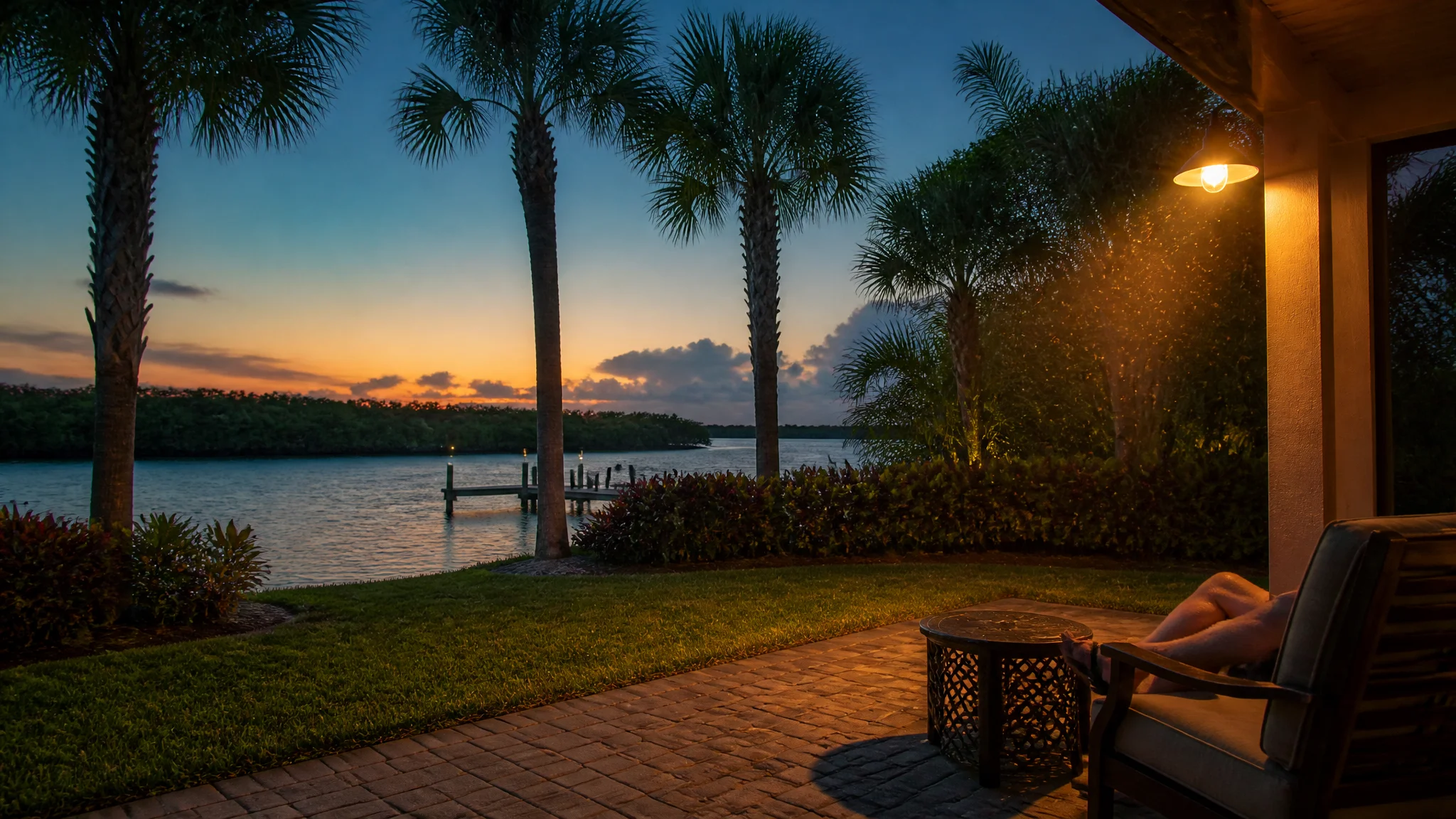
Dusk on a tidal Florida lot. The porch light is on. The water is a short walk away, and the mangrove fringe across it is regulated ground.
The Three Rings, in One Sitting
Ring 1 is tidal ground you are most likely not allowed to change. Mangrove fringe, salt marsh and the mud between them hold the larvae of the coastal pest species.
Ring 2 is ground somebody else is funded to manage. In Florida that is usually a mosquito control district. Its legal mandate may not include biting midges at all.
Ring 3 is your own ground. The wet organic soil on your parcel. The tree holes in your trees, and the damp strip under an irrigation line.
The rings matter because they set the ceiling on anything you buy. No device drains a marsh. No permit seals the gap under your door.
How the rings change the plan
Estimate the source area in each ring around the place you actually sit in the evening. Then ask what you can legally and physically change in each one. That ratio is your realistic result before any product decision.
On a mangrove-frontage lot the controllable fraction can be small. On an inland acreage holding stock it can be most of the problem. The device that is well bought in one case is money wasted in the other.
What the rings do not decide
The rings say where the animals were produced. They do not say how many will reach your chair tonight. That part is weather, hour and height, and three of the sections below are about exactly those.
| Ring | Ground it covers | Who can change it | What the published evidence supports |
|---|---|---|---|
| 1. Tidal source | Mangrove fringe, salt marsh, intertidal mud | Nobody, and the owner only within strict limits | Timing and exclusion, because removal is regulated |
| 2. District source | Common marsh, ditches and tidal flats near homes | The control district, if its mandate allows | Area-wide programs, measured as trap catch |
| 3. Own ground | Wet organic soil, tree holes, irrigation seeps, stock ground | You | Barriers and sealed openings, measured as landings |
| The air above all three | The layer adults actually fly in | Nobody | Height and hour shift exposure more than sprays do |
Table 1: the three-ring model used below, with the measurement type behind each row.
Ring 1: The Source You Are Not Allowed to Remove
If your lot fronts tidal water, the most productive midge ground is the vegetation in front of it. Florida treats that vegetation as regulated habitat, not as landscape.
This is the part of a Florida no-see-um problem that no product page will mention. Your plan has to start inside the law, not finish there.
What the statute calls a mangrove
The state page administering mangrove trimming quotes the act directly. It says the 1996 Mangrove Trimming and Preservation Act covers “any specimen of the species Laguncularia racemosa (white mangrove), Rhizophora mangle (red mangrove) or Avicennia germinans (black mangrove)”.
The same page adds a detail that removes the usual workaround. The act “does not distinguish between living and dead mangroves”. A dead stand on your shoreline is still regulated ground.
The permit line, in one sentence
Section 403.9328 says a person “may not alter or trim” any mangrove inside the landward extent of wetlands when the work “does not meet the criteria in s. 403.9326 or s. 403.9327 except under a permit”.
So the question is never whether you want the trees cut back. It is whether your specific trees and shoreline fit an exemption. The numbers below decide that.
You may not chemically defoliate the source
This is the single most useful legal fact on this page. Section 403.9328(3) states: “The use of herbicides or other chemicals for the purposes of removing leaves from a mangrove is strictly prohibited.”
No permit in that section unlocks it. The phrase is repeated in the exemption statute, which opens only if “no herbicide or other chemical is used to remove mangrove foliage”.
The homeowner exemption, with its numbers
Section 403.9326(1)(a) allows a landowner to trim without a permit inside a narrow band. The trees “may not exceed 10 feet in pretrimmed height as measured from the substrate”.
They also “may not be trimmed so that the overall height of any mangrove is reduced to less than 6 feet”. And the exemption “applies to property with a shoreline of 150 feet or less”.
Longer shoreline brings a second cap. Over 150 feet of shoreline, that exemption reaches 65 percent of the mangroves at most.
What changes when a professional does the work
Section 403.9326(1)(b) raises the ceiling for work “supervised or conducted exclusively by a professional mangrove trimmer”. The pretrimmed height limit becomes 24 feet instead of 10. The 6 foot floor stays.
It also staggers the work. For trees of 16 feet or more, trimming “must be conducted in stages so that no more than 25 percent of the foliage is removed annually”.
Read that as a calendar. A thinning you would like to finish this season becomes a four-year sequence instead.
The general permit ceiling
Beyond the exemptions, section 403.9327 offers a riparian general permit. It still requires the professional trimmer. It limits the work to mangroves that “do not extend more than 500 feet waterward”.
It also caps the same 65 percent of shoreline trees over 6 feet. Any deeper waterward stand needs an individual permit rather than the general one.
| What you want to do on shoreline ground | Threshold in the 2024 statutes | Where it lands |
|---|---|---|
| Trim a tree 10 feet or shorter | 6 foot floor, 150 foot shoreline, no herbicide | Exempt, s. 403.9326(1)(a) |
| Trim a tree over 10 feet yourself | Pretrimmed height ceiling exceeded | Permit territory |
| Hire a designated trimmer | 24 foot ceiling, 6 foot floor | Exempt within criteria |
| Thin trees 16 feet or taller | No more than 25 percent of foliage annually | Staged over years |
| Work a shoreline over 150 feet | 65 percent of shoreline mangroves maximum | Exempt within the cap |
| Work beyond 500 feet waterward | Outside the riparian general permit | Individual permit |
| Kill foliage with herbicide | “Strictly prohibited” | Never |
Table 2: mangrove action against the thresholds in the 2024 Florida Statutes pages listed in Sources. This is a reading of the text, not legal advice. Confirm your case with the office that issues the permit.
What this means for a waterfront plan
On a mangrove-frontage lot you should assume Ring 1 stays in place for the life of the property. Your midge pressure is therefore a chronic input, not a problem you clear in one weekend.
That single conclusion deletes half the product list. Anything sold as a way to clear that source is offering you a job the statute forbids. What is left is exclusion, timing, and treatment of your own ground.
Ring 2: The Ground Somebody Else Is Funded to Manage
Most Florida coastal parcels share their shoreline with ground that no private owner controls. Ditches, flats and common marsh sit inside a public system. It has boundaries people rarely discover until they call.
What a Florida district is legally bound to do
The 2026 open-access study of midge control on a Florida island states the framework plainly. “Legally, all Florida mosquito control districts are governed by state rules (5E-13) and state laws (FL Ch-388) requiring an enabling act (CH 98-461)”.
Each district operates under its own enabling act, written for its own responsibilities. That is where the surprise sits. The same paper says some districts “may not be statutorily allowed to control biting midges because their legal mandate is to control mosquitoes”.
The authors go further about what happens when residents call. They write that “local mosquito control agencies cannot respond to these requests for relief either due to legal reasons or limited resources”.
“No clear guidance” is the current state of the art
The same paper opens by naming the gap in the control community itself. It states that Florida districts face severe midge problems in coastal areas, yet “there is no clear guidance for integrating Culicoides management into mosquito-focused operations”.
Read that sentence before you accept any vendor claim about area-wide midge programs. The published literature is still describing the problem, not a standard solution.
Why marsh sources defeat the mosquito playbook
Mosquito control works where the water is. Biting midges do not cooperate with that logic, and the paper explains why in one sentence.
It states that “biting midges like C. furens breed in soil habitats associated with wetland ecosystems” and that “this restricts the ability to apply larval control measures effectively”. The larvae live in the mat around marsh grass, not in standing water you can treat.
The authors name the second half of the problem. No larval product in the mosquito cabinet fits that habitat. A district that cannot reach the soil cannot suppress the source with the tools its mandate funds.
What the district measures is catch, not bites
The Cedar Key work is the clearest public example of what area-wide data looks like in Florida. Sixteen propane-baited traps ran on Rye Key, a 5.91 hectare residential island, from April to October.
Those traps captured 32,258,666 C. furens in 2005 and 3,760,283 in 2007, a decline of 88.3 percent. The authors describe it as an area-wide population decline rather than a local effect at individual traps.
Nowhere in that program is a human bite counted. When a district publishes midge numbers, they are insects in a net. Keep that distinction when you read any control claim, including ours.
What to ask for, in writing
Four questions settle what your district can actually do for a midge complaint. Ask whether its enabling act names biting midges or only mosquitoes.
Ask which species drive the nuisance in your subsection, and whether trapping data exists for it. Ask what the treatment schedule is for the ground nearest your property, and what it targets.
Then ask for the last two seasons of catch data for your area. If that data exists, you have a baseline. You can then test whether your own work changed anything.
Ring 3: The Wet Organic Ground Under Your Feet
Your own parcel is the only ring where a Saturday changes the population. It is also the ring people investigate least, because the habitat does not look like a habitat.
What an egg-laying female chooses
Two Florida laboratory studies tested oviposition preference. They are the clearest picture available of what a female wants to land on.
For C. stellifer, females put 52.3 percent of eggs on habitat mud and 81.8 percent on vegetation. Controls took 18.2 percent or less. Every dish was held wet with 1.5 milliliters of water.
In follow-up work on a C. insignis colony, females laid 75.2 percent or more on enriched muds. The control took 31.0 percent. Each dish held about one gram of substrate over wet cotton.
A preference assay is not a field threshold
Those two experiments tell you what a female prefers when offered a choice in a dish. They do not give a soil standard you can measure your yard against.
No retrieved study set a grain size or salinity threshold. None gives the organic content at which a lot becomes a source. Anything printed as such a number would be invented, so this guide prints none.
The source that lives inside a tree
Ring 3 is not only shoreline. One barcoding study designed its whole method around the fact that C. debilipalpis larvae develop in tree holes.
Its researchers collected substrate from tree holes and flooded it to harvest floating larvae. They then matched those larvae to adult females. Eleven species formed the reference set.
For a wooded Florida lot that is the most actionable fact in this section. A water-holding cavity in a live oak is a midge habitat. It sits in the middle of your yard, away from any water.
What does not count as a source
A dry paver patio is not a source. Neither is a swimming pool or the water in your flower pots. Those are water bodies, not the wet organic mat these larvae need.
Indoor drains and houseplant soil belong to a different insect list entirely. If you think your midges breed inside, start with our biting midges in the house tests.
Four places to look first
Walk the property with a phone torch and check four things. The saturated strip beneath a drip line or a stuck sprinkler head, where mud stays organic and wet.
Second, the ground under a stock or feeding area. The mat there is the enriched mud the assays describe. Third, any tree hole or palm cavity holding debris and moisture.
Fourth, the edge where landscape fabric and thick mulch hold a wet mat against the stem. If none of those four exist on your parcel, Ring 3 is small. Your problem then lives in the other two rings.
Which Midges Are Actually in a Florida Catch
Nobody needs a species name to be bitten. You need one because the species tells you which ring the problem stands in. That decides what you can do about it.
On the Gulf islands it is usually one species
The Cedar Key study names the coastal pest complex for that part of Florida. It reports that “the two species Culicoides furens (Poey) and Culicoides mississippiensis Hoffman are the main pest species at Cedar Key”.
On the island itself the picture narrowed further. The authors note that C. mississippiensis, though important across the wider area, “was not detected in our Rye Key trap collections; all Culicoides identified from these samples were C. furens”.
C. furens is the saltmarsh and mangrove-edge species, the one tied to marsh grass ground. On a tidal lot, that is most likely what is arriving at your light.
On ground holding deer or cattle, the catch is a roster
A 2025 study collected wild midges on five Florida deer farms and identified the catch. Six species came back, in very unequal numbers.
- C. insignis: 944 specimens
- C. stellifer: 269
- C. debilipalpis: 68
- C. venustus: 16
- C. edeni: 5
- C. furens: 5
Treat that as a composition table for a Florida property with livestock, not as a statewide census. Four of the six names are species with larvae in wet organic ground. Those are not shoreline species.
Why the roster changes a purchase
A property dominated by C. furens is importing adults from tidal ground you cannot legally touch. Your spend belongs in exclusion, timing and your own Ring 3.
A property producing C. debilipalpis or C. stellifer may be growing its own problem in tree holes, mud mats and irrigation seeps. There, ground work can genuinely change the count.
The two situations look identical from a lawn chair. They have almost nothing in common as a buying decision.
What this guide will not name
Two names circulate in Florida no-see-um writing without reaching a quotable source. The beach-sand biter Leptoconops, and a mangrove-associated pest of horses, both come up in forum answers.
Neither produced a verifiable Florida record in this research pass. Both appear in the claims ledger at the end of this guide. Neither is used as evidence anywhere above.
Why the Nearest Marsh Did Not Predict the Catch
The instinct is that midges come from the closest wet ground to your house. The best Florida dataset available says that instinct failed on the one island where anyone mapped it.
The correlation that was not there
The Rye Key authors tested trap catch against the distance from each trap to the nearest larval habitat. In 2005 the result was r = -0.144 with p = 0.59. In 2007 it was r = -0.225 with p = 0.40.
Both are statistically empty. The island is surrounded by marsh and inlets, and sixteen traps were read. Proximity to the source did not predict the catch.
What did predict it
The same model found weather variables doing the work instead. Midge abundance “increased significantly as the mean wind direction shifted toward southerly sectors”.
Higher wind speeds, pressure and temperature also raised the catch. That model held year effects constant and reported Wald chi-square df 8, p = 0.046.
Wind is its own subject. Our Florida hour-by-hour guide covers what direction and speed do to an evening. The point here is narrower. Attribution by distance is not evidence.
The season has an envelope
Within that weather noise, the island data shows a clear seasonal envelope. Monthly captures peaked “typically occurring from May to July across most locations”.
Four of the sixteen traps reached totals “in the hundreds of thousands to over a million” in 2005, and October counts declined sharply, marking the end of the C. furens season.
Read this as capacity rather than as a schedule for your yard. Rain, tide and wind trigger a bad individual evening. Our Florida grow-site guide covers those triggers in full.
What this does to a Saturday cleanup
If your lot imports adults from tidal ground, cleaning your own ground changes your starting population very little. It still helps, because Ring 3 is the part you own.
But the honest expectation is fewer local emergences rather than a quiet evening. Set that expectation correctly. The alternative is a product you hide in the shed.
The Layer Above Your Head
Florida property plans are drawn in two dimensions. The published data says the third one matters more than most of the second.
The canopy outcounted the ground
A 2026 study ran hourly light traps at two heights on Florida deer farms. One sat near 1 meter and one near 11, from 1700 h to 0800 h.
Both species showed strong vertical stratification. The authors report “up to 7.4-fold and 11.5-fold differences” between canopy and ground for C. insignis and C. stellifer respectively.
The paper frames the consequence itself, noting that many species “reach significantly higher densities at tree canopy height (10-20 m), compared to ground level (1 m)”.
What that does to a ground spray
The same sentence continues with an operational warning. This layering, the authors say, “may compromise the effectiveness of space spray ground adulticiding”.
A fogger or a truck-mounted ultra-low volume application deposits its dose in the first few meters of air. If most of the population is ten meters up, that dose meets a minority of the animals.
What it does to a patio seat
For a household the practical reading is about placement rather than machinery. A seat under a live oak canopy sits under a denser air column. A seat on open, wind-exposed pavers does not.
That is an inference from trap height, not a measured exposure result. It is labeled as one here. No retrieved study counted people sitting in either spot.
The Clock the Industry Got Wrong
Florida assumes dusk. The trap data says the peak arrives after most control effort is already finished.
Peak flight was not crepuscular
The canopy study measured hourly activity and found the peak in the middle of the night. It reports flight “between 0028 h and 0103 h for C. insignis, and between 2240 h and 0234 h for C. stellifer”.
The authors then draw the operational conclusion. Dusk-timed ultra-low volume applications on deer farms “is not aligned with peak Culicoides activity (2200 h-0200 h), reducing efficacy of control measures”.
Those two windows are trap catches, not bite counts. They still reset the arithmetic for anyone planning an evening on a Florida lot.
Residual outlasts the truck
The Cedar Key paper summarizes two residential studies of bifenthrin. Both sprayed foliage around homes as a low volume surface treatment. Both “reported acceptable biting midge suppression for up to 6 weeks”.
It contrasts that with aerial naled at maximum label rates, applied at peak flight two hours after sunset. Without an integrated program including larval control, it gave “only 2-3 days of suppression of adult biting activity”.
Six weeks against two or three days is the most decision-relevant ratio in this whole guide. Residual foliage treatment of your own Ring 3 edge outlasts a knockdown event by an order of magnitude.
What a bottle bioassay proves
Do not over-read laboratory contact data. On those same five farms, bottle bioassays killed every Culicoides species tested. The dose was 10.75 micrograms of permethrin, and the time was 30 minutes.
Semifield cage trials at the maximum label rate killed everything exposed within an hour. The authors found no sign of resistance in those populations.
What none of that measures is a treated hedge at your house. Contact dose in a glass bottle and residual activity on a leaf in July sun are different quantities.
Buildings, Pens and Animals: What Exclusion Has Measured
Exclusion is the one layer where published numbers are large, cheap and repeatable. It is also the layer with the most specific conditions attached.
Door brushes: 14-fold. Fine mesh: not significant
A 2025 study tested vector-proof livestock accommodation. It fitted brushes around closed stable doors and counted what reached indoor traps. The brushes “resulted in a 14-fold reduction in the number of Culicoides collected from indoor traps”.
Adding fine mesh over the slatted windows did not add a statistically significant effect on top of that. The experiment ran 19 nights across four stables in mid-2024. Two pygmy goats stood in each one.
Read the result as gap discipline rather than as a mesh specification. The largest gain came from what happens at the opening when it closes.
An open door is no door
The same study tested the common compromise of housing animals with the door left ajar. It “had no effect on the number of Culicoides collected compared to outside”.
Blood meal analysis then confirmed the midges inside were feeding on the housed goats. Sealing and brushing the opening produced the 14-fold change; leaving it open produced nothing.
What the strongest barrier was actually built from
The most dramatic Florida figure in the literature is a treated fence line. A 2025 study on a Martin County deer farm found a permethrin-treated barrier “reduced landings of three Culicoides species … by 175-fold and 7-fold” against the pour-on comparison.
The build is worth reading because it is not a product you can order off a shelf. Two enclosures measured 2.5 by 2.5 by 1.2 meters. PVC pipe and welded wire with 5 by 10 centimeter openings formed the walls.
A 0.5 percent permethrin product went on at 1.34 fluid ounces per square meter. That happened one hour before each 24-hour sample. Barriers were re-treated every three days and discarded between rotations.
The daily cost hidden inside the smaller number
The pour-on treatment in that trial cut landings seven-fold rather than 175-fold. What the summary rarely carries is the labor. One fluid ounce went along the backline every single day. A gloved hand then spread it onto the sides.
It also came with a direction problem. The authors report the pour-on “had no measurable effect on … Culicoides floridensis Beck and appeared to attract Culicoides pusillus Lutz (8-fold increase)”.
A host treatment can therefore be species-selective in the wrong direction. On a mixed Florida catch that is not a small print in the methods section.
| Measure | What was actually counted | The published number | What nobody measured |
|---|---|---|---|
| Brush strips on stable doors | Midges in indoor light traps | 14-fold fewer indoors | Human bites in a house |
| Permethrin-treated fence barrier | Landings on a baited simulator | 175-fold reduction | A live horse, or residual life |
| Daily pour-on on the same farm | Landings on a baited simulator | 7-fold, and one species up 8-fold | Cost of daily handling |
| Foliage barrier spray, homes | Reported suppression window | Up to 6 weeks | Bite counts in treated yards |
| Aerial naled at peak flight | Adult C. furens activity | 2-3 days of suppression | Anything beyond that window |
| Area-wide trap grid, Rye Key | Insects in trap nets | 88.3 percent fewer in 2007 | Whether traps caused the decline |
Table 3: every measure above is reported against an insect count, not a human bite count. That column is the one a buyer usually wants. It is empty in the published record.
Buying Arithmetic for a Florida Lot
This is where a Florida search usually ends: one product page and one coverage claim. Here is how to read such a claim against the published record.
Start from a published density
The Cedar Key paper records the spacing logic behind a real trap grid. It notes the manufacturer recommendation of “one trap per acre of land (about 0.4 ha), placed in a suitable habitat near the mosquito larval source”.
The island program itself ran sixteen traps across 5.91 hectares, separated by about 0.40 hectares each. That is the only published density we found for an operating grid in Florida.
Note the sentence it applies to: the spacing claim is written for suppression of a mosquito population. It is not a midge bite reduction claim, and we will not borrow it as one.
What our own rating does and does not mean
The outdoor carbon dioxide trap we build is rated for 4,000 square meters of outdoor coverage. In the units above, 4,000 square meters is 0.4 hectare.
That coincidence is useful for sizing and nothing more. A rated footprint tells you the area one unit is engineered to service. It does not tell you the bite rate of the household standing in it.
No study retrieved here measured any outdoor device against human bite counts. That holds in Florida and everywhere else. Our own figures are engineering ratings for outdoor use, not measured bite reduction.
The device is also not a building product. It is an outdoor unit for large grounds. Small or indoor areas sit outside what it is built for. For a room problem, the indoor route is the one linked below.
Maintenance is the line item people miss
The published grid gives the real servicing rhythm for a fuel-baited outdoor trap. Propane tanks were changed every 18 days and octenol cartridges every 21 days.
That schedule produced 832 trap collections in a season across sixteen devices, and most individual collections held over a thousand insects, with some “exceeding 100,000 specimens”.
Convert that into your own terms. A baited outdoor unit on a tidal lot is a consumables and nets job. It is not a fixture you install once. Ask any supplier what the consumable interval and the local supply chain look like before price.
Bait type changes what a trap catches
Trap catch is not a fixed quantity that any device samples equally. A 2026 comparison collected 12,474 Culicoides across 21 species over nine nights.
In that test, traps lit by ultraviolet LED beat the carbon dioxide only trap. The gap was significant at p < 0.001. Light alone and light plus carbon dioxide were comparable to each other.
That trial ran in central Thailand. It constrains bait-type reasoning generally, not Florida species specifically. It is still the honest answer to “will any CO2 trap catch what is biting me”.
What an operator or distributor should document
For the buyers reading this as a purchasing question, five items separate a serious supplier from a catalogue. Rated footprint in square meters, with the test basis stated.
Which source geometry the unit is intended to serve, and which it cannot. Consumable interval and price, in the units above.
Then ask what the vendor does not claim, and whether service exists in your region.
If you specify units for client properties, price them per hectare against that published density. Then match the ring. A device serving Ring 3 cannot service a Ring 1 property.
| Florida lot type | Dominant ring | What the evidence supports | What stays unproven |
|---|---|---|---|
| Mangrove or marsh frontage | Ring 1, protected | Timing, sealing, personal protection | Any source removal by the owner |
| Oceanfront or sandy beach lot | Ring 1 plus drift | Height and hour shifts, sealing | Beach-sand species control |
| Equestrian or deer acreage | Ring 3 plus host | Treated barriers, gap sealing | Landings measured on a live horse |
| Campground or coastal rental | Rings 1 and 2 | Residual foliage treatment, lighting plan | Guest bite counts after treatment |
| Inland yard with stock or trees | Ring 3 | Ground work, tree hole removal | Which substrate thresholds matter |
| Large mixed parcel, 1 hectare up | All three | Devices sized at published density | Bite reduction at any device count |
Table 4: the lot-type mapping is this guide’s decision aid, built from the sources listed below. It is not a measured result. The right-hand column is deliberately not empty.
A One-Hour Audit Before You Spend Anything
Run this once, on a day when the biting was bad the night before. It converts a vague nuisance into a ring allocation you can act on.
- Stand at your usual evening seat and note the nearest wet organic ground in each direction.
- Check whether that ground is regulated shoreline, district ground or your own. Write the ring number against each one.
- Walk Ring 3 only. Photograph the four places listed earlier: irrigation seep, stock ground, tree hole, wet mulch edge.
- Count the openings between that ground and your seat. Check door gaps, screen condition, gate gaps and outbuilding doors.
- Note the hour the biting started, and whether your seat sits under a canopy.
- Ask your district the four Ring 2 questions. Ask for the last two seasons of catch data.
Three checks keep the audit honest. One bad night proves nothing, because wind direction and pressure drive catch as much as distance does.
An empty yard after a treatment proves nothing either, unless you counted before it. And a count taken at one height is a count of one layer.
Claims This Article Will Not Make
The honest boundary of this guide is shorter than most pages on the same search. Here is what we searched for and could not verify.
- No study we retrieved measured a consumer outdoor device against human bite counts, in Florida or anywhere else.
- No trap or suppression trial for Leptoconops in Florida was found, so no beach-sand control claim appears above.
- The frequently named mangrove pest of Florida horses did not appear in any retrieved source under that name.
- No larval habitat thresholds were measured. Grain size, salinity and organic content are not printed here as numbers.
- No fan or air-movement trial against biting midges was found. The wind evidence is correlational and points the other way.
- No mesh aperture in millimeters is quoted, because the one retrieved exclusion study reported a non-significant mesh effect.
- No Florida district page describing a midge-specific program could be retrieved, so the statutory quotation carries that section.
- No flight distance for a Florida species is given. The nearest usable fact is the null distance correlation.
- No claim is made that these midges transmit any human pathogen in Florida. Livestock and deer health is a separate subject.
- No state-wide species count is printed, because no retrieved source supplies one.
Where to Read Next on This Site
The three-ring model tells you where the animals come from. These guides cover the parts of the problem that model does not.
For the five grow-sites behind a Florida yard, start with no see ums in Florida. For the hour-by-hour weather gates that decide whether an evening is usable, use Florida no-see-ums.
Our guide to how to stop no see ums from biting ranks measures by controllable radius. If the insects are inside rooms, run the four source tests in biting midges in the house.
Still arguing with the name? can you actually see no-see-bugs settles what a count can decide at that size.
Sources Consulted
13 sources sit behind the figures above: 9 peer-reviewed open-access papers retrieved through Europe PMC and 4 Florida statute and agency pages. Each link goes to the page that carries the quoted sentence.
- Insects 2026, 17, 653 – “Can Trapping Abundance Data Be Used to Identify Persistent Target Areas for Culicoides Biting Midge Control Efforts?” (open access, CC BY – PMC13300559: At Cedar Key, the pest problem is two species, and on Rye Key every identified midge was one of them: Culicoides furens
- Journal of Medical Entomology 2025 – “Laboratory and semifield data indicate that vector Culicoides spp. in Florida are susceptible to permethrin” (open access – PMC12507431: On five Florida deer farms, the midge catch identified to species was 944 C. insignis, 269 C. stellifer, 68 C. debilipalpis, 16 C. venustus, 5 C. edeni and 5 C. furens
- Parasites & Vectors 2022 – “Assigning Culicoides larvae to species using DNA barcoding of adult females and phylogenetic associations” (open access – PMC9526334: The Florida midge you can point to on your own land is C. debilipalpis, whose larvae come out of tree holes
- Erram D, Burkett-Cadena N. Parasites & Vectors 11:175-187, 2018: Gravid C. stellifer put 52.3% of eggs on habitat mud and 81.8% on moss, against <=18.2% on the control
- Erram D, Burkett-Cadena N. Parasites & Vectors 14:307, 2021: A Florida colony species laid >=75.2% of eggs on organically enriched muds against 31.0% on the control
- Florida Department of Environmental Protection, “Mangroves” program page: The Mangrove Trimming and Preservation Act covers three named species and does not distinguish living from dead
- The 2024 Florida Statutes, Title XXVIII, Chapter 403, s. 403.9328, “Alteration and trimming of mangroves – permit requirement.”: Trimming a mangrove inside the landward extent of wetlands requires a permit unless it fits an exemption
- The 2024 Florida Statutes, s. 403.9326, “Exemptions”: The homeowner exemption: mangroves no taller than 10 ft pre-trim, never cut below 6 ft, shoreline of 150 ft or less
- The 2024 Florida Statutes, s. 403.9327, “General permits”: Beyond the exemption, the riparian general permit still requires the professional trimmer, a 500 ft waterward limit and a 65% cap
- Cooper VM, Buckner EA, Wisely SM, Campos-Krauer JM, Burkett-Cadena ND. Journal of Medical Entomology, 2025, tjaf104: A permethrin-treated fence cut Culicoides landings 175-fold on a Martin County deer farm; the pour-on cut them 7-fold
- Parasites & Vectors 2025 – “The efficacy of vector-proof accommodation for the protection of livestock against Culicoides” (open access – PMC11909808: Closing the door and brushing the gaps cut indoor Culicoides catch 14-fold; fine mesh over slatted windows added nothing significant
- Current Research in Parasitology & Vector-Borne Diseases 2026 – comparison of UV-LED light, CO2-only, and UV-LED + CO2 using a 3D-printed suction trap (open access – PMC13469804: A CO2-only suction trap caught far fewer midges than the same trap with UV-LED light
- Journal of Medical Entomology 2026 – “Culicoides insignis Lutz and Culicoides stellifer are more active at canopy height than ground level throughout the night in Florida” (open access – PMC12861983: At canopy height the catch ran up to 7.4-fold (C. insignis) and 11.5-fold (C. stellifer) higher than at 1 m