
Somebody types no.see ums into a search box, punctuation in the wrong place, because the words arrived that way from a neighbour’s mouth. They are looking for no see ums, and behind the typing sits a question much older than the spelling: how many of these things is normal, and how many is too many?
Every guide to no see ums promises a plan and almost none of them offer a number. That question deserves one. It almost never gets it. This page explains why the number does not exist, how researchers and public-health teams build one anyway, what a bad season has been measured to cost other people, and how to write down a threshold for your own ground in about ten minutes.
What a no-see-um is already has its own page on this site, along with how small they are and whether you can see them at all. The weather gates that decide whether they fly tonight live on the season and conditions page. Nothing below repeats that material. What follows is about quantity, and what quantity is worth.
No See Ums: How Many Is Too Many? The Short Answer
Four findings carry the whole argument, so they are stated before the evidence.
| Finding | What the evidence shows | What it changes for you |
|---|---|---|
| No published action threshold exists for biting midges | The only nuisance threshold found in the literature for a midge problem was written for a non-biting midge, and it was derived from public complaints rather than from insects per square metre | Anyone who quotes a single magic number to you is improvising. Build your own baseline instead |
| Every real count carries its instrument and its clock | Published work reports midges per trap-night, per emergence-trapping event, or per human-bait interval, and the units are not interchangeable | Two neighbours’ numbers are not comparable unless the trap, the hour and the weather are comparable too |
| Nuisance programmes are started by people, not by counts | The published cases of area-wide biting-fly programmes begin with complaints, surveys and campaigns, and the money is attached to lost use of a place | A written record of what you cannot do outdoors is the most persuasive evidence you can hand an agency or a board |
| A device changes the arithmetic only if you measure it | Trap-based studies show emergence continuing at highly variable rates through a season, so one week tells you almost nothing about the year | Count before you buy, count the same way after, and treat any number collected for the first time as a baseline rather than a verdict |
Everything after this table is the detail behind those four rows.
Why Nobody Will Give You A Number
Here is the honest answer: entomology has never agreed on a count at which biting midges stop being insects and become a problem. Mosquito management has rough indices. Agricultural entomology has economic injury levels for chewing pests whose damage you can weigh. Biting midges sit between the two, and the literature shows it.
The clearest statement of the gap comes from Florida, where these animals are now a first-order nuisance. A 2026 study of coastal monitoring put it plainly: “Florida mosquito control districts are increasingly confronted with severe Culicoides biting midge problems in coastal areas”. The same work described places where “biting midges are seasonally extremely abundant, causing annoyance to residents and tourists”.
Then came the sentence that matters here: “there is no clear guidance for integrating Culicoides management into mosquito-focused operations”. For what the coastal substrate looks like, see the Florida breeding-site map.
So the districts doing the work have no shared rule for what counts as too many. If the professionals running area-wide programmes do not have your number, a forum post certainly does not.
The one threshold that exists belongs to a different insect
Search the published record for a nuisance action threshold attached to a midge and you land on a study of non-biting midges in Israel. In 1998, emergence from waste-water stabilisation ponds created severe nuisance for nearby residents, and the researchers tested four sampling methods before fixing a trigger level (Journal of Vector Ecology, 2003).
Their conclusion is instructive rather than usable: “An action threshold was determined based on public complaints that were correlated with the numbers of midges caught by yellow sticky traps”. Note what the threshold was anchored to. Not insects per hour. Not a health limit. Complaints.
That is nuisance in one sentence. A nuisance number is a social quantity wearing an entomological coat. It explains why the advice online is so inconsistent, and it also hands you a method: if complaints are the real unit, a written log of your own lost outdoor use is legitimate evidence.
What A Midge Count Actually Consists Of
Every published number is a compound of three things: the animal, the sampler and the clock. Remove any one and the figure stops meaning anything. This is where most buying conversations go wrong.
Take a farm survey from the Republic of Korea. Researchers ran black light traps at nine cowsheds from June through October 2010 and reported “A total of 25,242 Culicoides females (24,852; 98.5%) and males (390; 1.5%) comprising of 9 species were collected”. Twenty-five thousand sounds catastrophic until you notice that it is nine sites, five months, one night per month.
Divide it out and you get roughly 560 midges per trap-night. That is a dairy farm in midsummer. It is not a verdict on your lawn, and it is not the same kind of measurement as anything a homeowner can take.
A second example shows how fast the units drift. In South Africa, a study comparing horse-baited stables collected “A total of 111,452 Culicoides of 26 species was collected on 60 trap nights”. Same insect family, same verb, wildly different meaning: those are trap-nights with a horse inside the building.
| Unit | How it is produced | What it can support | What it cannot support |
|---|---|---|---|
| Midges per trap-night | One light trap, one dusk-to-dawn run, catch counted | Season shape, comparison between sites run identically | Any statement about how many bit a person |
| Midges per emergence event | A cage over the breeding substrate for a fixed period | Where production happens, and how steady it is | Abundance in the air above the yard |
| Midges per human-bait interval | A collector, a fixed place, a fixed number of minutes | Actual exposure to skin, which is what people pay to reduce | Comparing one week with another unless the hour and weather match |
The trap is part of the number
Light traps do not sample the same population a person walks through. They attract from a distance, they favour the species that respond to a lamp, and they run while you are indoors asleep. Emergence traps over dung heaps in south-east England produced “More than 96,000 Culicoides” across 267 trapping events in two years, and the authors’ summary was about variability rather than level: “This study demonstrates continual and highly variable rates of emergence of Culicoides throughout the year”.
That result matters commercially as well as scientifically. It is the reason a single pre-installation count is weak evidence, and the reason any honest supplier should want two seasons of your own numbers rather than one afternoon of theirs.
The hour is part of the number
Biting midges are not evenly distributed across a day or a yard, so the place and the moment belong in the record. Work with human-bait collections on Culicoides paraensis near Belem in Brazil found that “we found most dense populations of host-seeking midges within and near the house”.
The same study reported that “Host-seeking activity was least in areas fully exposed to sunlight compared to the levels of activity indoors and in shaded areas outside”. A count taken in full sun at noon and a count taken under a shade tree at dusk are measuring two different animals in two different moods. For the hourly gates that decide flight in the first place, see the hour-by-hour conditions page.
How A Nuisance Becomes A Programme
Read the published history of biting-fly management and you will not find many cases where a count crossed a line and a budget followed. You will find people complaining loudly enough to be funded.
The best-documented recent example is a black fly. A 2020 survey study recorded the origin of a Maryland programme in one sentence: “In Maryland, a vocal group of residents campaigned their representatives to begin a management program for the black fly Simulium jenningsi Malloch”. The researchers then surveyed residents across Maryland and neighbouring states to measure how the nuisance was actually experienced.
What they found is a portrait of a threshold that lives in behaviour. “Quality-of-life concerns stemming from black fly swarms were primarily related to avoiding outdoor exercise and recreation”. People did not report a number of bites. They reported activities they had stopped doing.
The survey also found that “The majority of respondents used at least one method of personal protection against black fly annoyance, but satisfaction with any method was low”. Dissatisfaction was near universal, and it was not because the methods were unobtainable.
Worse, some of the money went in the wrong direction. The authors recorded that “Methods used by respondents included the removal of standing water and rotting vegetation from their properties, indicating a lack of knowledge about black fly breeding habitats”. Effort was real. Its aim was wrong. For the equivalent decision tree on this site, start at the property-scale exposure diagnosis and then what a breeding substrate actually requires.
| Case | What was measured | What triggered the programme | What happened next |
|---|---|---|---|
| Maryland black fly | Resident perceptions, activities avoided | A resident campaign aimed at elected representatives | An area-wide management programme began |
| South Carolina golf club | Membership survey plus adult and larval monitoring | Annoyance translated into a dollar figure | Larvicide applied to the identified river source |
| Israeli stabilization ponds | Four sampling methods tested against complaint records | Complaints correlated with sticky-trap catches | An action threshold was written from that correlation |
| Danish marsh pool | Emergence after sewage discharge | Mass attacks on grazing cattle | A published warning to future discharge planners |
What A Bad Season Has Been Costed At
Once a nuisance is written down as lost use, it becomes possible to price. The published figures are sparse, and they are worth reading precisely because they are so rarely quoted in product marketing.
The most transferable number belongs to a private golf club in the South Carolina Piedmont. Researchers surveyed the membership about black fly populations and their effect on golfing habits, then priced the result: “The economic impact of black fly annoyance at this club was estimated to be $27,202”. The source was then found by larval monitoring on the Enoree River, and “Four larvicide applications were conducted in 1994 and 11 in 1995”.
The outcome was measured in the same currency as the complaint. “Adult black fly populations were reduced 92 and 88% during 1994 and 1995”. That is what a funded, source-directed programme looks like when it works.
| Figure | What it prices | Whose problem it was | Transferability to your situation |
|---|---|---|---|
| $27,202 | One season of black fly annoyance at a single private golf club | A membership-based business | The closest published analogue to a campground or golf operation |
| USD 112 per non-lactating cow | Loss in the first outbreak of a midge- and mosquito-borne cattle fever | Dairy farms in Israel | Only if your animals are actually exposed to that virus |
| USD 280 per lactating cow | The same outbreak, in milking animals, mostly lost milk and abortion | Dairy farms in Israel | A ceiling, not a forecast, for a first exposure |
| USD 1.4 billion | A single year of a bluetongue epidemic in one country | French cattle and sheep sectors | Trade disruption, not biting nuisance. Do not reuse it as a nuisance cost |
| About 10 per cent of horses | Prevalence of insect bite hypersensitivity in France | Horse owners and the equine industry | A health outcome of midge bites, priced elsewhere in the vet literature |
The animal-welfare numbers are harder to price and easier to believe. “Insect Bite Hypersensitivity (IBH, Queensland itch, sweet itch, equine summer eczema) is the most common pruritic disease of horses”, and the French work describes it as “affecting approximately 10% of horses in France and is a major concern for the horse industry and private owners”.
Geography can remove the disease entirely. Of horses raised where the vector is absent, one prospective study states it directly: “IBH does not occur in Iceland because Culicoides species that bite horses are not present”. The animals did not change. The midges were not there.
Two structural facts come out of this table. Biting midges are “economically important blood-feeding pests closely associated with livestock production”, which is why the money literature is mostly about animals rather than backyards. And the largest published figures belong to disease and trade, not to nuisance, which is a reminder that the biggest number on the page is often the wrong number for your decision.
Where the money analogy stops working
This is the part a careful reader should hold against everything above. None of those figures is a threshold for a residential garden. They were built from herd books, membership rosters and veterinary diagnoses, and each has a stated or obvious boundary: the per-cow figures come from a first outbreak in a population with no prior exposure, the French billion is a trade loss, and the 10 per cent prevalence is a diagnosis rate in a country with different vector species.
There is also a limit this site states plainly wherever its own equipment is discussed. A CO2 trap is a mosquito device. It is not registered, tested or sold here as a control for biting midges, and no figure in this section should be read as a return on buying one. If your problem is midges, the honest use of a device is measurement and partial relief, not the arithmetic in the table.
Write Your Own Threshold Down
You can build the missing number yourself in about ten minutes an evening, and the method borrows directly from the studies above. It has three parts: a fixed station, a fixed clock, and a record of what you could not do.
One station means one place, chosen once and revisited. Put it where you actually sit, not where the insects congregate. One clock means the same window every time, anchored to sunset rather than to your convenience. The Belem work shows why: activity moves between sun, shade and rain within a single afternoon.
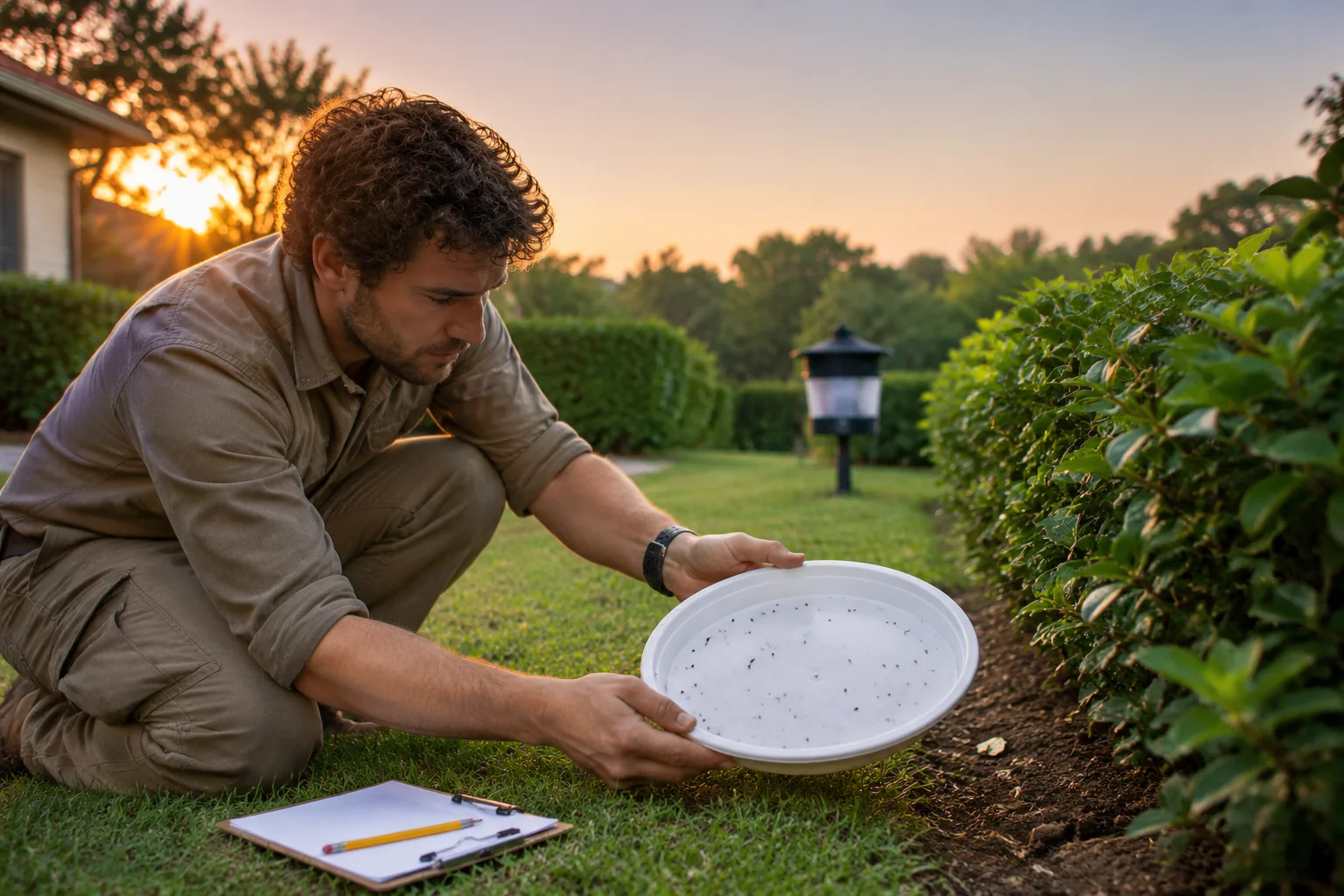
The record is the part people skip, and it is the part that turns a grumble into evidence. A white plate or a pale tray held low for fifteen minutes gives you a count. The line beside it, in plain words: did not sit outside after 7pm. That line is the reason the count matters. Both belong on the sheet.
| Line | Write down | What it protects you from |
|---|---|---|
| Station | One named spot, photographed once, used every time | Comparing the deck in June with the paddock in August and calling it a trend |
| Clock | Minutes after sunset, plus wind and whether it had rained in three days | Reading a calm still evening as the first night of the season |
| Count | Specks on a pale plate after a fixed fifteen minutes, or bites felt on exposed skin | Trusting memory, which compresses a bad week and forgets a mild one |
| Consequence | What you did not do, or what a guest or a customer did not do | Arguing about numbers when the real issue was the use of the place |
Six consecutive entries beat six months of impressions, because six consecutive entries can show whether your worst night was a weather event or a change at home. The mechanics of seeing the insects in the first place are on the detection page, and its warning applies here: one instrument in one spot cannot estimate a population.
What Too Many Means For Four Kinds Of Reader
A threshold is a decision rule, and decisions differ by who is making them. Four versions of too many are useful in practice.
| Reader | Too many means | First action that is worth money | What to stop doing |
|---|---|---|---|
| Household with a garden | You have stopped using one named outdoor area at one named hour | Fix the hour and the geometry: dusk use elsewhere, fan, pale clothing, light management | Buying a device before six logged evenings exist |
| Campground, rental or venue | A guest complaint becomes predictable, or an amenity closes early | Move the activity, not just the insects: shift scheduled use earlier and light discipline at the boundary | promises to a booking that the season will be clear |
| Livestock or yard manager | Animals lose condition, rest or production, or a hypersensitive animal is breaking skin | Find and dry the substrate, then protect at the hour. See the working order for animal premises | Treating the air instead of the ground it came from |
| Importer or distributor | Your market asks for a claim you cannot support | Fix the honest positioning of the product before a regulator or a large buyer fixes it for you | Translating a mosquito specification into a midge promise |
The venue row deserves one more sentence, because it is where the published research transfers most cleanly. The Maryland survey found people responding to nuisance by avoiding outdoor exercise and recreation. A venue that has measured that pattern is describing the same phenomenon the researchers measured, and can act on it with scheduling and site changes before it spends anything on hardware.
When The Count Goes Up And Nothing Is Wrong
A rising number is not automatically news about your property. Biting midge populations swing hard between years and hard within a season, and the published work says so in ordinary language.
The south-east England emergence study that followed 267 trapping events concluded that “This study demonstrates continual and highly variable rates of emergence of Culicoides throughout the year”. Continual and variable. Not a tidy wave you can forecast from one trap, and not a signal that anything changed on the ground.
Rainfall adds a delay that makes the same mistake in reverse. The Belem work found that “Seasonal population densities correlated with the pattern of rainfall, with a 2-month lag”. A wet week shows up in your count weeks later, which is exactly why a bad week feels inexplicable.
Then there is the substrate underneath. One of the starkest published examples is a shallow marsh pool in Denmark that received sewage discharge, after which the record states “A consequence of sewage discharge into a shallow marsh pool was large-scale hatching of the biting midge Culicoides nubeculosus from the recipient and mass attacks by this blood-sucking insect on grazing cattle”. The cattle did not change. The ground behind them did.
For the seasonal and weather explanations that belong to your region rather than to Brazil or Israel, this site keeps the hour-by-hour gates on the flight-conditions page, the multi-year shape on the season-calendar page, and the source-substrate conditions on the habitat page.
When The Count Is Low And You Are Still Being Bitten
The reverse error is more common in houses than in fields. A low plate count with persistent bites usually means the sampler is sampling somewhere else.
Three explanations cover most cases. The first is a micro-source inside the boundary, small enough that regional sampling never touches it; the diagnostic sequence is on the exposure-diagnosis page. The second is that the animals are arriving from a neighbouring source you cannot drain, in which case the honest lever is personal protection and scheduling rather than habitat work. The third is that the bites are not midges at all, and the wound evidence is read on the bite-differential page and the reaction page.
A fourth explanation deserves naming because it distorts supplier claims. Sampling gear disagrees. A light trap on a neighbour’s fence line and a white plate on your deck are different instruments measuring different fractions of the same evening, and neither is wrong.
No See Ums And The Arithmetic Of A Device
Once you hold a count sheet, the question you ask about equipment changes. It stops being whether the number will fall, and becomes what the device changes in the numbers you keep.
For the outdoor CO2 suction traps this site makes, the honest answer has three parts. The device is built for mosquitoes in open ground, with a stated effective range of 4,000 m2 and no indoor or small-area application. Its role in a midge situation is measurement, because a device running the same night after night in one place is the cheapest fixed-station sampler available to a property. And any relief it gives on biting midges is incidental rather than designed, a point stated on the effectiveness page and repeated on the risk page.
Placement still changes the arithmetic, and the site covers it in detail at trap placement in a yard. A device standing between a breeding edge and the space people use intercepts; the same device standing in the middle of the seating area competes with the people it is supposed to protect.
| Job | What actually does it | What the number looks like |
|---|---|---|
| Know how bad it is | Your own fixed station, fixed window, six consecutive entries | Specks per fifteen minutes at a named hour |
| Reduce bites tonight | Hour, geometry, airflow, fitted mesh, personal protection | Bites felt on exposed skin, logged the same night |
| Reduce next season | Find and dry the producing substrate inside your control | The same plate count, next season, same station |
Anything sold against the third row on the strength of the second row is being sold badly. If a supplier cannot tell you which row they are addressing, the questions below are worth asking in writing.
What To Ask An Agency Or A Supplier
Two audiences, one discipline: ask for the unit, the instrument and the baseline.
| Ask | Why it works | A good answer contains |
|---|---|---|
| What unit is that number in? | Most inflated claims quietly switch from per-night to per-season | Trap-nights, dates, sites |
| What caught them? | Light traps, emergence cages and human bait sample different fractions | The model or method, not just “trapping” |
| What was the baseline? | A reduction without a before is a story | Same station, same hour, prior period |
| Which species, and where does it breed? | This is what the Maryland survey found residents could not answer | A habitat, not just a name |
| Whose ground is it? | Source work is worthless if the source is next door | A jurisdiction, or an honest admission |
| What will you not claim? | The fastest read on a vendor’s judgement | A stated limit, unprompted |
Agencies are worth approaching even though their capacity is thin. The published assessment of US local programmes is blunt: “Local health department (LHD) vector control programs have experienced reductions in funding and capacity”. A written log with dates, a station name and a consequence is what makes a small team able to act on your case at all.
The Sixty-Second Version
There is no official number at which no see ums become too many, and the published threshold that exists was written for non-biting midges and anchored to complaints. Counts always carry their instrument and their clock, so two people’s numbers are rarely comparable. Programmes historically start from recorded annoyance and lost use, not from an insect density.
What you can do today is fix one station, one window after sunset and one pale plate, log six consecutive evenings, and write next to each number what you did not get to do. Then decide by what you are protecting: tonight’s dinner outside, or next season’s ground.
Frequently Asked Questions
Is there a number of bites per hour that is considered normal?
No published figure applies to a residential property. The reason is structural rather than an accident of research: nobody has agreed on the sampling method that such a number would have to be measured with, and the Florida work quoted above states that guidance for integrating midges into operations is missing.
Should I count insects or bites?
Count both, on the same sheet, in the same fifteen minutes. Insect counts compare sites to each other. Bite counts compare your evenings to each other, and they are the quantity that matches how nuisance is actually recorded in the literature.
Does a high count in one week mean I have a breeding problem?
Not on its own. Published emergence data show continual and highly variable output through a season, and rainfall effects arrive with a lag of weeks. A breeding problem shows up as a pattern across consecutive evenings at the same station, with a plausible wet substrate nearby.
My neighbour has far worse numbers than I do. Same species, surely?
Possibly not. Regional species mix changes what breeds where and when, and the difference is not resolvable from a count alone. The family-level differences are set out on the gnat comparison and the non-biting midge page.
Will spraying a resting area lower my count?
Expect a temporary effect at best, and the reasons are covered on the spraying page. The count sheet is still the right instrument, because it will show you within a week whether anything changed.
Sources
- E W Gray, P H Adler, R Noblet (1996). Economic impact of black flies (Diptera:Simuliidae) in South Carolina and development of a localized suppression program. Journal of the American Mosquito Control Association, 12(4), pp. 676-678. Metadata from the Europe PMC core record (journalInfo), MEDLINE.
- Mickael Cargnel, Yves Van der Stede, Andy Haegeman, Ilse De Leeuw, Kris De Clercq, Estelle Meroc, Sarah Welby (2018). Effectiveness and cost-benefit study to encourage herd owners in a cost sharing vaccination programme against bluetongue serotype-8 in Belgium. Transboundary and Emerging Diseases, 66(1), pp. 400-411. doi:10.1111/tbed.13034
- Yaniv Lavon, Ephraim Ezra, Orly Friedgut, Adi Behar (2023). Economic Aspects of Bovine Ephemeral Fever (BEF) Outbreaks in Dairy Cattle Herds. Veterinary Sciences, 10(11), pp. 645. doi:10.3390/vetsci10110645
- Evan Sequeira (2025). Dermoscopic Documentation of a No-see-um Bite. Cutis, 116(4). doi:10.12788/cutis.1275
- Jessica Eleanor Stokes, Simon Carpenter, Christopher Sanders, Simon Gubbins (2022). Emergence dynamics of adult Culicoides biting midges at two farms in south-east England. Parasites & Vectors, 15(1), pp. 251. doi:10.1186/s13071-022-05370-z
- Aaron M. Lloyd, Daniel L. Kline, Karen E. McKenzie, Daniel A. Hahn (2026). Can Trapping Abundance Data Be Used to Identify Persistent Target Areas for Culicoides Biting Midge Control Efforts?. Insects, 17(6), pp. 653. doi:10.3390/insects17060653
- A L Hoch, D R Roberts, F P Pinheiro (1990). Host-seeking behavior and seasonal abundance of Culicoides paraensis (Diptera: Ceratopogonidae) in Brazil. Journal of the American Mosquito Control Association, 6(1), pp. 110-114. Metadata from the Europe PMC core record (journalInfo), MEDLINE.
- Sigurbjorg Torsteinsdottir, Stephan Scheidegger, Silvia Baselgia, Sigridur Jonsdottir, Vilhjalmur Svansson, Sigridur Bjornsdottir, Eliane Marti (2018). A prospective study on insect bite hypersensitivity in horses exported from Iceland into Switzerland. Acta Veterinaria Scandinavica, 60(1), pp. 69. doi:10.1186/s13028-018-0425-1
- Abbey Cox, Allison J. Stewart (2023). Insect Bite Hypersensitivity in Horses: Causes, Diagnosis, Scoring and New Therapies. Animals, 13(15), pp. 2514. doi:10.3390/ani13152514
- Juwela Lam, Anna Eckert, Tanya Rhiner, Nina Waldern, Elio Schwarz, Katharina Birkmann, Daniel Widmer, Macsmeila Dietrich, Thomas M Kundig, Antonia Fettelschoss-Gabriel (2026). Validation of an improved insect bite hypersensitivity severity score for allergic equine insect bite hypersensitivity in horses. Journal of Veterinary Internal Medicine, 40(4), pp. aalag132. doi:10.1093/jvimsj/aalag132
- Blythe E. Lawson, Emily G. McDermott (2023). Topical, contact, and oral susceptibility of adult Culicoides biting midges (Diptera: Ceratopogonidae) to fluralaner. Parasites & Vectors, 16(1), pp. 281. doi:10.1186/s13071-023-05899-7
- Heung Chul Kim, Glenn A. Bellis, Myung-Soon Kim, Sung-Tae Chong, Dong-Kyu Lee, Jee-Yong Park, Jung-Yong Yeh, Terry A. Klein (2012). Seasonal abundance of biting midges, Culicoides spp. (Diptera: Ceratopogonidae), collected at cowsheds in the southern part of the Republic of Korea. The Korean Journal of Parasitology, 50(2), pp. 127-131. doi:10.3347/kjp.2012.50.2.127
- Justin Gerding, Micaela Kirshy, John W. Moran, Ron Bialek, Vanessa Lamers, John Sarisky (2016). A Performance Management Initiative for Local Health Department Vector Control Programs. Environmental Health Insights, 10, pp. EHI.S39805. doi:10.4137/ehi.s39805
- B O Nielsen, O Christensen (1975). A mass attack by the biting midge culicoides nubeculosus (Mg.) (Dipteria, Ceratopogonidae) on grazing cattle in Denmark. A new aspect of sewage discharge. Nordisk veterinaermedicin, 27(7-8), pp. 365-372. Metadata from the Europe PMC core record (journalInfo), MEDLINE.
- Rebecca C Wilson-Ounekeo, William O Lamp (2020). Perceptions and Responses of Residents to the Nuisance Black Fly Simulium jenningsi (Diptera: Simuliidae) in the Mid-Atlantic United States. Journal of Medical Entomology, 57(6), pp. 1872-1881. doi:10.1093/jme/tjaa129
- Biniam T. Lakew, Adrian H. Nicholas, Stephen W. Walkden-Brown (2021). Spatial and temporal distribution of Culicoides species in the New England region of New South Wales, Australia between 1990 and 2018. PLOS ONE, 16(4), pp. e0249468. doi:10.1371/journal.pone.0249468
- Ana Vasic, Nemanja Zdravkovic, Dragos Anita, Jovan Bojkovski, Mihai Marinov, Alexander Mathis, Marius Niculaua, Elena Luanda Oslobanu, Ivan Pavlovic, Dusan Petric, Valentin Pfluger, Dubravka Pudar, Gheorghe Savuta, Predrag Simeunovic, Eva Veronesi, Cornelia Silaghi (2019). Species diversity, host preference and arbovirus detection of Culicoides (Diptera: Ceratopogonidae) in south-eastern Serbia. Parasites & Vectors, 12(1), pp. 61. doi:10.1186/s13071-019-3292-3
- R. Meiswinkel, M. Baylis, K. Labuschagne (2000). Stabling and the protection of horses from Culicoides bolitinos (Diptera: Ceratopogonidae), a recently identified vector of African horse sickness. Bulletin of Entomological Research, 90(6), pp. 509-515. doi:10.1017/s0007485300000626
- Jorian Prudhomme, Clara Bardet, Ignace Rakotoarivony, Claire Garros, Emilie Bouhsira, Emmanuel Lienard (2025). Local investigation into the role of Culicoides species diversity (Diptera: Ceratopogonidae) in recurrent horse dermatitis cases in southwest France. Parasites & Vectors, 18(1), pp. 86. doi:10.1186/s13071-025-06694-2
- M Broza, M Halpern, L Gahanma, M Inbar (2003). Nuisance chironomids in waste water stabilization ponds: monitoring and action threshold assessment based on public complaints. Journal of vector ecology : journal of the Society for Vector Ecology, 28(1), pp. 31-36. Metadata from the Europe PMC core record (journalInfo), MEDLINE.