
Nobody types no-see-ums when they are standing on a deck at ten at night. They type no see them bugs, because that is the situation. Bites on the forearms, a screen door that never opened, an evening ended early, and not one insect you can find with the naked eye. The phrase is not a mistake. It is a measurement, and it is the first honest datum in the whole investigation.
Most pages that answer a search for no-see-them bugs hand back a bulb, and the bulb is the weakest of the levers available. Swap to a yellow “bug light”, they say, and the cloud will disperse. This page does something less satisfying and more useful. It collects what has actually been published about how biting midges respond to light, separates the measurements from the folklore, and then ranks the three lighting decisions a household or a venue can genuinely make.
Colour is one of the three. It is not the strongest one, and on the published evidence it is not even the second strongest.
Three numbers carry most of the argument. A light trap baited with carbon dioxide and an ultraviolet black light caught more biting midges than the same trap with an incandescent bulb or an ultraviolet LED, in Alabama (Zhang and Mathias, 2022). A shielded, downward-directed street luminaire attracted 42.6% as many insects as the conventional lamp it replaced, in a German village (Reinhard and colleagues, 2026). And larvae of the tiger mosquito raised under five light intensities, in two lamp types, showed no meaningful difference in development or survival (Johnson and colleagues, 2026).
Read together, those results sort the advice into what works, what depends on the species, and what is simply not true.
Where a claim below is ours rather than a published one, it is labelled. Where researchers disagree, the disagreement stays on the page. And where the literature is silent – which happens more often than any supplier’s brochure suggests – the silence is written down instead of filled with a guess.
Three Lighting Decisions, Ranked by Evidence
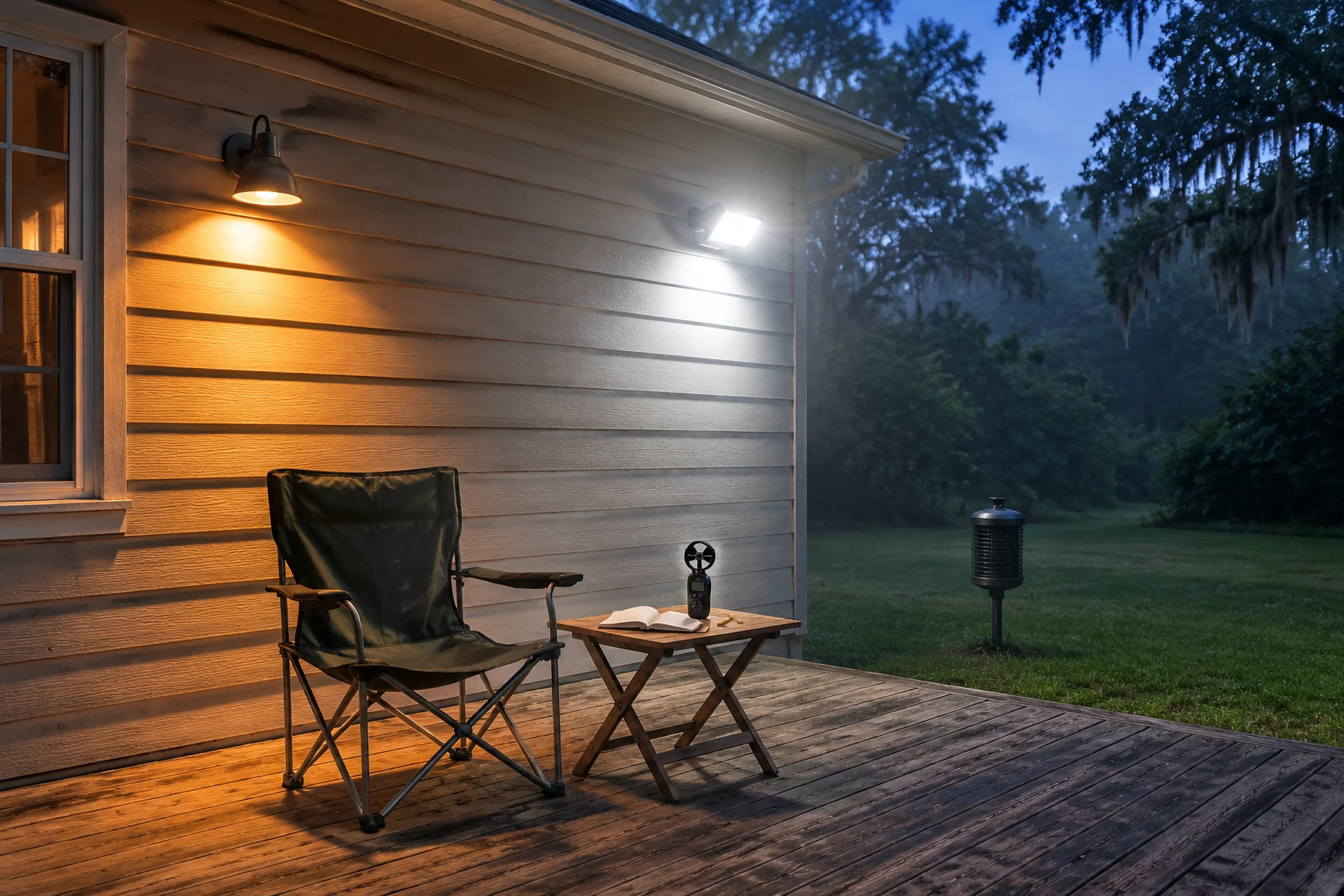
A property owner facing no-see-them bugs at dusk has exactly three levers on the lighting side, and they are not equally supported. The first is geometry: where the fixture points, whether the lamp itself is visible, and whether the light lands on the boards or into the air and the neighbours’ eyes. The second is duration: which hours the light is on, and whether it is on at all during the window when the animals are already committed to moving. The third is spectrum: what colour the light is.
The ranking below is not an opinion about no-see-them bugs generally. It follows from how many independent published tests exist for each lever, how large the measured effects were, and how directly the outcome measured was exposure to people rather than catch in a device.
| Decision | What you change | Published effect size | What was actually measured | Verdict |
|---|---|---|---|---|
| Geometry | Shielding, aim, cutoff, fixture height, distance from the seating area | Shielded, downward-directed luminaires attracted 42.6% as many insects as the lamps they replaced | Insects arriving at the lamp itself, at a road, in a village, over one season | Strongest. Copy it. |
| Duration | Which hours the light burns, and whether it burns during the crepuscular window | Not tested against human exposure in any study retrieved for this page | Attraction patterns changed shape across five night intervals, but mitigation stayed weak at twilight and late night | Plausible, cheap, unproven. Do it because it costs nothing. |
| Spectrum | Bulb colour: cool white, warm white, amber, green, ultraviolet | Direction reversed between species, and between traps of the same design | Catch in an entomological trap, almost always baited with carbon dioxide as well as light | Weakest for a homeowner. Decisive for a trap designer. |
Two consequences follow immediately, and both are unfashionable. If you are trying to reduce bites, spend your effort on where the light goes before you spend it on what colour the light is. If you are trying to build or buy a trapping device, spectrum is the single most consequential specification on the datasheet, because the device wants to win the argument rather than avoid it.
The rest of the article takes each lever in the order the evidence supports. Two things have to be settled first, before any lighting number can be read. One is what a midge eye can see. The other is how much of this literature was produced by an instrument with a known blind spot.
What a No-See-Them Bug Eye Is Built To See
A no-see-them bug is a biting midge in the family Ceratopogonidae, most often a species of the genus Culicoides. At 1 to 2 millimetres it is a small insect with small optics, and the compound eye it carries is built on the same plan as the eye of a fruit fly. Understanding that plan is what separates a bulb recommendation from a superstition.
In the model system, Drosophila, the outer photoreceptor cells carry a broad-band pigment and are treated as colour-blind. The deeper cells carry pigments tuned to the ultraviolet, to blue, or to green. That ultraviolet, blue and green sensitivity is deeply conserved across insects. In the blood-feeding flies that matter here, the measured sensitivity curves share a shape. Mosquitoes, biting midges, blackflies, sand flies, stable flies and horn flies all show two peaks. One sits in the ultraviolet, one in the blue-green, and response falls away sharply at longer wavelengths.
That single sentence explains most of what follows for no-see-them bugs. A lamp whose energy sits in the blue-green and ultraviolet bands, where no-see-them bugs are tuned is stimulating the two receptor classes these animals have. A lamp whose energy sits in orange and red is stimulating the receptor classes they mostly lack. This is why long wavelengths are usually, though not always, less attractive to biting flies, and why a lamp that looks identical to you can be an entirely different object to a midge.
The honest caveat is larger than the encouragement. The review that assembled this picture, published by Wilson and Wakefield in Parasites and Vectors in 2021, put plainly that colour vision has not been conclusively shown in the Culicidae, Ceratopogonidae or Phlebotominae, and that, in the words of that review, “no sensitivity data have been collected for the Ceratopogonidae”. Sensitivity has been measured in mosquitoes, sand flies, tsetse, horse flies, stable flies and horn flies. In the family that contains the animal biting your arm, the physiology is inferred from relatives.
So when a supplier tells you that a particular colour is invisible to no-see-them bugs, they are describing an extrapolation, not a measurement. Everything below has to be read with that gap open.
Why Data on No-See-Them Bugs at Night Arrives Filtered
There is a further problem, and we raised part of it before in our guide to no-see-ums in the house. Almost every number anyone can quote about what midges do after dark was produced by a light trap, and a light trap is not a camera. It is an instrument with a duty cycle, and its duty cycle does not match the animal’s.
The clearest demonstration is a study by Meiswinkel and Elbers in Medical and Veterinary Entomology in 2016, run in the Netherlands against cattle at pasture. Aerial sweeping – a net worked through the air around the animals – showed midges active across the whole day, with abundance peaking in the crepuscular period and falling during the brightest hours. The light trap beside it could only accumulate midges once darkness was real. In the authors’ words, the light trap “was able to accumulate Culicoides only at night”.
The consequence is a systematic distortion, not random noise. Two species feeding on the same cattle at the same time, one largely active by day and one largely active by night, will not be represented equally in the trap record. Meiswinkel and Elbers showed exactly that: Culicoides chiopterus and the Culicoides obsoletus complex were similarly abundant around the livestock, yet only the nocturnal one dominated the light-trap catch. The routine conclusion drawn from trap data – that the obsoletus complex is the common midge – was partly a statement about the lamp.
That is why the 0 lux limit lives in that earlier article as a caution rather than a discovery, and why it is repeated here only to draw a different moral. When a claim about biting midges and light reaches you, ask first whether the instrument could have seen the animals at all during the hours the claim is about. In temperate latitudes, where summer twilight drags on, whole periods of midge activity are invisible to the standard tool. The authors put the mechanism in a phrase worth quoting because it is the sentence that should sit in front of any lamp claim: “Inability to accumulate Culicoides at light intensity levels above 0 lux” makes the trap useless precisely when the sky is still bright, and they noted that this degrades surveillance progressively beyond 45 degrees north.
Read the wavelength experiments below with that filter in mind. They compare traps with traps, not no-see-them bugs with no-see-them bugs. Very few compare bites with bites, and none that we could locate compares a human being sitting in one chair under one lamp against the same person in the same chair under another.
The Wavelength Experiments, Read One at a Time
Five published experiments bear directly on the question a homeowner is asking. They were run on three continents, in habitats from a Spanish farm meadow to an Alabama deer facility to a Brazilian savanna, and they used different traps, different baits and different lamp technologies. Their conclusions do not agree, which is itself the most useful fact in this section.
Australia, Culicoides brevitarsis. Bishop and colleagues published an LED comparison for Australian biting midges in the Australian Journal of Entomology in 2004. Wilson and Wakefield summarised the result that matters here: for C. brevitarsis, “catches were higher for the green (520 nm) wavelength than for broad-spectrum incandescent light even when the green light was half the intensity of the incandescent”. Intensity was deliberately varied, which makes this one of the few midge studies where colour and brightness were separated.
North America, Culicoides sonorensis. The same review records that “Catches of Culicoides sonorensis were higher under UV (395 nm) light than under blue (460 nm) light, despite the latter being twice as intense”. C. sonorensis is the only species confirmed as a vector of epizootic haemorrhagic disease virus and bluetongue virus in the United States, so this is not an obscure corner of the literature. Read against the Australian result, the pattern is uncomfortable: one midge preferred green, another preferred ultraviolet, and in neither case did brightness explain the choice.
Spain, twenty-three species in one meadow. Gonzalez and colleagues ran CDC suction traps fitted with five different LEDs – white, green, red, blue, ultraviolet – for fifteen consecutive nights in a farm meadow in northern Spain. The work appeared in Veterinary Parasitology in 2016. They caught 9,449 biting midges across 23 species, along with 5,495 non-biting ceratopogonids, 602 mosquitoes and 12,428 other dipterans. In their words, “Significantly more Culicoides were collected in those traps fitted with green, blue or ultraviolet (UV) lights than in red and white-baited LED traps”. In a second trial the same team compared tube lamps against LEDs and an ordinary household bulb, and reported that “More specimens of all taxa were collected with fluorescent black light (UV) traps than with the other light sources”. The exception was the mosquitoes themselves, which came in better under the white fluorescent tube.
Alabama, three wavelengths and three habitats. Zhang and Mathias published in the Journal of Medical Entomology in 2022. They baited CDC traps with carbon dioxide, ran three distinct wavelengths at a deer research facility, and rotated the traps among a pine forest, a hardwood riparian zone and a lightly wooded strip beside a seasonal pond. Their conclusion was specific: “Ultraviolet (UV) black-light (350 nm-360 nm) attracted more midges than incandescent light or UV LED light (385 nm-395 nm)”. Note the internal contrast: a black light and an “ultraviolet” LED, both marketed as the same thing, did not perform the same way at all.
Trinidad, three trap designs. A third comparison, on a dairy goat farm in Trinidad, set a CDC ultraviolet trap against two variants of itself. One carried an ordinary bulb. The other carried no bulb at all, only a chemical lure plus carbon dioxide. That experiment is worked through in full on our page about whether you can see no-see-bugs, including what it says about why two neighbours with different lamps can disagree honestly about how bad the season is, and it is not reprinted here. What matters for this article is the direction: in that comparison a lamp was not the deciding component of the device.
| Study and place | Species focus | Lamps compared | Winning light | What the design can support |
|---|---|---|---|---|
| Bishop et al., Australia, 2004 | Culicoides brevitarsis | Green LED 520 nm, varied intensity, vs broad-spectrum incandescent | Green, even at half the intensity | A midge that prefers one narrow band regardless of brightness |
| Summarised in Wilson and Wakefield, 2021 | Culicoides sonorensis | UV 395 nm vs blue 460 nm at twice the intensity | Ultraviolet | A second midge that prefers a different band, also regardless of brightness |
| Gonzalez et al., Spain, 2016 | 23 Culicoides species, plus mosquitoes and other Diptera | Five LED colours; then tubes vs LED vs incandescent | Green, blue or UV over red and white; black light over all in trial two, except mosquitoes | Community-level ranking, with the explicit message that mosquitoes rank differently |
| Zhang and Mathias, USA, 2022 | Southeastern US species, deer facility | UV black light 350-360 nm, UV LED 385-395 nm, incandescent | Black light | Two lamps sold as “UV” are not interchangeable |
| Saikia et al., India, 2026 | Mixed field insects at a mango research centre | Six coloured solar LED bulbs, three heights, three time blocks | White, at 150 cm, at 26 °C | A coloured trap can be tuned, and the optimum is a combination, not a colour |
Two of these experiments on no-see-them bugs found green best, two found ultraviolet best, one found white best, and one found that the lamp mattered less than the odour. Nothing here supports a universal rule of the form midges hate yellow or midges love blue. What is supported is a narrower statement, and Wilson and Wakefield made it explicitly: “Culicoides species can potentially be divided into two groups in terms of light preference, namely green-attracted and UV-attracted”.
That is the finding worth carrying forward. The animal in your yard belongs to one of those groups, or to neither. Which one depends on the species composition at your site, and no county-level list in North America records whether the local fauna is green-attracted or ultraviolet-attracted. Our page on how big a no-see-um actually is covers the same uncomfortable gap from the identification side: the tools everyone recommends assume you can sort the animal to species, and you cannot.
The Brightness Confound: Why the Studies Point Different Ways
Before concluding that the literature on no-see-them bugs is simply a mess, look at how the lamps were specified. Almost every study in the table above describes its treatments by colour. Colour, as sold, is a human perceptual category, and the way LED lamps are rated makes the categories leak.
Wilson and Wakefield set out the mechanism with unusual bluntness for a review article. LED brightness is standardised against the human eye, which means a lamp sold as bright in lumens is bright to us, not to a midge whose visual pigments peak in the ultraviolet and the blue-green. Their sentence is the one to remember when a datasheet claims equivalence: “Two lights that appear equally bright to humans may be noticeably different to other animals.”
The specific casualty is the green result. The reviewers point out that when green and blue LEDs are compared, the green lamp almost always has the higher luminous intensity, because of how the human luminosity function weights 520 nanometres against 460. Larger green-LED catches may therefore be a brightness artefact rather than a colour preference. That does not refute the green result.
It removes the certainty, and it is exactly the kind of confound that separates a trap specification from a bulb recommendation.
Brightness also changes the ranking of no-see-them bug lamps, not just the magnitude. In one study a blue LED at 470 nanometres beat a green LED at 520 nanometres for Anopheles at equal luminous intensity. Brightening the green lamp then moved mosquito catches more than brightening the blue. The same reversal appears in sand flies, where blue beat green until the green lamp was brightened. At low intensity, sand flies preferred blue-green over ultraviolet; at higher intensity they preferred ultraviolet.
The reviewers attribute the interaction to the differing sensitivities of the separate photoreceptor classes.
One more asymmetry belongs in any decision about a lamp for no-see-them bugs. Traps with more powerful lamps generally catch more of these animals, and increasing the intensity of a given wavelength generally increases how attractive that lamp is. But two studies in the review suggest an upper limit beyond which catches either flatten or start to fall – and the reviewers say plainly “although such a threshold requires corroboration”. There is no published curve you can use to pick a dim enough to be ignored setting for a domestic lamp.
| Claim about a bulb or lamp | The field that must be filled in | What missing data does to the claim |
|---|---|---|
| Attracts fewer insects | Which species, at which site, against which control lamp | Rankings reversed between mosquitoes and midges in the same Spanish trial |
| Invisible to biting midges | Peak sensitivity of that species’ photoreceptors | No electrophysiological data exist for Ceratopogonidae at all |
| Matches a standard bug light | Luminous intensity at the midge’s spectral peaks, not lumens | Human-standardised ratings cannot settle a comparison between colours |
| Dim enough to avoid detection | Where the response curve flattens for that taxon and wavelength | Two studies hint at a ceiling; neither is corroborated |
| Tested in field conditions | Whether the outcome was trap catch or human landing or bites | Virtually every published outcome in this literature is trap catch |
This is also why the site’s own earlier answer, in what attracts no-see-ums, refused to rank light colour against carbon dioxide or distance. Four fields have to match before two attractant studies can be compared: species, dose, control, distance. Colour claims almost never supply three of them.
Yellow Bug Lights, Warm LEDs and No-See-Them Bugs
Now the question most people actually came here to ask. Does the amber bulb from the hardware store reduce the number of no-see-them bugs at your chair?
Start with what is against it. Yellow, in the 570 to 590 nanometre band that “bug lights” occupy, sits in an awkward place in the insect visual world: the review’s verdict is that “Yellow wavelengths (570-590 nm) can be either attractive or unattractive”. Green at 520 nanometres was the top performer in two of the studies above, and a lamp that reads as yellow-green to you can sit close to that peak. Meanwhile, the Australian work on C. brevitarsis is a warning against the whole product category. A midge in that study preferred a narrow green band over a broad warm spectrum even when it was outbid on brightness.
Start with what is for it. “Longer wavelengths are usually less attractive to biting flies”, and no-see-them bugs included, and the Spanish trial did place red and white behind green, blue and ultraviolet for the most abundant midge species. Warm lamps also drop the ultraviolet content that black lights are built around, and they usually arrive in fully shielded fixtures rather than the exposed-bulb barn lamps that make a patio into a lighthouse. If you replace an unshielded cool floodlight with a shielded warm one, you have changed several things at once, and at least one of them has strong published support.
That is the honest formulation for no-see-them bugs. A warm, shielded, downward-directed fixture is a defensible change, and part of its benefit is documented. Attributing that benefit to the warmth is not supported, and no study retrieved for this article measured bites on a person under two bulb colours at a residence. Where the midge literature was consulted for a claim about amber light and human exposure, it came back empty.
Anyone selling you a no-see-um bulb is selling a trap finding at a household price.
One further asymmetry about no-see-them bugs is worth knowing if you keep a porch light on for the household rather than for the lawn. The trap studies that motivate the ultraviolet recommendation are trying to concentrate insects in one place and then kill them; a domestic fixture is doing neither. An unbaited lamp with no fan, no net and no carbon dioxide is a weak collector even when the midges can see it perfectly well, and the animals that arrive and find no breath generally leave. Our piece on why gnats swarm covers the related point that an insect holding position in an air column is not the same animal as one seeking a host.
Geometry Beats Colour: The Road-Light Test
The strongest field result in this whole area has nothing to do with biting midges and everything to do with how a lamp is built. It also happens to be the cheapest finding for a property owner to copy.
In the village of Neuglobsow in Brandenburg, Germany, a team led by Reinhard and Dietenberger ran a controlled comparison of two roadside lighting systems. School students collected much of the data as citizen scientists, and the work appeared in Communications Biology in 2026. On one side were conventional cylindrical high-pressure sodium road lamps, mounted on top, glowing in all directions at 2000 kelvin. On the other were LED luminaires at the same nominal brightness and 2200 kelvin. Their optics pushed light down onto the road, and their shielding hid the bright source from the side.
The tailored and shielded fixtures “attracted only 42.6% as many insects as conventional HPS” lamps. That is the sentence the whole section turns on. Not a 10% improvement. Slightly less than half.
And the effect was broad: no insect order in the study was more strongly attracted to the tailored and shielded lamps than to the conventional ones, with two orders recorded at negligible counts excepted. The two lamp colours were within 200 kelvin of each other, and the brightness readings were effectively identical, so this was not a colour result. It was a result about where the photons went and what a flying insect could see of the lamp itself. The authors’ own framing is that shielding and tailoring “seems to outperform spectral tuning and dimming on many occasions”.
The same paper reports a second finding, from work by Seymoure and colleagues published in Biological Conservation in 2026, that refines it further. Testing different levels of shielding in a dark desert environment, that team “found that glare, more than uplight, attracted flying insects”. Uplight is the light pollution people complain about and photograph. Glare is the visible bright source that meets an animal’s eye. For a patio, the mapping is direct: an exposed bulb at eye level is the glare case, and it is the one the data singles out.
There is a limit to that transfer to no-see-them bugs, and it is worth stating. The German study measured insects arriving at lamps on a lakeside road, not midges arriving at a human being on a deck. It also found that the mitigation was weakest during twilight and in the late-night interval, which is precisely the crepuscular window that matters for biting midges. And the authors note that a full conversion to shielded, tailored luminaires is an infrastructure purchase, not a bulb swap.
What transfers is the principle and the direction of the effect, not the size of it.
Even so, this is the recommendation we defend hardest. It is the only one with a large, controlled, published effect behind it. And its mechanism – show less bright source, spill less light outside the target area – does not care which species happens to be in your county. The same logic governs a much older question on this site, whether a CO2 trap and a UV killer are two versions of one tool. They are not, and the difference is geometry and bait, not wavelength alone.
Height and Duration: The Two Settings Nobody Adjusts
Two further variables in a no-see-them bug evening are set once during installation and never revisited: how high the light is, and how long it burns.
Height. The Indian solar-trap study cited in the table above, by Saikia and colleagues in Pest Management Science in 2026, tested six coloured LED bulbs at three heights and three time blocks, and found that “the highest insect catch occurred at a temperature of 26 °C using a white solar LED light fixed at a height of 150 cm”. Read as a design experiment rather than a recipe, it says that height was one of three variables the model selected as significant, and that colour alone never determined the outcome. Read as a warning to households, it aligns with the glare result: 150 centimetres is about standing head height, which is where the glare case is worst and where a lamp is most visible from distance.
The vertical dimension of midge activity has been measured properly in Florida. Cooper and colleagues compared hourly light-trap catches near the ground against catches in the canopy, and published the result in the Journal of Medical Entomology in 2026. Those numbers, and what they mean for where you sit, are worked through in our Florida guide to no-see-bugs in Florida and in the multi-storey reading in no-see-ums in the house, and we will not restate them here. The point relevant to lighting is narrower: the trap height is a research variable with documented consequences for what you catch, and almost every domestic outdoor lamp in North America is installed at the height that the Indian trap optimisation selected for maximum catch.
Duration. If a lamp is on before no-see-them bugs are active and off after they have committed, it is functioning mostly as a nuisance light. The German data are the only temporal evidence we could locate, and they are ambiguous: attraction to both lamp types rose and fell through the night in the same shape, so the shielded fixture reduced how many insects came without changing when they came. That cuts against the popular advice to run an amber porch light on a timer, but it also means a timer costs you nothing in effectiveness while removing the hours when nobody is outside.
Practically, the two settings most households can change tonight are not the bulb. Move the light off the seating area and off head height. Point it down and shield the source. Put a switch or a timer on it so that it covers the hours the household uses the ground, not the hours nobody does.
Our guide to where to place a CO2 trap in a yard argues the same case for the device: position is a bigger lever than hardware, and the same yard layout that creates a glare problem usually creates a placement problem in the same corner.
Does Outdoor Lighting Make More No-See-Them Bugs?
There is a second, quieter fear behind the bulb question: that leaving a light on all summer is farming no-see-them bugs. It deserves a direct answer, because the answer is reassuring in one direction and uncomfortable in the other.
The reassuring half is about production. No-see-them bugs are not attracted to a lamp in order to breed there. Their immature stages live in wet organic substrate – mud at a marsh edge, saturated soil, manure-affected ground, tree holes, irrigation seeps – and the adult female’s host-seeking flight is a search for a blood meal, not for a habitat. A garden light does not create a source, and nothing we retrieved for this article shows it doing so.
On the mosquito side, the question has now been tested directly: Johnson and colleagues exposed tiger mosquito larvae to five intensities of artificial light at night, under both high-pressure sodium and LED lamps, against an unlit control, and published the result in the Journal of Experimental Biology in 2026. They found “no significant differences in average time to pupation or emergence across the different combinations of light type and intensity or control groups”, and “Mortality was consistently low across all groups”. Light at 10 to 200 lux did not sterilise the next generation, and it did not raise it.
The uncomfortable half is that the reverse fear about no-see-them bugs is better founded. Whether a fixed lamp concentrates host-seeking insects around the house, or merely reveals where they were already passing, is genuinely unresolved. Wilson and Wakefield raise the equivalent question for mosquitoes and disease outbreaks in heavily lit regions, and say in terms that “determining whether these outbreaks are caused by artificial lights attracting mosquitoes to human settlements requires further study”. That is the honest position for biting midges too. A lamp is a plausible concentrator, an unproven attractant, and a demonstrated source of one measurement artefact after another.
One number circulating in the light-pollution debate should be quarantined here. The widely repeated finding of more than 75 percent decline in total flying insect biomass over 27 years, from Hallmann and colleagues in PLOS ONE in 2017, was measured in protected areas and is a statement about biomass, not about porch lights. It does not mean that your exterior lamp is removing midges from your property, and it should not be quoted at a household decision.
So the practical reading of this section is short. Turning lights off will not collapse a population of no-see-them bugs on your land, and leaving them on will not breed one. What lighting changes is the hour and the location at which flying insects and people occupy the same few cubic metres. That is a smaller claim than the bulb sellers make and a larger one than the population debate can support.
Where a CO2 Trap Belongs in a Lit Yard Full of No-See-Them Bugs
Everything above has been about avoiding no-see-them bugs. This section is about a device that does the opposite on purpose, because the same physics governs both, and because buyers ask us the question in the wrong order.
The Pittar equipment described on this site is an airflow-suction carbon dioxide trap for outdoor use, rated to an effective range of 4,000 square meters, sold on enquiry rather than from a shelf. It mimics the carbon dioxide a host exhales, draws the insects that commit to that plume into a net, and lets them dehydrate. It is a mosquito device. We say in every article that mentions it, including this one, that it is not a control programme for no-see-them bugs, that captures of Ceratopogonidae in it are incidental, and that no claim of midge reduction is made or implied.
Readers who want the case argued properly will find it in biting midges and no-see-ums: a property-scale framework.
Within that honest frame, the trap literature does have something useful to say about light, and it points the opposite way from the household advice. For a device whose job is to catch, lamp choice is consequential and generally favours short wavelengths: the Alabama black light outcaught both incandescent and ultraviolet LED, and the Spanish trial put green, blue and ultraviolet above red and white. But the three-way Trinidad comparison of traps for no-see-them bugs, argued through on our no-see-bugs page, is the one that should sit in front of any buyer, because there the deciding component was the chemical lure rather than the lamp. Bait beat bulb.
Plume and geometry beat colour.
For the owner of one trap standing on a lawn with no-see-them bugs on the air with a porch light burning 15 metres away, three consequences follow. First, do not install the device inside the pool of a bright fixture. The published trap logic is that a light is a competing visual object, and a trap competing with a lamp for the same channel has already lost the position. Second, do not judge the device by what is caught under the lamp, which is where insects concentrate for reasons that have nothing to do with your trap’s performance; our piece on whether you can actually see no-see-bugs works through why a single device’s catch is a poor estimate of anything. Third, ask a supplier the duty-cycle question about no-see-them bugs that the Meiswinkel and Elbers result raises: if attractancy depends partly on a lamp, what happens at nine in the evening in June at 48 degrees north, when the air is full of midges and the sky is not yet dark enough for the lamp to be the brightest thing in the yard?
The same site logic applies indoors, and cheaply. Interior light seen through a screen is one of the few mechanisms that reliably moves small flying insects from the outside of a house to the inside of a window, which is why the evening lighting plan and the screen plan have to be decided together. That is treated in biting midges in the house, and the mesh specifications themselves in no-see-um net and noseeum netting.
A Two-Week No-See-Them Bug Audit You Can Actually Finish
Every recommendation above is testable at a residence in a fortnight, with a notebook and no equipment beyond a thermometer and, ideally, one of the small anemometers that costs less than two bottles of repellent. What follows is the protocol we would run ourselves. It is not a published method and no paper stands behind it; it is the discipline needed to stop a household from believing its own relief.
The single most important rule is to measure the outcome you care about. Insect abundance at the lamp is easy to see and almost worthless. Bites per hour, at one chair, at one hour, is the quantity the household actually wants. Write that column first for no-see-them bugs.
Count landings on a light-coloured shirt laid across your knees for a fixed two minutes, which keeps the arithmetic in a unit you can compare across nights.
The second rule, when you are counting no-see-them bugs, is one lever at a time. Changing the bulb, the fixture position and the timer in the same fortnight produces a story rather than a result. Run one week with the existing arrangement as a baseline, then change exactly one variable, then run the second week with everything else identical: same chair, same facing direction, same start time, same clothing, same people.
The third rule, once no-see-them bugs are on the log sheet, is to record the confounders in the same breath as the outcome, because the variables that dominate this insect are meteorological rather than electrical. Wind speed at seated height is a hard gate for no-see-them bugs. Temperature decides whether flight is happening at all, and the thresholds for Florida evenings are set out in our Florida hour-by-hour guide. A calm, warm, overcast evening with an unshielded floodlight will out-bite a windy, cool, clear evening with a bulb of any colour, and the bulb will be blamed.
| Column | What to write | Why it is there |
|---|---|---|
| Date, start and end time | Same minutes every night | Activity shifts through the night; a drifting window destroys comparability |
| Lamp state | Which fixtures were on, at what height, shielded or not, distance to chair | The variable under test, recorded as geometry before colour |
| Bulb as bought | Colour temperature, stated lumens, wattage | Enough to repeat the setting, not enough to explain it |
| Air temperature | Degrees at seated height | Gates whether flight is occurring at all |
| Wind | Anemometer reading, or leaves / no leaves / dust | The strongest single predictor of an evening you can sit through |
| Landings, two minutes | One number, light shirt across knees | The outcome of interest, in a unit a person can count |
| Bites counted next morning | One number | Landings and bites diverge; itch onset lags by hours |
| Notes | Rain in the last 72 hours, neighbours mowing, tide, dusk brightness | Source and arrival effects you cannot control but can discount |
Expect the result to be ambiguous. Expect at least one night where the log says nothing, because the wind dropped out of the wrong direction at nine. That ambiguity is the honest finding, and it is why this article ranks shielding above spectrum: the shielding effect survived in a field comparison with all of this noise in it, and the bulb effect has never been tested at a chair.
Three Readers, Three Answers About No-See-Them Bugs
The same physics produces different instructions depending on what you are responsible for, and the differences are not cosmetic. A household optimises an evening. A venue optimises a booking season. A contractor optimises a recommendation that has to survive a client’s own count.
The household fighting no-see-them bugs should shield and aim before it re-bulbs, put the light on a switch, move the fixture away from the seating edge, and stop treating the bulb as the intervention. If a change is wanted for comfort rather than evidence, a warm, fully shielded fixture pointing down is a reasonable purchase and no one should be told otherwise. What should be refused is the claim on the box.
The campground, rental or event operator with a no-see-them bug complaint has a different constraint, because exposure is scheduled rather than accidental. The cheap levers are layout and timetable: put the seating and the play area away from the marsh, the tideline, the trough or the damp tree line, which is a source question before it is a light question, as our page on sand gnats and why open sand becomes a bite zone works through. Then run site lighting low, warm and heavily shielded, and put the fixtures on the paths rather than above the guests. Then move activities off the crepuscular hour where the season allows, which is a scheduling decision that costs nothing and is invisible in the arithmetic of the midge.
The pest-control professional is the reader most exposed by this literature, because the client will run the audit above whether or not you hand them one. Light-based devices in a service context are best positioned as measurement or interception, not as control: a device that reliably reduces the number of insects reaching one dark corner of a site is a different product from a device whose catch you can compare between weeks. The commercial arithmetic for larger ground is set out in how to control mosquitoes in a large outdoor area and in the model comparison in M3000 vs MM4200, and neither discussion depends on a bulb claim.
| Reader | Change first | Change second | Do not expect |
|---|---|---|---|
| Homeowner with a deck | Shield, aim down, move fixture off the seating edge | Switch or timer covering occupied hours only | A measurable drop attributable to bulb colour |
| Campground or rental operator | Relocate activities away from the source ground | Low, warm, fully shielded path lighting instead of area floodlighting | A guest who stops noticing a species-specific peak hour |
| Pest-control contractor | Define whether each device measures or intercepts | Offer the client a two-week log with the confounder columns | A client count that stays quiet through a wind shift |
| Importer or distributor | Reject spectrum claims that omit species and intensity | Specify what the lamp does before full dark | A registration that covers biting midges for a lamp |
What a Spectrum Claim About No-See-Them Bugs Has to Contain
For the buyers reading this as a sourcing question, the useful output of this literature is not a recommended colour. It is a specification format. A lamp claim that survives contact with the published work has to carry six fields, and the moment one is missing the claim becomes a description of a bulb rather than of an effect.
For a lamp aimed at no-see-them bugs the fields are species, wavelength, intensity, control, distance and outcome. Species, because the green-versus-ultraviolet split runs through the genus. Wavelength, as a peak or a distribution, not as a colour name or a colour temperature: 2700 kelvin is a description of a lamp for humans and tells a midge nothing in particular. Intensity, in a unit that is meaningful at the wavelengths in question rather than in lumens alone.
Control, meaning the lamp it was compared against in the same trap on the same night. Distance, meaning how far the effect carries, which is a per-device figure and is one of the reasons the site treats attraction range as an estimate for a single unit rather than a property radius. And outcome, meaning whether what was counted was insects in a net, insects at a lamp, or bites on a person – the last of which, in this corner of the literature, has almost never been counted.
One regulatory asymmetry belongs here. Skin-applied repellents are registered against a defined list of pests, and our analysis of what actually repels no-see-ums shows how narrow that list is. A garden lamp making an insect claim is generally in no such register. There is no agency that has evaluated whether your amber porch light is unattractive to Ceratopogonidae, which means the sentence on the box has not been read by anyone with the power to refuse it.
That is not an argument that the claim is false. It is an argument for treating a lamp datasheet with the same scepticism you would bring to a supplement.
If you are specifying equipment for a programme, the honest questions to put to a manufacturer are therefore about mechanism and duty cycle rather than about colour. What does the device present as an attractant, at what rate? Does any part of that attractancy require darkness? What was the control in the trial being quoted, and how many nights? Which species, at which site, and who counted? Our buying guide, what to know before buying a CO2 mosquito trap, lists the equivalent questions on the gas and airflow side, and the OEM and ODM programme page is where private-label buyers can raise them directly.
Questions People Ask at Night
Do no-see-them bugs bite in the dark?
Yes. No-see-them bugs bite in the dark, and the Dutch sweep-netting evidence says they are active in daylight as well. Host-seeking by biting midges is gated by temperature, wind and humidity far more tightly than by the presence of a lamp, and the crepuscular label attached to the group hides a lot of species-level variation. Darkness is the condition under which a light trap can do its job, not the condition under which a midge can find you.
Will a yellow bug light stop the biting?
No published test of which we are aware measured bites on a person under a yellow lamp and the same person under a white one at a residence. Yellow sits in a band that the review literature describes as sometimes attractive and sometimes not, and one Australian midge preferred a narrow green band over broad incandescent light even when it was losing on brightness. A warm, shielded fitting is a reasonable purchase. The sentence on the packet is not evidence.
Should I turn the porch light off when I sit outside?
Try it with no-see-them bugs, log it, and expect the wind to confound you. The German road-light work found that attraction rose and fell through the night in the same shape for both lamp types, so switching changes how many insects are drawn to the fixture rather than when the animals are active around you. If you are being bitten at a chair, the light five metres away is a secondary suspect. The ground that made them, and the air that moved them, come first.
Do ultraviolet mosquito lamps make a yard worse?
They are designed to attract, and the short-wavelength literature says they attract no-see-them bugs well, particularly when carbon dioxide is present as well. Whether a zapper or a UV suction unit therefore raises local nuisance around the people standing next to it has never been measured in any study retrieved for this page. What is documented is the reverse direction, in traps: black light and green and blue LEDs concentrate biting midges more effectively than an ordinary household bulb.
Does lighting affect how many midges hatch?
There is no evidence for that in no-see-them bugs, and the closest direct test in a mosquito came back negative. Larval habitat – wet organic substrate, not lamps – governs production. The practical consequence is that lighting is an exposure tool at best, and never a source-reduction tool. Our walkthrough of the biting midge life cycle covers what actually has to be wet for an infestation to exist.
What about the moon, and the light from my phone?
Twilight brightness is the only illuminance variable with published consequences for these animals, and it operates through the trapping instrument rather than through the host. Nothing retrieved for this article measured a hand-held screen, a torch or a headlamp against midge landings. Our article on no-see-ums in bed notes the related point that an evening’s exposure is usually decided by the ground you stood on hours earlier, not by the lamp you happened to be under.
What To Do About No-See-Them Bugs Tonight, In Order
Everything in this article about no-see-them bugs compresses into a short list, and only one item on it involves a bulb. The ordering is the finding.
If no-see-them bugs have taken over your evening, work the list in this order. First, stand on your own deck at the hour you normally use it and look at the house. Any lamp you can see the bare source of is a glare fixture, and glare is the attribute that a 2026 shielding study singled out over uplight. Shield it, hood it, or point it down.
Second, move the light or the chairs so that the lit zone and the sitting zone are not the same few metres of air, since a lamp that concentrates insects is only a problem if you are standing in its cone. Third, put the fixture on a switch or a timer so that it burns when the household is on the ground. Fourth, if you want a warmer bulb as part of that work, buy it, and understand that you are buying ambience with a weak bonus, not a control measure.
Fifth, and last on the lighting list but first in importance, walk your own property line and the ground immediately around it with the question the rest of this site keeps returning to: where did these insects come from? Nothing about a no-see-them bug is more consequential than the substrate that produced it, and no lamp has ever out-voted a marsh. If the answer is a tideline, a ditch, a neighbour’s damp paddock or an irrigation seep, the lighting conversation is a comfort conversation, and the useful ones are in Florida’s five larval habitat maps, the drought-town water map and how to stop no-see-ums from biting.
Sixth, if you decide to run a device anyway, choose it on plume, airflow, maintenance and site fit rather than on a lamp claim, and hold it to the standard used in whether CO2 traps work outdoors. Pittar builds outdoor carbon dioxide traps in two configurations, the battery-assisted M3000 and the mains-powered MM4200, and both are quoted on enquiry rather than priced on a shelf. The product range and the enquiry page are the right places to put the six specification questions from the previous section in front of a manufacturer, and the trap FAQ answers the ones most buyers ask first.
Claims This Article Will Not Make
The boundary of this page is shorter than the boundary of most pages answering the same search, so here is the list of things we looked for and could not stand behind.
- No published study we could locate measured human bites under two bulb colours at a residence. Every household colour claim on the market is an extrapolation from trap catch.
- No electrophysiological spectral sensitivity data exist for the family Ceratopogonidae. Colour preference in biting midges is inferred from the shape of their photoreceptor classes, and colour vision itself has not been demonstrated.
- No study connects a domestic exterior lamp to a change in no-see-them bug production, emergence or season length on a property. The mosquito larval test that comes closest found no effect on development or survival.
- No upper intensity threshold for these animals is corroborated, so no lamp can be recommended as dim enough to be ignored.
- No published result supports the claim that a carbon dioxide mosquito trap reduces biting midges. Captures happen; control is not demonstrated, and it is not claimed here.
- We do not name a best bulb. The genus divides into green-attracted and ultraviolet-attracted groups, the species list for most American counties is not resolved at that resolution, and a recommendation would be a guess wearing a specification.
Sources Consulted and Method Note
Six primary papers on biting midges and no-see-them bugs carry the argument, plus one review that assembles the physiology and one control trial that supplies the strongest effect size on the page. Each was read in full or in its published abstract, and every direct quotation was checked character by character against the source text before publication. Where a figure is used in the body, the study that measured it is named at the point of use.
- How biting-fly eyes work, and the case for designing unattractive domestic lamps rather than merely attractive traps. Wilson R, Wakefield A. Parasites and Vectors, 2021: Artificial light and biting flies: the parallel development of attractive light traps and unattractive domestic lights
- The 0 lux limit on light trapping, and the daytime species it hides. Meiswinkel R, Elbers ARW. Medical and Veterinary Entomology, 2016: The dying of the light: crepuscular activity in Culicoides and impact on light trap efficacy at temperate latitudes
- Wavelength and habitat in the same trap, on the same deer facility. Zhang X, Mathias DK. Journal of Medical Entomology, 2022: The Effects of Light Wavelength and Trapping Habitat on Surveillance of Culicoides Biting Midges in Alabama
- Five LED colours, then tubes against LED against incandescent, in a farm meadow. Gonzalez M, Alarcon-Elbal PM, Valle-Mora J, Goldarazena A. Veterinary Parasitology, 2016: Comparison of different light sources for trapping Culicoides biting midges, mosquitoes and other dipterans
- Lure against lamp, and the trap with no bulb that won on richness. Brown-Joseph T, Oura CAL, Carrington CVF, Harrup LE. Medical and Veterinary Entomology, 2022: Comparison of surveillance trapping methods to monitor Culicoides biting midge activity in Trinidad, West Indies
- Shielding and emission geometry, measured across a night in five intervals. Reinhard JE, Dietenberger M, and colleagues. Communications Biology, 2026: Citizen science reveals temporally structured insect attraction and mitigation efficacy under artificial light at night
- Whether light at 10 to 200 lux changes mosquito development. Johnson LE, and colleagues. Journal of Experimental Biology, 2026: Impact of light pollution spectra and intensity on the development and mortality of tiger mosquito (Aedes albopictus) larvae
- Colour, height and temperature as a single optimisation problem in a solar trap. Saikia H, Buragohain R, Bhattacharjee D. Pest Management Science, 2026: Optimising the insect trap rate of solar lights: an application of a linear mixed-effects model to count data
- Vertical stratification of Florida biting midges, read in full in our Florida and indoor guides rather than restated here. Cooper VM, and colleagues. Journal of Medical Entomology, 2026: Culicoides insignis and Culicoides stellifer are more active at canopy height than ground level throughout the night in Florida
The 75 percent biomass figure quoted in the no-see-them bug population section is from Hallmann and colleagues, PLOS ONE, 2017, and is cited here only to mark what it does not measure. The Australian green-LED work is Bishop and colleagues, Australian Journal of Entomology, 2004, and the glare-versus-uplight work is Seymoure and colleagues, Biological Conservation, 2026; both are cited through the papers that reproduce their findings, and neither was quoted directly on this page.