
People who search for no see ums California usually want to know what bit them, and when it will stop. The published record answers a different question, and the answer is more useful. In California the immature stages of the main biting midge have been sampled, counted, mapped to a strip of ground only centimetres wide, and dried in a laboratory until the authors could name the number of hours it takes to stop them hatching. Almost no other state can say that.
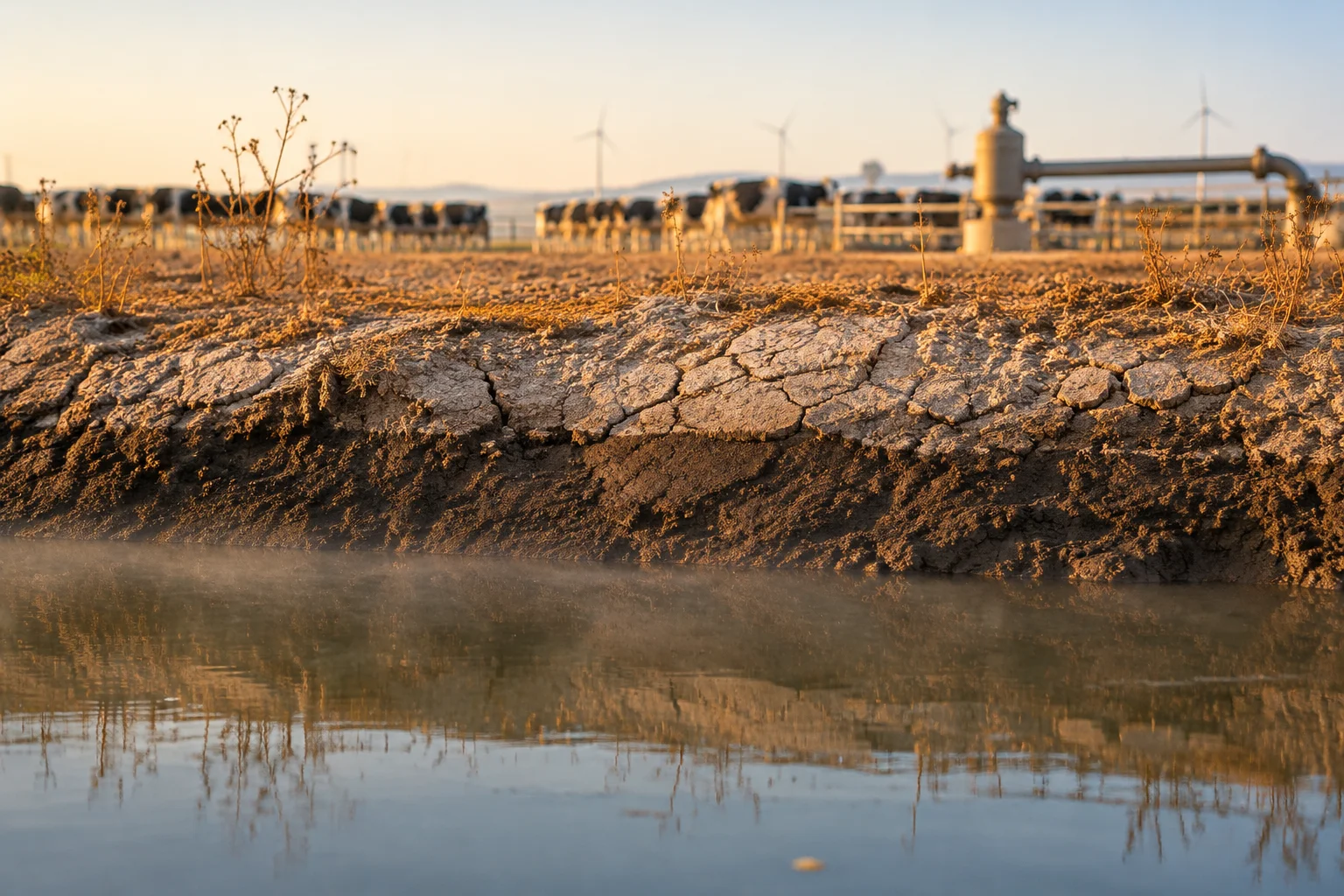
That work changes the advice. The mosquito playbook says dump the standing water. The midge nursery is not a body of water at all. It is the wet face of a bank, a few centimetres tall, sitting above the waterline and soaked from below.
You cannot tip it over. You can move the water away from it, and there is a clock attached to doing so. This page is about that arithmetic, because for no see ums California the productive ground is usually visible, measurable, and owned by somebody.
If you want the version of no see ums California that has numbers behind it, three studies carry most of it. A 1989 survey of 26 dairy wastewater ponds in western Riverside County counted larvae against pond shape. A 2017 study at a dairy wastewater pond bank counted eggs against height above the waterline, centimetre by centimetre.
A 2014 experiment lifted those eggs off wet mud, dried them for fixed periods, and put them back. Those three, plus a Sacramento Valley population study and a set of California vector records, are the spine of everything below.
Why No See Ums California Are a Bank Problem, Not a Pond Problem
Start with the nursery geometry, because it is the most transferable fact on this page. Researchers at a California dairy wastewater pond took 5 ml surface mud samples along four transects, on six dates, cutting strips 10 cm long, 1 cm wide and 0.5 cm deep at 5 cm increments from 15 cm below the waterline up to 25 cm above it. Eggs were floated out with magnesium sulphate, held on moist filter paper, and scored for hatching over three days.
The result was a narrow band. “The highest density of viable eggs (21 eggs/5 ml), proportion of mud samples positive for viable eggs (75%), and proportion of eggs hatching (80%) were found 5 cm above waterline.” Below the waterline the answer was simpler: “Most samples from below the waterline had no eggs and were not analyzed statistically.” A midge pond is therefore not productive because it is deep. It is productive because of the few centimetres it leaves damp above itself.
What makes that counter-intuitive is that measured wetness did not explain the band. Sample moisture averaged 25.8 plus or minus 2.1 at 5 cm above the waterline and 19.8 plus or minus 2.6 percent at 25 cm above it, and that difference did not vary significantly by position.
Wetness alone did not sort the eggs. Height did. The female is choosing a position relative to a water surface, not hunting for water.
Her position is also oddly precise. Individual gravid midges were given a one-litre container with an artificial mud bank, and where they laid at all, “73% deposited them singly in lines ranging up to 5-6 cm in length (meanderers), while 27% laid eggs in clumps (dumpers).” Eggs were positioned an average of 45 plus or minus 12 mm back from the waterline. That is a hand-span from the surface, drawn out in a thread.
Read the band, not the pond
For a reader this converts into one inspection rule. Stop asking whether a property has water. Ask where a water surface meets a slope at a shallow angle, then look at the vertical face between the current waterline and roughly 25 cm above it.
That face is the habitat. A pond that looks unimportant can be a nursery if its bank is shallow. A pond that looks alarming can be nearly inert if its sides are steep and its level moves.
Larval anatomy backs the same conclusion from the other direction. The first instar of Culicoides sonorensis is the only instar with a proleg, a structured crawling organ armed with hooked setae. “On terrestrial mud, this proleg was used for surface crawling, and the L1 navigated dry conditions better than the more aquatic L2-L4 stages.” The authors’ reading of that organ is direct: “Eggs are laid above waterline, and the L1 proleg is probably an advantage in terrestrial surface movement.” The youngest instar has to walk across damp ground before it can live in wet ground.
So the band must satisfy two incompatible demands at once: wet enough for a larva to move across it, never wet enough to drown in it. That tension is the entire management opportunity, and it is why the next section is about hours rather than hectares.
How Long Does Ground Have to Stay Dry?
This is the question the rest of the internet answers with vibes. A laboratory experiment on Culicoides sonorensis eggs gives coefficients. Eggs of known age were dried, then returned to wet substrate. The youngest were hopeless: “Eggs 4-10 h old failed to hatch after 12 h of drying at 75% relative humidity (RH).” Everything older survived something.
Against controls, hatch fell on a steep curve. “Relative to control eggs, average egg hatch was reduced by 36% after 12 h of drying, 79% after 24 h, 91% after 36 h, and 97% after 48 h.” A remnant held out to the end: “Some embryos (1%) survived and hatched after 60 h of drying and water losses of nearly 60%.”
Then the experiment became more useful, because age mattered as much as duration. “Older eggs (28-34 h) survived severe desiccation and >50% water weight loss.” They also recovered quickly, regaining their water within roughly two hours of rehydration. The turning point is a developmental event, not a weather event: “critical embryo age to survive drying is between 10 and 24 h.”
Two consequences follow, and they point in opposite directions.
| Hours of drying | Hatch reduction | What it means for a bank |
|---|---|---|
| 12 | 36% | Serious damage, not a clean stop. Freshly laid eggs are the loss. |
| 24 | 79% | That cohort stops being a nursery. |
| 36 | 91% | Only the most advanced embryos carry on. |
| 48 | 97% | Effectively cleared, at this humidity. |
| 60 | 1% hatched, so roughly 99% derived | A remnant survives. Never plan around zero. |
Why the timing matters more than the amount
Eggs are laid in the hours after sunset and age through the night. A female laying at eight in the evening has a ten-hour embryo on the bank by six in the morning, and one past the critical window by the next evening. A drying event placed in the wrong hours is therefore wasted. The authors of the egg-sampling study drew that conclusion themselves and stated it as a control method: “As a potential control method, reducing water levels after midnight would encourage young egg desiccation.”
A drawdown that starts at noon and finishes by morning has already passed over eggs which matured safely through the night. A drop landing between midnight and dawn catches them at precisely the age when they cannot recover. Duration still matters, because two hours of midday heat is not twelve hours at 75% relative humidity. What the pair of studies gives you is the shape of the problem: a nightly, one-sided window that shuts by morning.
Why a dry week can accomplish nothing
The same papers explain why the naive version of source reduction fails. First, the band is only centimetres tall, so a small rise re-wets it, and the eggs are not passive about water: “Humidity gradients relieved desiccation stress, and eggs appeared to regain water from saturated RH conditions.” Second, a bank that dries but stays shaded between irrigations returns to productive moisture fast, and the L1 is built to ride that out. Third, the adults arrive from elsewhere, so an emptied band is re-colonised within a season. That third point has its own hard experiment, and it belongs to a page this one hands off to rather than repeats.
The honest summary is narrow. Drying the band is real arithmetic with published coefficients. It is arithmetic about one life stage, of one species, at one humidity, in a laboratory. It is not a promise about your evenings.
What the Mud Has to Contain
Moisture decides whether a bank can be used. Food decides how productive it is, and here California has an experiment rather than an opinion. Culicoides sonorensis first instars were put into sterilised mud mixed with manure from dairy cattle and white-tailed deer at six concentrations, and into mud spiked with manure from six more farm animals at one concentration. Adult emergence was then watched for 90 days.
For no see ums California the food question has a measured answer rather than an opinion, and dairy cattle manure at 25 percent of the substrate was the best mixture tested. Emergence reached at least 76.7 percent and development finished in 25.5 days or less.
Every other concentration was worse: at the lower and higher doses tested, no more than 41.3 percent of midges emerged and development took 31.2 days or longer. That is a peak, not a slope. More manure is not automatically a better nursery.
Two animals were near-useless as food. Deer manure supported emergence of 13 percent or less, with development taking 29 days or more. Chicken manure produced no adults at all: emergence was zero. The authors’ own summary is the useful part, because it names the exception and the consequence.
“These results suggest that manure of several farm animals, except for white-tailed deer and chicken, can contribute substantially to C. sonorensis development in the field.” And then: “the potential of animals other than cattle in sustaining local populations of C. sonorensis cannot be overlooked when designing management strategies.”
Beef cattle, sheep, goat, pig and horse manures all sat in between. They generally supported development, but emergence and development time “varied widely between species” according to the same paper. That spread is why a neighbour’s anecdote about a species is weak evidence for yours.
| Manure added to mud | What the trial found | Reading for a property |
|---|---|---|
| Dairy cattle, 25% | At least 76.7% emergence, development in 25.5 days or less | The reference case. A dairy bank is a nursery. |
| Dairy cattle, other doses | At most 41.3% emergence, 31.2 days or longer | Over-enrichment is not a free gain. |
| Beef cattle, sheep, goat, pig, horse | Supported development; results varied widely between species | Treat each animal group as its own test. |
| White-tailed deer | 13% or less emergence, 29 days or longer | Deer pressure is not the same claim as deer production. |
| Chicken | No adults emerged | A coop is not a midge nursery in this trial. |
Two caveats are load-bearing. The work was done on sterilised mud in containers, in one species, under one temperature regime. And emergence in a dish is not abundance on a farm, because the bank has to stay wet for the whole 25 days or more that development takes. The connection between the two is exactly what the Sacramento Valley and Riverside County field studies addressed, which is where the next two sections go.
Pond Shape Is a Control, and California Measured It
In the late 1980s an entomologist sampled Culicoides variipennis larvae five times across ten weeks of late summer in 26 dairy wastewater ponds in western Riverside County. Seven things were recorded on the same dates: slope, how much cattle could reach the water, whether visible manure solids were present, salinity, chemical oxygen demand, plankton volume, and whether the pond was pumped out for irrigation. That is still the most direct California evidence linking a pond’s physical design to how many midges it makes.
This is where no see ums California stop being a mystery and become an operating procedure. Four of those variables moved larval density in one direction and two in the other. Density rose with plankton volume, with animal access, and with salinity, and fell with slope and with pumping for irrigation. In plain terms: a shallow pond that cattle can walk into, that is allowed to bloom, that is never pumped out, and whose banks are gentle, is a midge factory.
The measured gap was roughly a factor of two. The paper’s own words for the productive case are shoreline mud “that were not pumped (means = 106 larvae per 30 ml)”, and it names the shape that held them: shallow, unpumped evaporation beds. The alternative design was documented in the same sentence group: “In contrast, pumped ponds were deeper, had steeper slopes, and supported lower densities of C. variipennis (means = 52 larvae per 30 ml).”
The mechanism the author offered for the difference is the one that matters to a reader who cannot re-engineer a pond. Pumped ponds held water continuously and were more stable in time. Unpumped beds dried, cracked and were re-flooded.
And the paper flags the obvious candidate: “Rapid water level fluctuations in the pumped ponds also may have reduced C. variipennis density.” Fluctuation is the lever that costs nothing.
| Attribute | Direction found | Who can change it |
|---|---|---|
| Bank slope, gentle | Steeper slope meant fewer larvae | Operator, at grading time |
| Pumped for irrigation | Pumped meant fewer larvae | Operator, by schedule |
| Cattle able to reach the water | More access meant more larvae | Operator, with fencing |
| Plankton volume | More bloom meant more larvae | Indirect, through loading and residence time |
| Visible manure solids | Recorded alongside density in the same survey | Operator, at solids handling |
| Salinity | Positive in this field survey, negative or lethal in other studies | Nobody should treat this as a lever |
The salinity line is a warning, not an instruction
That last row deserves its own paragraph, because it is the kind of finding that gets turned into a product claim. In this pond survey salinity moved with larvae. Elsewhere in the published record it moves against them, and in rearing plates the upper limits are abrupt.
Both patterns are real, they are measured on different species in different setups, and the site has already worked through why a physicochemical correlation is not a management tool. It is covered on the larval habitat conditions page, and nothing here adds to it.
What the pond survey does add is a set of decisions with named owners. Fencing cattle out of a bank, pumping on a schedule rather than by convenience, and grading a shoreline steep where it is safe to do so are all ordinary property operations. Their effect on midges is published, quantified in larvae per 30 ml of mud, and local to California dairies.
The California Season, Named by Species and Region
The season is the question most no see ums California searches are really asking. Virus surveillance happens to be the best source of midge season data in the state, because the midges were trapped for years to answer a livestock question. The clearest statement of the shape comes from a study designed to test whether bluetongue virus could pass through the midge’s own eggs: “BTV infection of livestock is distinctly seasonal (late summer and fall) in temperate regions of the world such as California.”
The trap data behind that sentence is more granular than the sentence. On two Sacramento Valley dairy farms sampled for 52 weeks, adults vanished on a calendar. “Adult midges disappeared from both farms from late November until May; however, low numbers of parous female midges were detected in traps set during daylight in the inter-seasonal winter period.” Vanished, and yet not gone.
Farther south the calendar dissolves. In the Chino dairy region of southern California, host-seeking midges were caught through winter and into early spring across three years, and the accompanying survival estimate for winter adults ran to 27 days or less. That combination, low-level activity plus a month-long adult lifespan, is the published argument that transmission continues quietly rather than restarting each summer. It also failed to find virus in midges caught between January and April, which is the honest limit of what anyone has demonstrated.
A northern California bird facility supplies the one fully species-resolved curve available anywhere in the state, and it belongs in a season table rather than a footnote. Trapping near captive bobwhite quail found nine biting midge species, and “Of these, 94% were C. bottimeri, which was abundant near the birds.” For that species, “adult activity began in late-April, slightly before the onset of disease in the quail”, while “Activity peaked between July and late-September, coincident with maximum reported transmission, and adult activity ceased by early-November.” Over three seasons of bird examinations, 65 percent of collected C. bottimeri were engorged with blood, and non-engorged females showed 43.6 percent parity, which the authors took as evidence of good survival.
| Signal | Where and what | Season statement |
|---|---|---|
| Livestock infection | Temperate California, bluetongue records | Distinctly seasonal, late summer and fall |
| Adult trapping, 52 weeks | Two Sacramento Valley dairies | Gone late November to May, parous females in winter daylight |
| Winter host-seeking | Chino, southern California, three years | Host-seeking throughout winter; survival up to 27 days |
| One species, resolved | C. bottimeri, northern California quail | Late April start, July to late September peak, over by early November |
| Desert pulse | Santa Rosa Mountains, Riverside County | L. torrens very abundant for two weeks after heavy summer rain |
| Egg cold tolerance | Laboratory, colony and field-collected immatures | Winter cold does not reliably clear the bank |
Cold does not clean the substrate
Freezing is the mechanism people hope for, and it was measured. Culicoides sonorensis eggs, larvae and pupae were cooled, and the pattern was stage-specific. “Larvae and pupae succumbed to temperatures higher than their respective SCPs, indicating death from prefreezing cold injury.” Eggs were the tough stage, tolerating one-hour exposure far below freezing without complete mortality, while complete larval mortality came at a much milder temperature. Field-collected larvae from subtropical California and temperate Colorado did not differ significantly in survival, and a 24-hour chill beforehand did not harden them.
Read against the egg band, that result is unwelcome but clarifying. The stage sitting 5 cm above the waterline all winter is the stage least bothered by cold weather. Frost is not a sanitation event. Hour-by-hour gates for a warm evening, and what wind does to a biting window, are handled on the evening activity page and for a cold climate on the Minnesota page; this page adds only the immature side.
The Desert Branch: Leptoconops, Not Culicoides
A California reader in the desert is often dealing with no see ums California under a different genus, and the substrate has nothing in common with a dairy bank. In the Santa Rosa Mountains of Riverside County, host-seeking midges were collected “with CO2-baited suction traps over a period of 30 mo.” The count is the point: “Nineteen species of Culicoides and seven of Leptoconops were collected.” Five of the Culicoides were previously undescribed.
Where those species sat in the landscape was not uniform. “Culicoides variipennis, a vector of bluetongue virus in agricultural settings, and C. lahontan were numerous in sandy washes but were much less common in the mountains themselves.” The animal that mattered for lambs was the one comfortable on rocky ground.
And parity, the proportion that has already fed and laid, split the same way: “Parity (an indicator of longevity and success in finding hosts and oviposition sites) in mountain areas was very low in C. variipennis (5%).” Five percent says an agricultural species is dying in terrain it cannot reproduce in.
The desert nuisance in that same list behaved like weather. “L. torrens was very abundant in the same area for 2 wk following heavy summer rains.” Two weeks, triggered by rain, then gone. Nothing in the mud-band arithmetic applies to that event, because a sand-dwelling midge is not bound to a waterline.
Medicine recorded the human cost of the same insect. A dermatologist reporting on bites during a midge outbreak wrote: “I had the opportunity to observe such bites by the gnat Leptoconops torrens during a recent epidemic that occurred in an inland desert area of California.” The lesion was specific: “The bite may produce an urticarial wheal, but, more characteristically, it induces formation of a hard, indolent, pruritic papule.” How to separate that from a flea, a chigger or a mosquito bite is a different article, and the wound page owns it.
Why the mud playbook fails on sand
Leptoconops in California deserts is tied to dry-looking ground rather than wet-looking ground. Females of L. californiensis were collected from five lizard species “in desert sand dune habitats in San Bernardino and Riverside counties”, with as many as six midges feeding on one lizard at once, and they “fed during calm, warm daylight periods from March through October.” Daylight, sand, calm air, warmth: the opposite of every rule in this article’s first half.
One field test against that genus is worth recording for readers who ask what actually works on them. Ten volunteers were tested against L. carteri in the Central Valley with a lemon-eucalyptus formulation alongside a DEET control and an untreated control.
“Half of the eucalyptus subjects received no bites, and the true median protection time probably exceeded the test duration.” The design detail that keeps the result honest is in the same abstract: “with 6 h of continuous exposure per treatment.” Six hours in the field, ten people, one site. Whether a repellent transfers to your species and your evening is a rule in itself, set out on the repellent page.
Why the Mosquito Larvicide Tank Is the Wrong Tool
Anyone who runs a spray programme will ask the same question next: the nursery is reachable mud, so can it be treated? The access genuinely exists, as a paper on the subject puts it, “larval midges utilize semi-aquatic habitats which are permissive for Bti product application.” Bti is the bacterial larvicide that drives most mosquito programmes. It does not work here, and now there is a measurement of how badly.
Exposing Culicoides sonorensis larvae to a commercial Bti product produced a 90 percent lethal concentration of 386 mg per litre. In the authors’ own framing that is “almost 10 000 times more than that of some mosquito species,” and “no concentration of active ingredient tested achieved 50% larval mortality.” The comparison group was not marginal: at the product’s label rate for Aedes aegypti, all mosquito larvae died.
The proposed reason is physiological, and it is not a workaround you can buy. “The larval gut was found to be more acidic after exposure to Bti which inhibits Bti toxin activity”, while “mosquito larvae had alkaline guts regardless of treatment.” Making the rearing water alkaline did improve the active ingredient in a dish. The authors’ conclusion is deliberately unhelpful to anyone selling a tank: “We conclude that Bti is not practical for larval Culicoides sonorensis control at the same rates as mosquitos but show that alterations or additives to the environment could make the products more effective.”
Two further points belong beside that number. The registered host range of Bti products, and the reasons biological control generally under-delivers against midges, are established on the natural enemies page. And a newer result complicates the idea of treating the nursery at all: midges whose larvae survived sublethal insecticide exposure in organically enriched habitat, including “livestock wastewater, which can accumulate pesticide residues from livestock treatments” went on to carry higher virus loads as adults. Killing most of a nursery is not the same outcome as not creating one.
Ground With No Animals on It Still Produces Midges
The substrate literature used above is dairy-centred for a reason: dairy effluent is what California’s immature-stage surveys went looking for. A broader western survey, published in 2025, tested whether that focus was leaving something out. Ten sites in northern Colorado were visited fortnightly from June to September, covering large livestock operations, small domestic operations and natural spaces, and every sample was then held in an insectary for eleven weeks so that anything able to emerge would have the chance to. “Samples were maintained in the insectary for 11 weeks and monitored for emergence of adult midges.”
Two findings came out of that design. The first is about habitat type. “Standing water substrates displayed higher presence and abundance of midges than running or transient habitats, though all microhabitats showed emergence.” Every category produced midges. The second is the reason the survey was done: “it is well-known that BTV can be found outside of livestock areas, with transmission occurring in natural settings.”
For a homeowner with no livestock, the practical reading of no see ums California is therefore not relief. It is a correction of target. Your property may be producing nothing at all and still be bitten, and the same species mixture is not what a dairy bank produces. The composition half of that result, which is the part most often misquoted, is documented on the animal premises page and is not repeated here.
What you own instead is the interception decision, plus a realistic view of distance. Weak fliers do not stay nearby when the air is moving, and the records run to kilometres. That arithmetic of arrival is set out on the size and flight range page and on the Arizona page, which handles borrowed numbers explicitly.
What a Midge Count on Your Own Ground Can and Cannot Decide
Every number in this article came from an instrument, and the instruments disagree. California dairies were the test site for exactly that problem: suction traps baited with CO2, with UV, or with both, set near animals, near wastewater ponds, and out in open fields. The placement beat the bait for raw yield. “Traps set in open fields collected significantly higher numbers of males and females than in either of the other two locations.”
The bait decided who got counted instead. “UV traps were poor at collecting nulliparous females, but the addition of UV to a trap increased the abundance of males in a collection.” A light trap is therefore biased toward males and toward females that have already fed, which is the opposite of the population you are trying to reduce. This is also why the careful California studies did not use light: the 52-week Sacramento Valley monitoring ran “by trapping (CDC style traps without light and baited with dry-ice) along N-S and E-W transects on each farm.”
| Instrument | Question it answers | What it cannot tell you |
|---|---|---|
| 5 ml surface mud sample, floated | Is this bank producing eggs now, and how high above the water | Nothing about adult pressure tonight |
| CO2-baited suction trap, no light | Host-seeking females, including those not yet drawn to a lamp | Males, and the species a lamp would have found |
| UV light trap | Which species are present in a survey list | Nulliparous females; a fair count of either sex |
| Bites on people | Whether an evening was unacceptable | Whether your ground produced a single midge |
A reader deciding what to buy should read that table before reading any product page. Sampling bias, the arithmetic of what one trap represents, and the reason a device count disagrees with what lands on skin are treated on the visibility and counting page and on the thresholds page.
The Four-Line Bank Card
What follows is the smallest record that the published arithmetic on no see ums California can actually use. Four lines, filled in at the water’s edge with a phone camera and a tape measure, in the last hour of light. It is deliberately not a biting count, because a biting count answers a different question and is already covered on the thresholds page.
| Line | What to write down | The published reference point |
|---|---|---|
| Band | Height from waterline to the first dry, cracked, or vegetated surface | Egg density peaked 5 cm above the waterline; samples ran to 25 cm |
| Exposure | Hours per day that band is visibly dry, and whether any of them fall between midnight and dawn | 36% hatch loss at 12 h, 79% at 24 h, at 75% relative humidity |
| Loading | Which animals can reach the water, and what the mud is enriched with | Dairy manure at 25% supported 76.7% or more; chicken supported none |
| Stability | Whether the level is pumped, and how fast it moves when it changes | Unpumped beds held 106 larvae per 30 ml against 52 in pumped ponds |
Fill that card in twice, a fortnight apart, at the same hour. If the band height and exposure columns do not move, nothing in this article predicts a change in production, whatever the mosquitoes do.
Four Weeks at the Edge: A Test You Can Run
The test below measures substrate. For no see ums California that is the only honest target, and it will not measure relief, and it should not be sold to anyone as a way to prove a product worked.
Week one: find every bank on the property
Walk at dusk and list every place where standing or slow water meets a shallow slope: effluent or retention ponds, trough aprons, low points in an irrigated field, a leaky valve line, a wheel ruck that holds water, a drainage inlet with a muck edge. For each one, photograph the face from the side so the band is visible, and measure the band. Shaded bands count double, because they stay wet longer.
Week two: sample the band, not the water
At two or three of those sites, take a small surface scraping from the vertical face 5 cm above the waterline and from 20 cm above it, in a sealed bag, at the same time of day. Keep them cool and undrained. A laboratory or a vector control district can float and count; a grower with a hand lens will at least see whether something moves. Sampling technique and flotation chemistry are the ones published in the egg-density study.
Week three: change one variable and leave the others alone
Pick the single lever you own. On a property with a pump, that is schedule: let the level fall so that the previously productive band is exposed through the night rather than through the afternoon. On a property with animals, it is fencing a reach point. Do not change two things at once, because every number quoted here is a single-variable result.
Week four: read the card, then predict the adults
Re-run the card at the same sites and the same hour. If the band is higher and drier, the egg arithmetic predicts a smaller cohort in roughly the 25 to 31 day window that development occupies. Adult pressure should be tracked separately and honestly, with bites or with a CO2-baited trap that you move as little as possible.
What No See Ums California Still Do Not Have
It is worth naming the gaps on a page that has leaned so hard on published numbers, because several of them are exactly what a reader wants to know.
There is no published action threshold for biting midges anywhere in the United States, California included, and no nuisance standard a Californian can cite to an agency. There is no per-county occurrence map for midges in the state; what exists is species records from dairies, quail facilities, mountains and sand dunes, assembled for other purposes. Nobody has run the midnight-drawdown idea as a field trial; the sentence quoted earlier is a proposal drawn from an egg experiment, and it is cited here as exactly that.
No study has published the egg-band geometry for California salt marsh, riverbank, orchard flood, or suburban swale habitats, even though marsh-edge Culicoides have been studied in the state for other reasons. Nobody has measured whether larval gut alkalinity can be manipulated usefully in a pond. Human-landing rates for California are absent, so the bite side of no see ums California rests on case reports from an outbreak, a lizard study, and a pair of livestock papers. And the salinity question is genuinely unresolved rather than merely complicated.
Where a CO2-Suction Device Fits
Given all of the above, the honest placement of a machine among no see ums California is narrow, and it is worth stating in the same terms the surveillance literature uses. A CO2-baited suction unit is built on the cue that the California field studies relied on: host-seeking female midges follow a carbon dioxide plume, which is why the Santa Rosa Mountain survey used “CO2-baited suction traps” for 30 months and why the Sacramento Valley monitoring used dry-ice-baited traps without light.
Pittar’s Airflow suction carbon dioxide mosquito trap is an outdoor unit rated to an effective range of 4000 square metres. It works by drawing insects toward the CO2 cue and then capturing them in an airflow that carries them into a net, where they desiccate. On the evidence in this article, the sensible placement is between a bank you have identified and the place where people sit, as an interception of the flight rather than a treatment of the source, and at a scale that matches the rated range. It is not designed for indoor use, and it is the wrong size of tool for a small paved courtyard.
What such a device cannot do follows from the egg band. It does not lower a waterline, it does not dry a bank, and it does not act on larvae. Anyone comparing units should read placement guidance, the model comparison, and the planning method for a defined outdoor area before choosing. Pricing for the unit and for bulk or resale supply is by direct enquiry, since configuration and volume change it.
No See Ums California: The Questions People Ask Last
Are no see ums the same as mosquitoes in California?
No, and for no see ums California the difference is not cosmetic. Mosquitoes breed in water or at its surface; the midge that dominates the California literature breeds in the mud band above the water, and its eggs die if that band dries at the wrong hour. Adult mosquitoes take blood for egg development in most pest species, which is why a container dump helps with one and not the other. The comparison is worked through on the midge versus mosquito page.
Why are they in my house if the nursery is outside?
Because they are small enough to pass ordinary screens and are drawn to the same cues a house emits at dusk. Indoor records for California are thin, and a species-level answer about the insect indoors belongs to the indoor page and the bedroom page, neither of which relies on the dairy data used here.
Does a swimming pool cause them?
A clean, filtered, steep-sided pool is a poor nursery: there is no shallow mud band and no organic enrichment at the waterline. Overflow structures, backwash lines, irrigation discharge and a pool cover that holds water on top are a different matter, because each creates the band this article is about. Judge the edge, not the volume of water. That is the single most useful rule for no see ums California on a residential lot.
How long does a California midge season last?
The published records give a range rather than a date. Late summer and fall is the clear seasonal window for livestock infection. Trapped adults on two Sacramento Valley farms were absent from late November to May, with parous females still turning up in winter daylight traps. In the south, host-seeking midges were caught all winter across three years.
A northern California quail facility recorded one species active from late April to early November. Desert Leptoconops produced a two-week pulse after heavy summer rain. So a search for no see ums California by season returns a range of calendars rather than a date, and anyone selling you one date is guessing.
Can I just treat the mud?
The evidence here says treat it chemically and you will probably fail. The standard mosquito larvicide needed a 90 percent lethal concentration of 386 mg per litre against these larvae, and no tested concentration of the active ingredient reached half mortality, because the midge larval gut acidifies after exposure and disables the toxin. What the arithmetic supports instead is physical: move the water on a schedule that exposes the band overnight, fence the reach points, and grade the shore where it is safe.
Will a CO2 trap make my yard midge-free?
No page on this site can promise that, and no study in this list would support it. A CO2-baited suction device intercepts host-seeking females in the air around where it stands, which is exactly what the California field studies used it for. It does not act on the 5 cm band where the next generation is sitting. If the band is on your ground, changing its water schedule is the intervention with numbers behind it.
If the band is on someone else’s ground, which is common, then interception and personal protection are the parts you control. For a buyer comparing units at a defined acreage, the pre-purchase checklist and the large-area guide are the right next reads.
What should I tell a contractor or a supplier?
Give them the bank card. Four lines, three sites, two visits, one named variable per week. A supplier who responds with a product instead of questions about your band and your pumping schedule is answering a different question than the one the California data asks. Distributors and pest-control firms evaluating units for a California territory can start from the application pages or ask about supply terms through the OEM and ODM page.
What to Take Away From No See Ums California
California is the state where the midge nursery was actually measured, and what was measured is small. Viable eggs concentrate about 5 cm above a waterline, in mud that a moisture probe cannot distinguish from the mud 20 cm higher. Drying that band for 24 hours at 75 percent relative humidity removes about four fifths of the hatch, and the hour at which you start matters because a ten-hour-old embryo already survives what a four-hour-old one cannot.
The food the band needs comes from a short list of animals, with dairy cattle at the top and chickens at the bottom. The pond design that makes the most midges is shallow, gentle, reachable, blooming and never pumped, and the design that makes half as many is its opposite.
None of that is a claim about your evening, and the removal experiment that this site reports in full, together with the life-cycle account, found results nobody wanted.
But for no see ums California the productive surface is usually identifiable from a bank with a tape measure, and the levers attached to it have named owners. Look for the band. Count what is in it. Change one thing, at the right hour, and read the card again.
Sources Consulted
- Wong et al. (2017). Field Distribution and Density of Culicoides sonorensis (Diptera: Ceratopogonidae) Eggs in Dairy Wastewater Habitats. Journal of Medical Entomology, 55(2), pp 392-397. 10.1093/jme/tjx203
- McDermott and Mullens (2014). Desiccation Tolerance in the Eggs of the Primary North American Bluetongue Virus Vector, Culicoides sonorensis (Diptera: Ceratopogonidae), and Implications for Vector Persistence. Journal of Medical Entomology, 51(6), pp 1151-1158. 10.1603/me14049
- Abubekerov and Mullens (2017). Egg and Larval Morphology of Culicoides sonorensis (Diptera: Ceratopogonidae). Journal of Medical Entomology, 55(3), pp 553-560. 10.1093/jme/tjx236
- Mullens (1989). A quantitative survey of Culicoides variipennis (Diptera: Ceratopogonidae) in dairy wastewater ponds in southern California. Journal of Medical Entomology, 26(6), pp 559-565. 10.1093/jmedent/26.6.559
- Erram and Zurek (2017). Larval Development of Culicoides sonorensis (Diptera: Ceratopogonidae) in Mud Supplemented With Manure of Various Farm Animals. Journal of Medical Entomology, 55(1), pp 43-50. 10.1093/jme/tjx197
- Mayo et al. (2014). Seasonal variation and impact of waste-water lagoons as larval habitat on the population dynamics of Culicoides sonorensis (Diptera:Ceratpogonidae) at two dairy farms in northern California. PLoS ONE, 9(2), pp e89633. 10.1371/journal.pone.0089633
- Mayo et al. (2012). Anthropogenic and meteorological factors influence vector abundance and prevalence of bluetongue virus infection of dairy cattle in California. Veterinary Microbiology, 155(2-4), pp 158-164. 10.1016/j.vetmic.2011.08.029
- Osborne et al. (2015). Lack of Evidence for Laboratory and Natural Vertical Transmission of Bluetongue Virus in Culicoides sonorensis (Diptera: Ceratopogonidae). Journal of Medical Entomology, 52(2), pp 274-277. 10.1093/jme/tju063
- McDermott et al. (2016). Low Temperature Tolerance of Culicoides sonorensis (Diptera: Ceratopogonidae) Eggs, Larvae, and Pupae From Temperate and Subtropical Climates. Journal of Medical Entomology, pp tjw190. 10.1093/jme/tjw190
- Zhang and Gerry (2023). Host-seeking activity of adult Culicoides sonorensis (Diptera: Ceratopogonidae) during winter in southern California, USA, and assessment of bluetongue virus overwintering. Journal of Medical Entomology, 60(4), pp 789-795. 10.1093/jme/tjad049
- Mullens et al. (2006). Culicoides bottimeri as a vector of Haemoproteus lophortyx to quail in California, USA. Veterinary Parasitology, 140(1-2), pp 35-43. 10.1016/j.vetpar.2006.03.015
- Mullens and Dada (1992). Spatial and seasonal distribution of potential vectors of hemorrhagic disease viruses to peninsular bighorn sheep in the Santa Rosa Mountains of southern California. Journal of Wildlife Diseases, 28(2), pp 192-205. 10.7589/0090-3558-28.2.192
- Steffen (1981). Clinical and histopathologic correlation of midge bites. Archives of Dermatology, 117(12), pp 785. 10.1001/archderm.1981.01650120031016
- Mullens et al. (1997). Lizard feeding by Leptoconops (Brachyconops) californiensis (Diptera: Ceratopogonidae) on desert sand dunes. Journal of Medical Entomology, 34(6), pp 735-737. 10.1093/jmedent/34.6.735
- Carroll and Loye (2006). Field test of a lemon eucalyptus repellent against Leptoconops biting midges. Journal of the American Mosquito Control Association, 22(3), pp 483-485. 10.2987/8756-971x(2006)22[483:ftoale]2.0.co;2
- Barbera et al. (2025). Larval development habitats of Culicoides sonorensis midges in the western United States. Journal of Vector Ecology, 50(2), pp 138-146. 10.52707/1081-1710-50.2-138
- McDermott et al. (2016). Trap placement and attractant choice affect capture and create sex and parity biases in collections of the biting midge, Culicoides sonorensis. Medical and Veterinary Entomology, 30(3), pp 293-300. 10.1111/mve.12177
- Osborne et al. (2024). Variable gut pH as a potential mechanism of tolerance to Bacillus thuringiensis subsp. israelensis toxins in the biting midge Culicoides sonorensis. Pest Management Science, 80(8), pp 4006-4012. 10.1002/ps.8104
- Bunkers et al. (2026). Larval exposure to insecticides increases adult susceptibility to bluetongue virus in Culicoides sonorensis Wirth and Jones (Diptera: Ceratopogonidae). Ecotoxicology, 35(10), pp 200. 10.1007/s10646-026-03183-9
- Banerjee et al. (2023). Effect of substrate salinity and pH on life history traits of the bluetongue virus vector Culicoides peregrinus . Bulletin of Entomological Research, 113(6), pp 829-837. 10.1017/s0007485323000512