
Ask a friend which is which and you will get an argument about size. Ask in a shop and you will get a shelf. Both answers miss the place where the difference becomes expensive, which is the control product.
Are no see ums the same as chiggers as a control target? No, and the proof sits on the label rather than in the bite.
This is not another body-plan comparison. Our page on the biology of the two already works through legs, life stages, activity temperature and the way each animal reaches you, and it is worth reading first.
What that page deliberately leaves open is the decision most readers have behind the question. Once you know they are different animals, you still have to decide what you would apply, to what surface, on whose evidence, and how long before it stops working.
So the framing here is four tests, ordered by how cheap they are to run. Every quoted sentence was re-read against the retrieved source before publication, and every figure names the animal and the place it came from. Where the evidence belongs to a tick rather than a chigger, or to a laboratory tube rather than a lawn, the text says so.
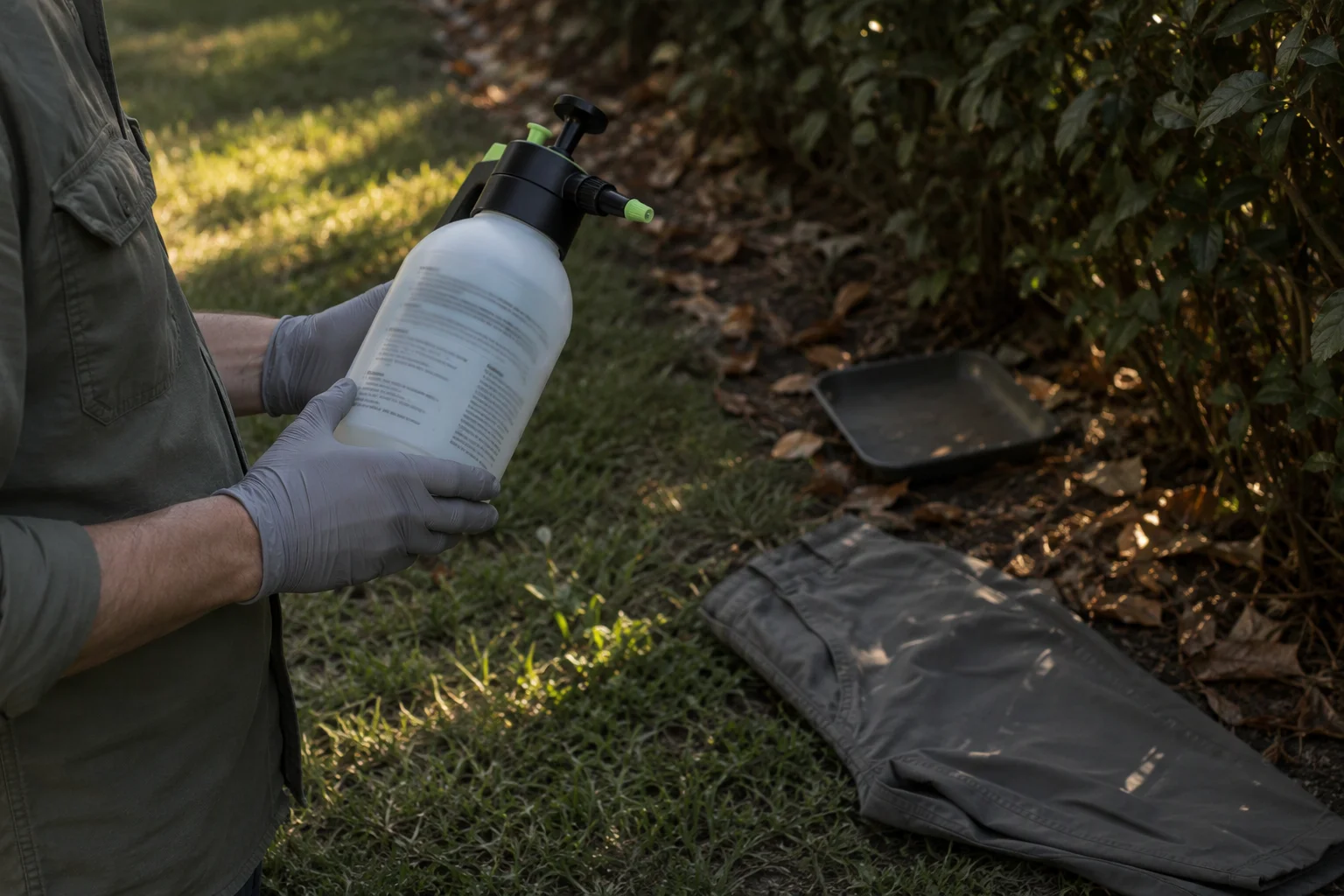
Are No See Ums the Same as Chiggers? The Short Answer
No. A no-see-um is a flying insect, a biting midge in the family Ceratopogonidae, and the biting sex is the female adult. A chigger is the larval stage of a mite, an arachnid, and it does not fly, jump or hunt you across a yard. It sits on vegetation and waits for something to walk into it.
That much is settled, and it is not the interesting part. The interesting part is that almost every consequence people actually care about – which product, sprayed where, on whose advice, and for how long – follows from those two sentences. Read as a control target, no see ums the same as chiggers only looks like one question. It is two questions with different answers.
One caveat before the tests. Most published control literature for mites is about ticks, and most published control literature for biting midges is about livestock premises. Where a number below comes from a tick rather than a chigger, it says so. That borrowing is the state of the evidence, and pretending otherwise would be the first mistake on this list.
Why a Spray Can Settles It Better Than a Bite
Bite evidence is genuinely useful, and this site keeps it on its own page: what a wound tells you about what bit you, including the bleeding criterion and the shape of the mark. The trouble is that a bite is a record of something that already happened. By then the product decision is behind you.
A control product is the mirror image. It is a written claim about a future event. It names an organism, a surface and a duration. Those three fields are exactly where the two animals diverge, and you can check all three in the time it takes to turn a container around.
| Test | What you look at | What it decides |
|---|---|---|
| One – the label | Which organisms the product is registered to act on, and whether it is registered at all | Whether the claim in front of you has ever been tested |
| Two – the target site | Active ingredient and its mode of action | Whether the chemistry is even aimed at a mite |
| Three – the surface | Where the active has to be placed: fabric, animal, ground, mud, wall | Whether your effort lands on the stage that bites |
| Four – the clock | How fast susceptibility to that compound falls under use | Whether this season’s decision is next season’s problem |
Test One: What the Label Is Allowed to Promise
Start with the weakest document in the transaction, because it is the one consumers trust. Not every product sold for biting arthropods has been tested against anything. In the United States a category of botanical and low-hazard formulations is exempt from federal registration on the strength of its ingredient list, and efficacy testing is not part of that exemption.
That gap was measured directly. A 2024 team put eleven of those exempt products, plus two registered DEET controls, on human skin and offered them to blacklegged tick nymphs in a finger bioassay, sampling every hour out to six and a half. The registered products held: the DEET formulations “showed >= 97% repellency for all examined timepoints.”
The exempt products did not. Across the eleven, “an average of 63% of ticks were repelled in the first 1.5 h after application”, and then “the average fell to 3% repelled between 2.5 and 6.5 h”.
Ten of the eleven looked like DEET at thirty minutes. Only four still looked like DEET at ninety. Then none of them worked.
The authors’ own conclusion is the line worth photographing: “Neither the claims on the labels nor specific active ingredients and their concentrations appeared to predict the duration of efficacy we observed for the 25(b) exempt products.” They go on to say plainly that because the products are unregistered, “the methods used to determine the application guidelines on their labels are unclear”.
Two things follow. First, a label that lists neither mite nor midge is not being coy; in most jurisdictions a product may not lawfully claim anything unlisted. Second, a label that lists both should make you ask which assay produced which number, because those are usually different experiments on different animals with different units.
Test Two: The Chemistry Is Aimed at a Different Animal
Acaricide and insecticide are not two names for one thing. They are two registers, two assay protocols and, often, two target proteins. The molecular evidence for that has become quite specific, and it is the deepest sense in which the answer to are no see ums the same as chiggers is no.
Where a miticide actually binds
Take amitraz, a compound used against mites for decades. A study in Pest Management Science cloned the receptor it acts on from the poultry red mite, and set out to explain both its action and the resistance that has followed, noting at the start that “Reliance on chemical acaricides has led to resistance, and plant essential oils represent an eco-friendly alternative, but their mode of action remains unclear.”
Two findings matter here. The first is evolutionary: when the authors compared the mite receptor with counterparts in other animals, the mite version grouped with other mite versions and was, in their words, “distinct from insect orthologs”. A receptor that differs between a mite and an insect is a receptor that can bind a drug differently.
The second is a warning about the words on a bottle. In the same system the plant compound thymol “also exhibited agonist activity at micromolar concentrations”, acting on the same receptor as the synthetic. Two products can share a shelf, share a marketing sentence and share a target, and still differ by a wide margin in how hard they pull it.
When an insecticide turns out to work on a mite
The split is real but it is not a wall, and the clearest modern example runs the other way. The isoxazolines were developed and sold as insecticides for fleas and ticks on companion animals. A 2025 study asked whether they could be turned against Varroa destructor, the mite that has devastated honey bees, and stated the motive flatly: the mite “has developed resistance to commonly used synthetic acaricides, such as amitraz, tau-fluvalinate, and coumaphos.”
The dose numbers are the interesting part. Against the mite, the median lethal dose of fluralaner was 0.07 ng per mite, described in the paper as “only 2x less toxic than amitraz (0.04 ng/V. destructor), but 25,600x more toxic than coumaphos (1789 ng/V. destructor)”. Same mite, same unit, three compounds, and four orders of magnitude between the best and the worst.
Selectivity was not a property of the class either. In the same work one isoxazoline had a selectivity ratio of 0.3 and was “much more toxic to honey bees than to V. destructor”, another was equally toxic to mite and bee, and fluralaner and lotilaner were “123x and 2x more toxic to V. destructor than to honey bees”. Mechanistically, exposure to 30 um fluralaner “led to reversal of GABA inhibition with a significant increase of nerve firing”.
So the honest result of Test Two is not that mites simply need a different drug. It is less comfortable than that: the class name tells you almost nothing. You need the active ingredient, the species it was measured against, and the ratio between the pest and everything you did not intend to affect.
| What you read | What it reliably tells you | What it does not tell you |
|---|---|---|
| Shelf category, for example a garden insect spray | The registered targets printed on the label | Anything about mites |
| Chemical class – pyrethroid, isoxazoline, formamidine | Which protein family is involved | Whether that protein in a mite resembles the one in an insect |
| Active ingredient and dose | The only level at which published comparisons mean anything | How long it lasts outdoors |
| Registration status | Whether a regulator ever saw an efficacy claim | Whether it will still work next season |
Test Three: The Surface You Would Have to Treat
Here the two records stop overlapping almost flatly. Read the midge literature and the treated surface is a place: mud, a bank, a culvert, the wall of a shed. Read the mite literature and the treated surface is a body or a garment.
That is not a difference of emphasis. It follows from how each animal finds a meal.
The mite record is a record about clothing and animals
The best chigger-specific experiment of this kind is old and clean. Australian researchers ran a field study comparing treated military uniforms against untreated ones, working in northern Queensland in November 1990 against Eutrombicula hirsti, a chigger whose whole strategy is to board something walking past. Their result: “Volunteers who wore treated uniforms received significantly fewer chigger attachments than individuals who wore untreated uniforms.”
The sizes of the effects are worth setting side by side. Uniforms treated with dibutylphthalate produced a 97.6% increase in protection. Uniforms carrying 0.058-0.101 mg/cm2 of permethrin produced 96.4% protection. United States Army uniforms treated at a higher loading, 0.125 mg/cm2, produced 83.2%. The higher dose lost, and the authors recorded that “The differences between the clothing treatments were not significant.”
Read that carefully, because it is the opposite of what a product page would tell you. Above a certain point the loading stopped mattering; what mattered was that a treated surface sat between the ground and the skin. The authors’ conclusion is deliberately narrow: clothing impregnated with either compound “is an effective method for personal protection against E. hirsti”. It is not a statement about lawns.
That field result sits inside a small registered category. As one 2026 tick study puts it, “permethrin is the only active ingredient used in fabric-applied repellents”, and it notes that consumer use of even that is restricted in some markets. The same study tested a lemon-eucalyptus oil fabric spray against two tick species and reported that “In human trials, repellency remained above 95% for up to 1 wk post-treatment for I. scapularis”, while protection against the second species “declined after 7 d on synthetic fabrics.” Fabric works. Fabric also has an expiry date, and it is different for every textile.
The veterinary arm points the same way. In a study of fifteen dogs brought in with moderate to severe itching from Neotrombicula autumnalis, the harvest mite of western Europe, “The dermatitis resolved with successful treatment of the parasitic infestation.” Fourteen cleared within one to three weeks on a topical permethrin and pyripoxyfen combination, and “Two applications were necessary in four dogs.” The animal was the treated object. The garden was not touched.
That study also opens with a sentence that should temper anyone reading too much into it: “Few data are available in the literature on the dermatological consequences and treatment of Neotrombicula autumnalis infestation in dogs and cats.” Fifteen client-owned dogs, one clinic, no untreated control group.
The midge record is a record about ground and premises
Now turn the page to the insect. Biting midge control work is overwhelmingly about production sites and animal buildings, because that is where the insects are made and where the money is. The practical consequence is that the treated surface is mud, a wall or a fence line rather than a person, and the read-out is a trap count rather than a bite count.
This site has that record written up elsewhere and will not repeat the numbers here. The substrate conditions that make a larval habitat are on the page about where no-see-ums live, and what a contractor actually applies, and how long it survives, is on the spraying page.
The order of work on a livestock premises is on the animal-site page and, for the eastern Plains specifically, on the Iowa page. What a device can and cannot promise an outdoor site is on the effectiveness page.
What matters for the present comparison is the shape of the evidence rather than its content. For a midge, an intervention is evaluated by counting what arrives at a trap over time. For a chigger, an intervention is evaluated by counting what attaches to a volunteer, or by clearing an animal over two or three weeks. Those are different experiments in different units, and a product that passed one has not passed the other.
The repellent literature shows the same split from the other side. Against chiggers, repellency is reported as a dose or a duration. One laboratory series found that three essential oils and their main constituents “exhibited significantly more potent repellency than DEET (3.85 mg/cm2)” on a median-repellent-concentration basis, while also recording that the duration measure “was significantly more pronounced in DEET (RT50, 323 min) than in all essential oils and constituents (108-167 min).” More potent, far shorter. A number without its unit and its clock is not a result.
The same group’s earlier method paper explains why so little of this transfers to a label. They built a five-minute laboratory procedure to screen candidate repellents because field testing on human volunteers is slow and awkward, tested eleven compounds, and reported that only one “was significantly more effective than deet”. Much of what is known about chigger repellency is known in a tube, on mites that had never seen a garden.
| No-see-um (biting midge) | Chigger (trombiculid mite) | |
|---|---|---|
| Surface carrying the active | Larval substrate, building walls and roofs, nets and screens | Clothing, an animal’s skin, occasionally a ground layer |
| Typical experimental unit | Insects per trap-night | Attachments per volunteer, or infestation per animal |
| Where it is measured | Farms, coasts, animal houses | Laboratory tubes, clinics, military field trials |
| Residential lawn trials | Rare, mostly coastal or municipal | Effectively absent from the retrieved record |
Test Four: The Product You Pick Is a Depreciating Asset
The fourth test is the one nobody runs in a shop, and it is where mite control carries a burden midge control mostly does not. Chemical control of mites rests on a small number of active ingredients, and mites evolve against them. The best-documented case is Varroa destructor, and the numbers are unusually precise because beekeepers keep records.
In a two-year experiment, eighty colonies carrying one mite population of intermediate susceptibility were assigned to coumaphos, amitraz, tau-fluvalinate or oxalic acid, treated twice a year, with susceptibility measured before treatment, after two applications and after four. In the coumaphos group, bioassay mortality fell from 42% at the start to 21% after two applications and 19% after four. In the tau-fluvalinate group the share of mites carrying at least one susceptible copy of the L925 gene position fell from 33% to 8% and then to 6%. Even amitraz, usually the reserve option, slid from 86% to 74%. The authors’ summary is unambiguous: “Four consecutive applications of coumaphos or tau-fluvalinate within 2 years markedly reduced susceptibility to that compound, mostly after the first two applications.”
The damage is partly reversible and partly not. A meta-analysis of fifteen studies modelled the whole problem and found that “acaricide effectiveness declined by 5.5% per year of active treatment, while sensitivity rebounded by 10.7% per year following treatment cessation.” Recovery runs faster than decline, which sounds encouraging until the next clause: “neither rotation nor mixture strategies were associated with improved mite mortality.”
The explanation sits inside the animal. The same analysis notes that the mite’s breeding system, in which siblings mate, removes the dilution effect that rotation depends on; that the resistance mutations appear to cost the mite little; and that beeswax absorbs acaricides and keeps delivering a sub-lethal dose long after anyone stopped treating. Each of those is a mite problem rather than an insect problem.
On the insect side of the household spray, the same chemistry is being met by the same route. Permethrin resistance in the brown dog tick Rhipicephalus linnaei was surveyed across Thailand in larval packet tests, and “Resistance ratios ranged from 1 to 56 when compared to the least susceptible local population”, with resistance tracking mutations in two domains of the sodium-channel gene. Their recommendation is the sentence a buyer should read before a purchase: elevated resistance in those populations “indicate that veterinarians and farmers should consider tick control products with alternative modes of action.”
This is where the two halves of are no see ums the same as chiggers finally separate cleanly. For midges on your ground, the resistance question is live and contested, and this site keeps it on the Texas vector page, which covers what has and has not been measured in field populations. For mites, resistance is not a live question but a settled one, measured in percent per year.
The One Measure That Is Not Chemistry at All
There is a third answer to the control question, and it sidesteps Test Two entirely. Diatomaceous earth, the powdered fossil shell material sold in garden centres for decades, acts on arthropods without binding a receptor. The mite literature has been quietly re-examining it, and three results change what you should expect from a dusting.
The first is speed. Against nymphs of the American dog tick, dipping in diatomaceous earth at 30 degrees Celsius gave an estimated median survival of five hours at 50% humidity and four hours at 70%, with “mortality starting within 1 h”. In a two-choice assay the ticks walked straight onto treated surfaces and then died at a median of three hours, from which the authors drew the obvious conclusion: the material “is not a repellent”. It does not deter and it does not mask.
The second is dose. In simulated field conditions, pine straw infested with nymphs and dusted at rates from 5.00 down to 0.31 g per square metre lost every tick inside a day. At the lowest rate, 0.15 g per square metre, mortality was 81.40% after 24 hours. Under the electron microscope the dead ticks were almost clean: “most of the cuticle surface was devoid of DE except for the hypostome”. On that basis the authors explicitly questioned “the generally accepted mode of action for DE, that is, cuticle damage and dehydration.”
The third is that life stage beats dose. A laboratory study on the Asian longhorned tick found larval mortality beginning twenty minutes after sprinkling and complete by two hundred minutes, while adult males and females needed six to eight hours to start dying and were not all dead until the twenty-four-hour reading. A dust timed against a stage that is not present is a dust that missed.
It also works in combination, at least for the cattle tick. A field trial pairing an insect-pathogenic fungus with diatomaceous earth recorded two combinations “reaching 97% and 88%, respectively, 21 days post-application”. After a second round the authors reported complete control for one and 94.8% for the other. That second application is doing something real, and it is the pattern to expect from any ground treatment.
Two cautions, both honest. None of those studies used chiggers; they used ticks, which are mites but not the mite in your grass. And a dust has its own exposure question, because the non-selectivity that makes it hard to evolve against also makes it poor at choosing targets once it is airborne.
| Finding | Animal | Reading |
|---|---|---|
| Dipped in powder at 30 degrees Celsius | American dog tick nymphs | Median survival five hours at 50% humidity, four at 70%; first deaths inside one hour |
| Free choice over treated surface | American dog tick nymphs | Median survival three hours, and no avoidance, so the effect is not repellency |
| Pine straw dusted at 5.00 down to 0.31 g per square metre | American dog tick nymphs | Every tick dead within a day at each of those rates |
| Lowest rate tested, 0.15 g per square metre | American dog tick nymphs | 81.40% mortality at 24 hours |
| Sprinkled and immersed | Asian longhorned tick | Larvae dying from twenty minutes, complete by two hundred; adults taking six to eight hours to start |
| Combined with an insect-pathogenic fungus, field application | Cattle tick | 97% and 88% at 21 days, improving after a second round |
Are No See Ums the Same as Chiggers as a Control Target?
Put the four tests in one place and the answer stops being a slogan. The middle column is the insect; the last column is the mite larva.
| Test | No-see-um | Chigger |
|---|---|---|
| Label target | Usually absent. Midges are rarely a listed pest, and registered skin repellents are assayed on mosquitoes | Sometimes present as chiggers or as mites generally; often covered instead by a tick claim |
| Chemistry | Insecticides. The receptor work shows the mite protein is not the insect protein | Acaricides, plus a growing list of compounds rescued from the insecticide shelf |
| Where the active must sit | The larval substrate, or the air between it and you | Fabric and skin, or the animal carrying the larvae |
| Evidence for a residential lawn | Thin but real, mostly coastal and municipal | Effectively absent; the retrieved record is clinical, veterinary and laboratory |
| Resistance clock | Live, recently measured, still contested | Settled and quantified, at roughly five percent a year |
| Does a CO2 suction device belong in the plan | It is an outdoor insect tool, sized on the large-area page and placed by the placement page | No. It is not an instrument mite work uses, and the reason is on our comparison page |
If You Have a Lawn, a Patio and No Interest in Acarology
Four things follow, in order of cost.
First, decide which animal you are complaining about before you buy anything, and decide it from the encounter rather than the itch. A cloud at dusk over open ground, bites on the parts of you that were exposed, a yard that floods or holds mud: that is the midge story, and its levers are on the stopping-the-bites page and on the mesh page. Bites gathered where clothing sat tight, after sitting in long grass or brushing a hedge edge, with nobody bitten on the open patio: that is the mite story.
Second, if it is the mite story, the two cheapest interventions are not sprays. They are trousers tucked into socks on the days that matter, and a hot wash afterwards. Neither appears in the retrieved literature as a controlled trial, and both cost nothing.
Third, read the label as a legal document rather than a review. If the organism is not listed, the product was never tested on it. In the unregistered category, even the listed claims may never have been tested at all.
Fourth, if you do choose a product for a mite problem, choose the active ingredient by name rather than by the word on the front, and accept that a ground treatment is a support act rather than the lead. That division of labour is what the table above exists to show. The arithmetic on how many insects justify action at all is on the threshold page.
For a Pest-Control Company or a Property Manager
For a firm quoting work, the value of the distinction is contractual rather than entomological. A visit sold as midge control and a visit sold as chigger control are different jobs, on different surfaces, judged on different counts, with different realistic outcomes. If a service sheet carries one line item for both, the second complaint will be written against the first promise.
The practical version is short. Scope the job from where the bites happened, not from what the client calls the insect. If the ground is the target, the site walk is a substrate walk and the follow-up is a count. If a client’s waistband and ankles are the target, no ground product will produce a count you can defend, and the honest deliverable is exposure advice plus an animal-side recommendation for whatever is carrying the mites.
Buyers comparing suppliers should ask the two questions these tests make answerable. Which active ingredient, measured against which species, at what dose? And how many applications has that product already had in that place? A supplier who cannot answer both is selling a bottle.
Where a client wants a machine on the lawn rather than a programme, that is a legitimate request with a narrow scope. Pittar builds airflow-suction carbon dioxide traps for outdoor ground: a device that answers the carbon-dioxide cue host-seeking insects follow, pulls them in on an airflow and lets them dry out. The published coverage figure is 4,000 square metres, which puts it on a large property rather than in a room, and it is an outdoor device only. Indoors and on small areas it is the wrong tool.
The M3000 and MM4200 differ in how they are powered, not in what they attract. Pricing is by enquiry, because the honest answer depends on the site; start with the ground you are standing on.
Where This Evidence Runs Out
Four gaps are worth naming, because each one is a place where a confident article could be written on top of nothing.
The first is the species problem. The mite control numbers above are mostly tick numbers, moved sideways, and the ones that are genuinely chigger numbers come from a handful of species in Queensland, northern Europe and a few laboratories in Asia. Which trombiculid species occupy your county, and whether any of them prefer a human to a mouse, is unanswered for most of the map. If you want to know how far identification can be pushed before it needs a laboratory, that is on the magnification page.
The second is the domestic animal. The Thai village study that found chiggers inside a residential grid, on backyard birds as well as on rodents, tells you that the reservoir of the problem can be inside a fence line. It does not tell you what to do about it, and this page will not invent an intervention on its behalf.
The third is the lawn. Nobody in the retrieved record has run a controlled residential-lawn trial of a chigger treatment with an untreated control, a pre-treatment count and a follow-up season. Everything about a lawn here is an inference from an animal, a garment or a tray.
The fourth is the device. A carbon dioxide suction trap is an insect instrument. The mite literature has its own field tools, and the comparison page sets out why an airborne sampling device is not a measure against an animal that walks. No number on this page supports putting a trap out for chiggers, and none is offered as one.
The nearest analogue in the mite literature is instructive, and it is not flattering to anyone who sells devices. A volatile pyrethroid emanator tested as a ground-based barrier against blacklegged ticks started from the premise that “Pyrethroids are effective for personal protection against tick bites and environmental treatment of tick-infested areas.” What the chamber work then found was contact and short-range effect on adult females “during a two-hour forced exposure period in a Peet Grady-style chamber.” Two hours, forced, inside a box, at under one centimetre of range. That is the distance between a promising emanator and a defended perimeter, and no published residential trial had closed it at the time of retrieval.
The Short Answers
Are no see ums the same as chiggers?
No. One is a flying insect whose female bites to feed; the other is the larval stage of a mite that walks onto whatever brushes past it. They share a habitat word, a season and a symptom, and almost nothing below that line.
Will a garden insecticide handle both?
You cannot assume it. A product registered against insects is registered against insects, and the receptor work on mites shows why the assumption is weak: the mite version of the target protein groups with other mites and is distinct from the insect version. Some compounds cross the divide and some do not, and the difference is a property of the molecule rather than of the shelf it sits on.
Does a natural or botanical product settle it?
No, and this is the one place where the retrieved evidence is unusually blunt. In the human skin bioassay of eleven unregistered botanical products, ten looked competitive against the DEET controls after half an hour and none of the eleven were still doing anything after two and a half hours. “Neither the claims on the labels nor specific active ingredients and their concentrations appeared to predict the duration of efficacy.”
Is diatomaceous earth the safe answer?
It is the non-neurological answer, which is a different thing. It acts fast on mobile stages at low surface doses, it does not appear to be resisted, and its own authors now doubt the textbook explanation for how it works. What it does not have, anywhere in this record, is a chigger trial or a garden trial.
My pets come in covered in red dots. Does that change the plan?
It changes the target. The veterinary evidence for the harvest mite of Europe is small but consistent in direction: treating the animal cleared the dermatitis in fourteen of fifteen dogs within one to three weeks. If animals are the source of what you are finding on yourself, the animal is the surface to address, and the same logic applies to whatever is sleeping in the kennel rather than to the hedge.
Should I hire someone who can spray for both?
Hire someone who will tell you they are two jobs. Ask which active ingredient, against which species, at what dose, and how many times that compound has already been used on your ground. If a firm cannot answer those four things, the difference between the midge and the mite is not the only gap in the quote.
Sources Consulted
- Burtis et al. (2024). Efficacy of unregulated minimum risk tick repellent products evaluated with Ixodes scapularis nymphs in a human skin bioassay. Parasites & Vectors, 17(1), pp 50. 10.1186/s13071-024-06146-3
- Anholeto et al. (2026). Repellent efficacy of a novel essential oil-based fabric spray formulation against Ixodes scapularis and Dermacentor variabilis ticks in laboratory conditions and human trials. Journal of Medical Entomology, 63(1), pp tjag011. 10.1093/jme/tjag011
- Cheng et al. (2026). Characterization of the Dermanyssus gallinae octopamine receptor DgOctbeta2R as the molecular target for synthetic and natural acaricides. Pest Management Science, pp ps.71271. 10.1002/ps.71271
- St Amant et al. (2025). Repurposing isoxazoline insecticides to control Varroa destructor populations in honey bee colonies. Pest Management Science, 82(2), pp 1369-1376. 10.1002/ps.70285
- Frances et al. (1992). Clothing impregnations of dibutylphthalate and permethrin as protectants against a chigger mite, Eutrombicula hirsti (Acari: Trombiculidae). Journal of Medical Entomology, 29(6), pp 907-910. 10.1093/jmedent/29.6.907
- Smal et al. (2004). Treatment of Neotrombicula autumnalis dermatitis in dogs using two topical permethrin-pyriproxyfen combinations. Journal of Small Animal Practice, 45(2), pp 98-103. 10.1111/j.1748-5827.2004.tb00210.x
- Shin et al. (2013). Repellency of cassia bark, eucalyptus, and star anise oils and their major constituents to Leptotrombidium pallidum (Acari: Trombiculidae). Journal of Medical Entomology, 50(3), pp 579-584. 10.1603/me12129
- Lerdthusnee et al. (2003). Development of an in vitro method for the evaluation of candidate repellents against Leptotrombidium (Acari: Trombiculidae) chiggers. Journal of Medical Entomology, 40(1), pp 64-67. 10.1603/0022-2585-40.1.64
- Moreno-Marti et al. (2026). Repeated field treatment selects for reduced susceptibility to acaricides in Varroa destructor. Pest Management Science, pp ps.71500. 10.1002/ps.71500
- Bryant and Mikheyev (2026). Why rotation and mixture fail: treatment history and the declining acaricide efficacy in Varroa destructor. Pest Management Science, pp ps.71341. 10.1002/ps.71341
- Takhampunya et al. (2025). Mutations in the voltage-gated sodium channel associated with permethrin resistance in Rhipicephalus linnaei populations in Thailand. Scientific Reports, 15(1), pp 7369. 10.1038/s41598-025-91600-0
- Garshong et al. (2024). Use of diatomaceous earth to control nymphal American dog ticks, Dermacentor variabilis Say (Acari: Ixodidae): laboratory to simulated field experiments. Experimental and Applied Acarology, 94(1), pp 3. 10.1007/s10493-024-00972-x
- Dong et al. (2025). Acaricidal effects of diatomaceous earth on Haemaphysalis longicornis under laboratory conditions. Experimental and Applied Acarology, 95(3), pp 30. 10.1007/s10493-025-01054-2
- Zuniga-Rivera et al. (2025). Metarhizium anisopliae and diatomaceous earth for the control of Rhipicephalus microplus ticks: laboratory and field trials. Tropical Animal Health and Production, 57(4), pp 177. 10.1007/s11250-025-04438-z
- Murgia et al. (2026). Assessment of the contact and spatial efficacy of the BiteBarrier perimeter device for area control of Ixodes scapularis. Scientific Reports, 16(1), pp 30169. 10.1038/s41598-026-49297-2