
Search biting midges texas and nearly everything returned was written for a lawn: dusk, a patio fan, wet mulch, a window screen with an aperture far too coarse. That advice is real, and this site has a Texas page built for it. It is not the whole Texas record.
The rest of the evidence about this insect in this state sits in veterinary and wildlife journals. It counts midges standing in mud beside a cattle tank, measures how long a larvicide survives a High Plains afternoon, and asks how many midges it takes to infect a deer. Those are different questions, and they answer to different decisions.
This page works that second ledger. Every quoted line was re-read against the retrieved source text before publication, and every figure names the place it came from. Where Texas has no published study of its own, the borrowed data is labelled as borrowed rather than quietly presented as local.
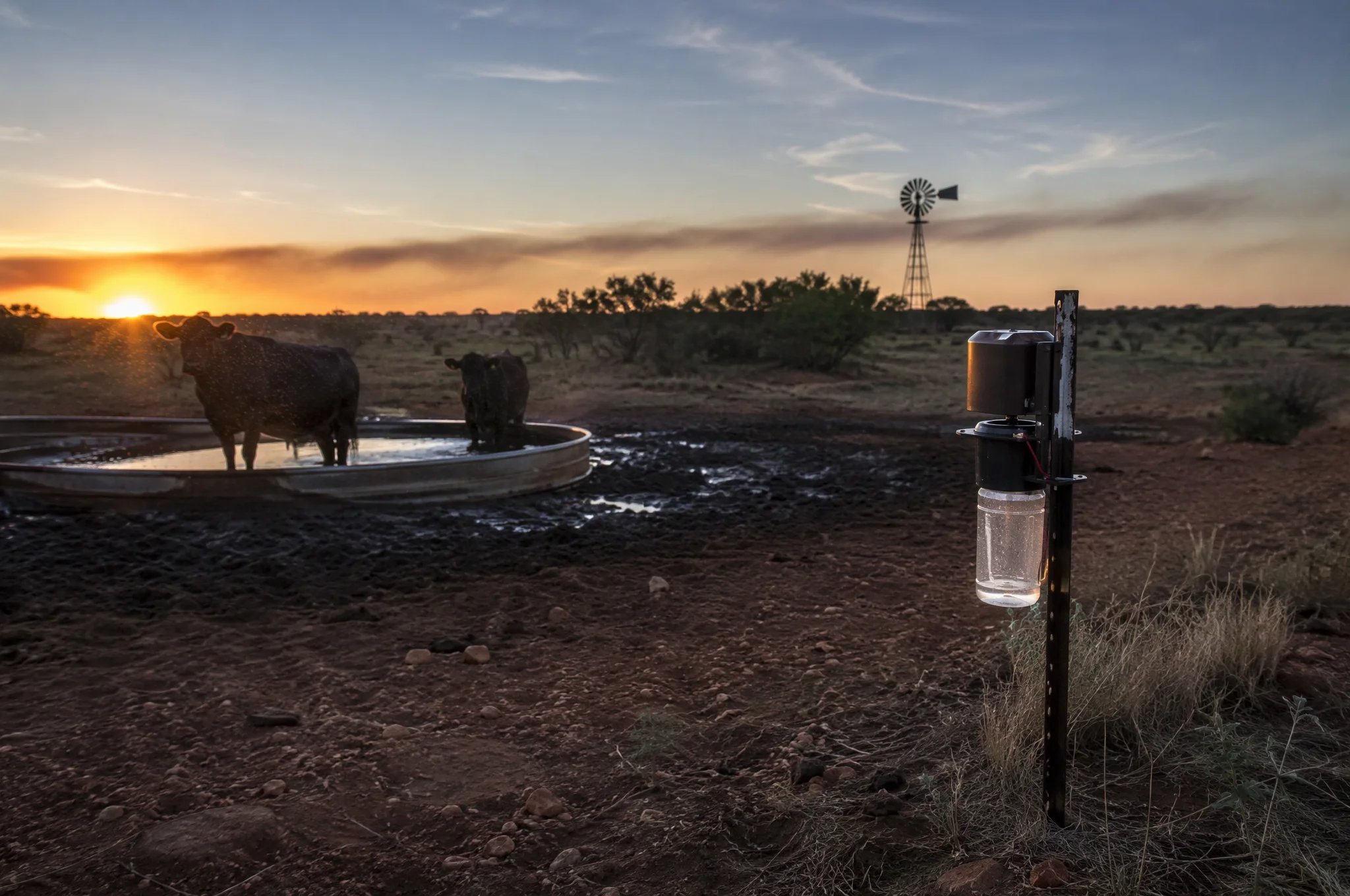
Why a Search for Biting Midges Texas Returns Patio Advice
The imbalance is not a conspiracy. It is a funding trail. Biting midges in the genus Culicoides transmit viruses of veterinary consequence, so the people paid to count them are animal-health laboratories rather than municipal vector districts.
Mosquito control districts publish mosquito numbers. Midge numbers surface in entomology and virology journals, attached to a disease question.
The consequence for a Texas reader is practical. The advice that travels well – dry the standing water, add air, fine-mesh the porch – was built from a nuisance model. The advice that has to be read out of the veterinary literature is about larval substrate that is not standing water at all, about animals as the thing that makes the substrate suitable, and about viruses that move at midge densities no homeowner would call a problem.
Both ledgers are legitimate. They answer different questions, and a Texas property usually needs one of them badly and the other not at all. This page keeps to the half of biting midges texas that nobody writes garden advice about.
| Question on your mind | Where it is answered here | What that page is built from |
|---|---|---|
| Why is my patio unusable at dusk, and what do I change first? | The Texas catch-record page | Published catches from Texas ground, marsh versus woodland communities, the yard substrate walk, screen aperture, air and timing |
| What is producing them on cattle, horse or deer ground, and what has ever been measured against it? | This page | Texas and southern-Plains vector studies, larvicide and adulticide trials with a Texas arm, hemorrhagic disease serology, vesicular stomatitis outbreak records |
| What bit me, read as a wound? | The bite-evidence page | Lesion geometry, the itch clock, what a topical can and cannot reach |
Texas Is Where the Country Learned What the Midge Carries
The American bluetongue story starts in this state. Hourrigan and Klingsporn put it in one line in a 1975 review in the Australian Veterinary Journal: “Bluetongue was first reported in the United States in 1948 in sheep in Texas.” The same paper records what a first season looked like in a naive flock – “When the disease first occurs in a flock, the morbidity may reach 50 to 75% and mortality 20 to 50%” – and what followed it: “In subsequent years, the morbidity may be only 1 to 2% with very few deaths.”
Those two sentences are the most useful thing in this article for anyone who keeps ruminants. Severity belongs to first contact. After that, the same virus on the same ground with the same midges produces very little visible disease.
The vector has not disappeared. The host population has moved.
The 1975 paper also states the vector conclusion without hedging: “Culicoides is considered the important insect vector of bluetongue.” And it names the animal that makes the system work quietly: “Cattle are considered significant virus reservoirs.” Cattle carry the virus without looking ill. Sheep show the disease. That asymmetry is why one species can be the reservoir and the neighbour be the casualty, and it is the first reason biting midges texas belongs in a veterinary conversation as much as a garden one.
Near-Universal Exposure, Almost No Visible Disease
If the vector is everywhere in Texas and cattle are reservoirs, what should a deer population look like? Stallknecht, Luttrell, Smith and Nettles ran the numbers on Texas ground. They “serologically tested 685 white-tailed deer collected from November 1991 through March 1992 throughout their range in Texas” and reported that “Overall, 574 (84%) of deer had antibodies to EHDV or BTV.”
Exposure was not a single hit either. The deer carried “evidence of exposure to two to five serotypes detected in each ecological region.” Prevalence ran from “57% in the Gulf Prairies” upward, reaching every animal sampled in the northwest Edwards Plateau.
And almost no sickness accompanied it. The authors refused to explain the gap away: “The apparent lack of HD in relation to this high antibody prevalence cannot be explained, but may be related to enzootic stability in which a near perfect host-virus relationship exists.
“
A later study went looking for one mechanism, working with fawns on Texas ground. The hypothesis is stated in the source itself: “Enzootic stability, potentially associated with acquired resistance and subsequent transfer of maternal antibodies, innate resistance, or both, has been hypothesized to explain the lack of reports of hemorrhagic disease (HD) in white-tailed deer”. Their antibody clock is worth writing on a barn wall: “precipitating antibodies disappeared by 23 wk of age and serum neutralizing antibodies disappeared by 17-18 wk of age.”
Outdoor fawns were bitten while still carrying that inherited antibody. By October, “39 of 40 (98%)” of the animals that had stayed outdoors were positive by agar gel immunodiffusion, and “32 (80%) had SN antibody titers to one or more of five viruses”. Virus itself came out of the population too: “Epizootic hemorrhagic disease viruses were isolated from seven (18%) of the outdoor fawns and all 40 remained clinically normal.” The authors concluded that “Natural exposure of deer to EHD and BT viruses occurred at this site in the presence of maternal antibodies without causing disease.”
| Study | Animals and place | Antibody finding | Visible disease |
|---|---|---|---|
| Stallknecht 1996, J Wildl Dis | 685 white-tailed deer, statewide, Nov 1991 to Mar 1992 | 574 of 685 positive to EHDV or BTV; two to five serotypes per ecological region; from 57% in the Gulf Prairies up | Few reports of hemorrhagic disease in these populations |
| Gaydos 2002, J Wildl Dis | Fawns, Texas site, indoors versus outdoors | 39 of 40 outdoor fawns positive by October; 32 of 40 with neutralising titre to at least one of five viruses | All 40 outdoor fawns clinically normal while carrying maternal antibody |
| Reeves 2024, J Zoo Wildl Med | 364 free-ranging mule deer, Trans-Pecos and Panhandle, 2015 to 2019 | 76% to BTV, 78% to EHDV, 71% to both | Sampled as apparently healthy animals |
The mule deer work matters because it is not the same deer or the same corner of the state. Reeves and co-workers sampled animals captured “in the Trans-Pecos and Panhandle regions of Texas from 2015 to 2019” and reported that “Antibodies to BTV and EHDV were identified in 76% (277/364) and 78% (285/364) of the population, respectively, and 71% (258/364) had antibodies to both diseases.” These were animals judged healthy enough to enter a reference-interval set.
Read the three studies together and a Texas rule emerges. Exposure is the baseline state of wild ruminants in this state. Disease is an event that needs its own explanation – a drought, a new water source, a herd moved in from elsewhere, a year with more midges than usual.
If you keep deer, elk, sheep or goats in Texas, the question is never whether the midge pressure exists. It is what has just changed, and that is the practical content of biting midges texas for anyone keeping susceptible stock.
How Many Midges It Takes
Nuisance advice assumes that density is the problem: fewer midges, less risk. The transmission literature does not support that arithmetic, and this is the section that should change how a landowner reads a good evening.
Ruder, Drolet, Mills and co-workers asked the question directly, using a colonised colony of the one species the record treats as proven. Their framing is blunt: “In North America, the only confirmed vector of EHDV is Culicoides sonorensis, although other Culicoides species are suspected vectors.” They then offered deer the bite of five midges, and in one case ten.
What happened at the skin is the part people skip. On the first deer, “deer A, only 1/10 midges fed and only took a partial blood meal but 4 additional probe sites were observed on the skin”. On the second, all five fed. “Both deer developed viremia and mild clinical disease.” The authors drew the obvious conclusion and named the mechanism: “Infection of WTD with EHDV-2 by the bite of 1 to 4 C. sonorensis demonstrates EHDV-2 transmission efficiency and the potential importance of probing.”
Probing matters because a probe is not a feed. A midge that samples and leaves can still deliver virus, and the same animal can be probed many times in an evening without a single completed blood meal being collected by the person trying to count them. Density on the skin is a poor proxy for exposure, which is one reason a bite count kept by hand is so hard to compare with anyone else’s. The counting units themselves are the problem, and that argument belongs to the threshold page, and it is why this half of biting midges texas resists a bucket count.
The second half of the arithmetic is what infection does to the midge, because that determines whether an infected population thins itself out. Erram, McGregor, Acevedo, Alto and Burkett-Cadena fed EHDV-2 to C. sonorensis through an infected blood meal and tracked the females and their offspring. The headline null result is the important one: “Our findings suggest that EHDV-2 infection has no major impact on C. sonorensis survival/longevity or oviposition but has a significant negative effect on midge fecundity/fertility.”
The fertility hit was large. “egg hatch rates were significantly lower in the EHDV-2 fed group (35.8 +/- 5.2%) than the control group (74.5 +/- 6.8%)” – and the compensation came from the other side of the same ledger, since “larval survival rates were higher in the EHDV-2 fed group (59.8 +/- 4.9%) compared to the control group (34.1 +/- 6.5%)”. The researchers also looked for the virus in the next generation and found it in “1.7%, 1/58 adults tested”, evidence for what they set out to test, namely “the potential vertical transmission of EHDV-2”.
Two consequences follow for anyone managing livestock ground. An infected midge is not a dying midge, so a population that is carrying virus does not announce itself by thinning out. And a hatch rate cut in half, offset by doubled larval survival, means adult abundance stays a bad reading of infection pressure in both directions.
| Question | What was measured | Result | What it rules out |
|---|---|---|---|
| How many infected midges are needed to infect a deer? | Two white-tailed deer exposed to 10 and 5 infected C. sonorensis | Both became viraemic; on one deer a single partially fed midge plus four probe sites was enough | The idea that a low-count evening is a safe evening for a susceptible animal |
| Does carrying the virus shorten the midge or reduce its laying? | Survival, oviposition rate, eggs laid, larval duration, eclosion, sex ratio | Not significantly different from uninfected midges | Using a thinning adult population as a sign that virus is circulating |
| Does an infected female leave fewer offspring? | Egg hatch and larval survival of the F1 generation | Hatch fell from 74.5% to 35.8%; larval survival rose from 34.1% to 59.8% | Reading next month’s trap count as evidence about this month’s infection rate |
Which Midge Is Doing It Is Still an Open Question
A manager reading the last section will notice that one species carries almost everything: Culicoides sonorensis. That species has a complicated identity, and Texas sits inside the complication.
Until 2000 it was treated as a variety inside the Culicoides variipennis complex. Holbrook, Tabachnick, Schmidtmann, McKinnon, Bobian and Grogan settled it by looking for hybrids. “We report sympatry among larval populations of the Culicoides variipennis complex in widespread and diverse aquatic habitats throughout the United States.”
The two patterns both included Texas: “Six sites in California, Nevada, New Mexico, and Texas were co-inhabited by C. v. occidentalis and C. v. sonorensis” and “8 sites in Florida, Georgia, Louisiana, Maryland, and Texas were co-occupied by C. v. sonorensis and C. v. variipennis.”
If two named forms share a breeding site and never blend, they are separate species. The authors found no blends: “No intermediate forms were identified either electrophoretically or morphologically in adults reared from field-collected larvae and pupae.” The result was to “elevate Culicoides sonorensis to species rank”, with one older name folded away: Culicoides albertensis “is a synonym of C. sonorensis”.
That is a clean taxonomic decision. It is also a warning about trap samples, because the next generation of tools found something the taxonomy had not settled. Paquette, Czekay, Manalaysay and co-workers built a multiplex real-time PCR to separate C. sonorensis from C. variipennis and C. occidentalis, noting that morphological separation “is laborious, time-consuming, and requires entomology expertise”. The assay worked against its reference set. Then it failed on eight animals: “The multiplex assay, however, failed to detect eight morphologically identified C. sonorensis specimens collected from Alberta in 2014.”
Their explanation was not a pipetting error.
The sequences formed their own cluster, and the authors wrote that “We hypothesize that those specimens might be C. albertensis” – the name the 2000 paper had put to sleep. The operational lesson for a buyer or a consultant is simple. A report that says Culicoides species, undetermined, is not a lazy laboratory. It may be the honest answer available for the complex your midge belongs to, which is why no supplier should promise species-level certainty out of biting midges texas samples.
What Biting Midges Eat When They Are Not Biting
Every control programme in this article targets blood feeding or larval mud. Both are real. Neither is the whole diet. Adult midges also drink sugar, and the study of that habit has only recently started producing numbers.
McGregor and Davis fed C. sonorensis sucrose or water before and after a blood meal and followed the females and their young. The abstract states the neglect directly: “biting midges also feed on sugar resources for energy, an area of study that has received little attention”. Sugar before the blood meal mattered twice over: “Access to sucrose prior to a blood meal increased adult survival
and resulted in a 12.9% increase in the proportion of females successfully taking a blood meal.” Sugar afterwards pushed the schedule: “Females provided access to sucrose after a blood meal produced eggs 2.1 d later than females provided water only after a blood meal.”
The survival gain is the number to notice. A female that lives longer has more chances to find a host, and in a vector that can transmit after a single probe, survival is the variable with the most leverage. The authors draw the conclusion for epidemiology rather than for the garden: “This study emphasizes the need to incorporate sugar ecology into our understanding of vector-borne disease epidemiology.”
What do wild midges actually drink? Nobody knew. Markwardt, Olds, Shults and McGregor went to a tallgrass prairie in northeastern Kansas and looked inside the flies for plant DNA. “The plants fed on by wild Culicoides are largely unknown, as are the driving forces behind selection of specific plants.” The yield tells you how hard the method still is: “DNA was extracted from a total of 788 biting midge individuals, with 321 (40.7%) of these successfully amplifying and just 78 (9.9%) producing a sequence with a successful host match.”
Of those 78, the matches scattered across “the Amaranthaceae, Cupressaceae, Solanaceae, and Verbenaceae”, and “Most matches were only identified to the plant family level with high confidence.” There was no loyal pairing of insect and plant: “no significant association was found between Culicoides species and plant family”. A generalist feeder is bad news for habitat-based control, because there is no single plant to remove and no specialist relationship to break. On biting midges texas ground that is the least glamorous finding in this article and one of the most useful.
Which is exactly why the applied version of this idea is a bait rather than a planting. Snyder, Cernicchiaro, Allan and Cohnstaedt built one: “The mixing of an insecticide with sugar solution creates an oral toxin or insecticidal sugar bait (ISB) useful for reducing adult insect populations.” Tested against C. sonorensis, the pyrethroids acted fastest, and “Pyrethroid treatments resulted in the greatest mortality in the first hour at the lowest concentrations and spinosad consumption resulted in the least mortality.”
The behavioural result is the one that decides whether such a bait would ever work on your ground. The midges were offered poisoned sugar and clean sugar at the same time. “Biting midges were not deterred from feeding on the 1% ISB solutions despite the presence of an insecticide-free alternative source of sugar.” They did not taste their way out of it. Whether that trade is worth making on a property with pollinators on it is a different calculation, and it is worked through on the lethal-method ledger.
A Larvicide Trial With a Texas Arm, and a Texas Result
Larval control is the intervention with the most theoretical leverage, because the midge has to pass through mud. It is also the intervention with the least published field evidence. Cuellar, Ewing, Swanson, Unlu and co-workers ran one of the few semi-field trials available, and they deliberately ran it in three climates.
The design matters more than the summary. The team tested larvicide products against C. sonorensis and “investigated how environmental factors influence the degradation and persistence of the larvicide active ingredients (AIs) in an artificial larval habitat at three study locations (Lubbock, TX; Manhattan, KS; and Slidell, LA)”. Lubbock sits on High Plains cattle ground. Slidell sits in Louisiana humidity.
The first finding is the good news, and it is narrow. “All tested larvicide products resulted in larval mortality in bioassays, but efficacy declined significantly with days post-treatment across all products.” Every product worked on the day it was applied. None of them stayed working.
The second finding is the one a Texas buyer needs. “Overall, larval mortality in bioassays post-treatment was significantly lower at the TX site relative to the LA and KS sites.” The driest of the three sites produced the weakest residual control. The authors then separated two usual suspects: “Qualitative comparisons between site-specific observed mortality and environmental conditions show variations in climate (precipitation but not photodegradation) possibly associated with product performance.” Sunlight was not the culprit. Rain was, in the counter-intuitive direction – “Greater amounts of rainfall occurred in LA and KS than in TX during the study periods, which is likely to have reduced residual efficacy over time.”
Read carefully, that last sentence is about disturbance as much as chemistry.
The authors’ own conclusion names both: “environmental factors, particularly precipitation and larval habitat substrate disturbance may have played a role in limiting larvicide efficacy against Culicoides midges”. On Texas ground, the substrate that grows midges is the substrate cattle stand in. Anything that moves cattle moves the habitat. A product that fails in the Panhandle and holds in Louisiana is not a different chemical. It is the same chemical on ground that gets worked, which is the most under-sold caveat in biting midges texas control.
| Measurement | Result across the three sites | Practical reading |
|---|---|---|
| Immediate kill in bioassay | All products caused larval mortality | No product needs defending on day one |
| Persistence | Efficacy declined significantly with days after treatment, for every product | Re-application interval is the specification, not the active ingredient |
| Site ranking | Texas was significantly lower than Louisiana and Kansas | Arid-ground expectations set from wet-ground trials will disappoint |
| Attributed driver | Precipitation, not photodegradation; substrate disturbance named in the conclusion | What the animals do to the mud is part of the treatment |
Chemical Control: Susceptible Now, Which Proves Nothing About Next Season
Two Florida papers published a year apart read like an argument with themselves, and both are useful. They are also the closest thing the literature has to an honest adulticide baseline for biting midges.
Cooper, Buckner, Campos-Krauer, Wisely and Burkett-Cadena started from a gap: “Current control practices for biting midges rely heavily on chemical insecticides, yet their efficacy and potential for insecticide resistance in biting midges remain poorly documented.” They collected wild midges on five Florida deer farms and tested six species by the bucket: “C. insignis (n = 944), C. stellifer (n = 269), C. debilipalpis (n = 68), C. venustus (n = 16), C. edeni (n = 5), C. furens (n = 5)”.
At a dose of “10.75 ug permethrin per bottle” in a CDC bottle bioassay, mortality was total “within 30 min across all Culicoides spp.” Semi-field cages sprayed at the maximum label rate behaved the same way. Their conclusion was reassuring on its own terms: “significant resistance to permethrin has not developed in the Culicoides populations tested.”
Pitzer, Cooper, Taylor, Phillips, Burkett-Cadena and Shults tested the same chemical a year later and moved the question. They noted first that “research regarding biting midge insecticide efficacy largely has been focused on animal and barrier treatments using formulated commercial products”. Then they compared colonies with wild flies: “the susceptibility of a laboratory-reared biting midge colony” “was significantly less than wild Culicoides spp.” And wild midges were softer than wild mosquitoes, since “Similarly, wild Culicoides spp. also were significantly more susceptible than wild mosquitoes when exposed to an ultra-low volume permethrin application under field conditions.”
The part that matters for the next decade of spraying is the selection experiment. Pushing a colony through permethrin generations produced a shift, and the authors drew the inference carefully: “insecticide resistance development in this pest could occur in field populations if pressured.” They label it for what it is: “This is the first account of the potential for insecticide resistance development in Culicoides.”
Put the two papers side by side and the honest reading is not that permethrin works, nor that it is failing. It is that the window where it works is a property of the population you are spraying, of the dose that actually arrives, and of how many times you have arrived with it. Susceptibility is a measurement with an expiry date, and nothing in either paper sets that date for biting midges texas populations.
The third paper closes the loop on what happens between full success and outright failure. Mullins and McDermott opened with the observation that “The efficacy of insecticide treatments can wane over time as insects either develop resistance or the active ingredient is degraded in the environment”, and with the premise that “Sublethal insecticide exposures can change vector behaviour in ways that affect vectorial capacity.” They exposed midges to permethrin, coumaphos and fluralaner at concentrations designed to kill a tenth to a third of them, then offered a blood meal.
“We identified a significant inhibition of engorgement by permethrin up to 12 h post-exposure as well as by fluralaner up to 6 h post-exposure.” That is not a win, because a suppressed midge is a midge that is still alive and still probing, and probing was just shown to be enough. One result even ran the other way, which is why the authors note that “The different modes of action of each of these insecticides may account for their differing effects on Culicoides feeding.” A dose that has drifted below label is a behavioural intervention you did not choose.
| What was tested | Population | Measured outcome | Boundary of the claim |
|---|---|---|---|
| Permethrin bottle bioassay, 10.75 ug | Six wild species from five Florida deer farms | All tested midges dead within 30 minutes | One county, one chemical, one season |
| Ultra-low volume permethrin at label rate | Same wild midges, semi-field cages | Total mortality within one hour | Caged midges cannot leave the spray cloud |
| Laboratory colony versus wild flies | Colony C. sonorensis against wild Culicoides | The colony was significantly less susceptible | Colony data understates field knockdown |
| Repeated laboratory selection | A long-established colony | Resistance could develop under pressure | Potential, not a field failure yet reported |
| Sublethal exposure | C. sonorensis at LC10 to LC30 | Engorgement inhibited up to 12 hours after permethrin | Feeding was suppressed, not stopped, and the midges survived |
Vesicular Stomatitis: Outbreak Arithmetic, Not Nuisance Arithmetic
Of the midge-borne problems in Texas, the one that produces county-level consequences is vesicular stomatitis. It is not a nuisance story. It is a movement, market and quarantine story, and its published record is written in premises and counties rather than in bites.
Pelzel-McCluskey, Christensen, Humphreys and a long list of co-authors reviewed the US position with the 2019 and 2020 seasons in view. The pattern they describe is episodic by design: “Over the past 20 years, VSNJV outbreaks in the southwestern and Rocky Mountain regions occurred with incursion years followed by virus overwintering and subsequent expansion outbreak years.” The regulatory lever follows from that: “Regulatory response by animal health officials is deployed to prevent spread from lesioned animals.”
Then the sizes. “The 2019 VS incursion was the largest in 40 years”, running “from June to December 2019 with 1144 VS-affected premises in 111 counties in eight states”, Texas among them, “and was VSIV serotype, last isolated in 1998.” The following year did not shrink much: “A subsequent expansion occurred from April to October 2020 with 326 VS-affected premises in 70 counties in eight states.” And the two viruses behaved separately: “The primary serotype in 2020 was VSIV, but a separate incursion of VSNJV occurred in south Texas.”
Read as a Texas landowner, that paragraph contains the whole reason insect identity is a veterinary question here. A six-month outbreak window across eleven hundred premises is not controlled by anything an individual owner does to a patio. What an owner can control is what happens at the fence line during those months, and what paperwork their animals carry. That is the part of biting midges texas that ends in a phone call rather than a spray tank.
What were the insects doing during an outbreak? Scroggs, Swanson, Steele and colleagues ran surveillance during the 2023 season, when “a multi-state outbreak of vesicular stomatitis New Jersey virus (VSNJV) occurred in California, Nevada, and Texas, infecting horses, cattle, and rhinoceros”. Carbon dioxide baited traps set from mid-May to mid-August “collected 2357 Culicoides biting midges and 1215 Simulium black flies”. Of the pools tested, “Nine RNA-positive pools of Culicoides spp. and sixteen RNA-positive pools of Simulium spp were detected”, and “Infectious virus was detected by cytopathic effect in 96% of the RNA-positive pools.”
RNA is not proof of transmission, and the authors say so: “The vector competency of these species for VSNJV has yet to be determined but warrants examination.” The same group had earlier shown why the caution is worth having. In Wyoming in 2006, Drolet, Reeves, Bennett and co-workers recorded that “Within two weeks of the outbreak onset, 12,203 biting flies and 194 grasshoppers were collected near three equine-positive premises in Natrona County, WY.” They also noted that “Collected dipterans known to be competent for VSV transmission included Simulium black flies and Culicoides biting midges”, and sequenced the virus out of black flies until it matched the index horse exactly. They called it “the first field evidence of possible VSV maintenance in black fly populations during an outbreak.”
The laboratory side explains why maintenance is plausible. Rozo-Lopez and Drolet grew the virus in either mammalian or insect cell lines and then fed it to midges. Where the virus had to cross the midgut to establish, “the insect-derived viruses had significantly higher titers, infection, and dissemination rates than mammalian-derived viruses”. They also pointed at a route nobody sprays for: “females and males are capable of highly efficient venereal transmission, despite their relatively low virus titers”, which is why they conclude that “Culicoides may play a role in VSV overwintering.”
| Season | What the record counts | Where | Vector evidence |
|---|---|---|---|
| 2006, Wyoming | One index horse; 12,203 biting flies collected in two weeks | Three equine-positive premises, Natrona County | Virus sequence from black flies identical to the index case |
| 2019, eight states | 1144 affected premises, 111 counties, June to December | Colorado, Kansas, Nebraska, New Mexico, Oklahoma, Texas, Utah, Wyoming | VSIV, a serotype last isolated in 1998 |
| 2020, eight states | 326 affected premises, 70 counties, April to October | Arizona, Arkansas, Kansas, Missouri, Nebraska, New Mexico, Oklahoma, Texas | VSIV dominant, with a separate VSNJV entry into south Texas |
| 2023, three states | Horses, cattle and rhinoceros affected | California, Nevada, Texas | 2357 midges and 1215 black flies trapped; 25 RNA-positive pools, infectious virus from 96% of them |
What Stands on the Ground Last Month Emerges This Month
Everything above points at the same lever, and one study measured it directly. McGregor, Markwardt and Davis asked whether the animals using a site change what comes out of the mud, and answered it without relying on anyone’s memory of where the cattle had been. “Trail cameras recorded vertebrate activity at eight sites at the Konza Prairie Biological Station with cattle, cervids, and/or bison, which was paired with larval substrate sampling to investigate midge density.” Their starting premise is the sentence to quote to a supplier: “the importance of vertebrate animal activity in biting midge density has not been satisfactorily quantified”.
The headline correlation is a lag, not an event. “The total time spent by all 3 target animals over the previous month and the average time spent by bison were significantly positively correlated with overall biting midge emergence.” Animal hours in the previous month, counted by camera, tracked midge emergence. And the effect was not uniform across species: “These results show that different ungulates impact midge abundance and emergence in different ways”, with cattle days and cattle events lining up positively for C. crepuscularis and several bison variables cutting the other way for other species.
Two consequences. First, a management change on livestock ground has an entomological lag of roughly a month, so a treatment judged three days later is being judged against the wrong population. Second, the direction of effect belongs to the species, which means a single number such as midges per night is summarising several organisms that responded to your cattle differently, which is why biting midges texas surveys reporting one total are so hard to act on.
Where the risk sits inside a property is a separate question, and it does not resolve evenly. Benn, Orange, Gomez and co-workers modelled abundance across two transmission seasons on farmed-deer ground in Florida, tracking gravid females and “parous (most likely to transmit the virus)” females separately, on the premise that “Understanding how midges are distributed across landscapes can inform HD virus transmission risk on a local scale”. The habitat signal was state-dependent: “Gravid midges preferred areas close to water on the border of well and poorly drained soil”, while “parous midges appeared less selective of habitat”. Their conclusion is the one that should govern where anyone spends money: “the distinct spatial and abundance patterns between species and physiological states suggest that the HD risk is non-random across the study area”.
Non-random is good news for a manager, because non-random patterns can be found and avoided. It is also a warning about the word abundance. The midges that matter epidemiologically are the ones that have already fed and are looking again, and those are the ones least tied to the wet edge you can see from the truck.
Finally, the frame around all of it. Hudson, McGregor, Shults and co-workers reviewed what a warming, drier, windier pattern does to this family of viruses, listing effects that “lead to range expansion in the geographic distribution of vector species, and increase transmission period duration (earlier spring onset and later fall transmission)”. Their statement about Texas weather specifically is written as a conditional, and it should stay written that way: “If transmission intensity is associated with weather anomalies such as droughts and wind speeds, there may be changes in the number of outbreaks and periods between outbreaks for some regions.”
Reading Biting Midges Texas Against Your Own Ground
Five questions, in order. Each one is answerable on foot in under an hour, and each one is a different decision than the last. This is the part of the page a ranch manager, a boarding barn, a hunting lease or a pest-control contractor can hand to somebody.
| Question | What a real answer looks like | Why the record says so |
|---|---|---|
| 1. Which ground gets wet and stays trampled? | A named list of tank aprons, low points under fence lines, shade-bank mud, bedding piles, the ground under a hay feeder | Larval habitat is worked mud, not a pond; substrate disturbance was named as a limit on larvicide performance in the three-site trial |
| 2. What animals stood there in the last thirty days? | Camera or shift records per site, not a memory of where the herd generally is | Time spent by animals in the previous month correlated positively with midge emergence across eight study sites |
| 3. Is my expectation built on the wrong climate? | Re-application intervals taken from label plus a local check, not from a wet-state trial | Residual larvicide performance was significantly lower at the Texas site than at the Louisiana and Kansas sites |
| 4. What has my contractor actually sprayed, at what dose, how often? | Product, concentration, rate, date, weather, and the count before and after on the same unit | Susceptibility is measured, not permanent; selection experiments showed resistance can develop under pressure, and sublethal exposure changes feeding behaviour |
| 5. What is my paperwork position during an outbreak year? | A movement plan that assumes premises-level and county-level controls, plus a defined point at which you stop treating and start documenting | Recent US outbreaks ran to 1144 and 326 affected premises across eight states, with regulatory response aimed at spread from lesioned animals |
Notice what is not in that list. There is no question about a device, a supplement, an ultrasonic unit, or a fogger sold for patio use. There is no question about how the bites look, which is answered elsewhere on this site, and no question about which screen mesh to order, which belongs with the exclusion material on the netting page.
Where a CO2 Suction Trap Belongs in This Record
Every number in the outbreak table above came out of a trap, and most of those traps were baited with carbon dioxide. That is worth stating because it explains what our own equipment is and is not, honestly.
Pittar builds airflow-suction carbon dioxide traps for outdoor ground: a machine that mimics the exhaled-carbon-dioxide cue that host-seeking biting insects follow, pulls them in on an airflow, and lets them desiccate. The published coverage figure is 4,000 square metres, which puts it in the range of a large property rather than a room, and it is an outdoor device only. Indoors and on small areas it is the wrong tool. The M3000 starts on battery and runs on gas, for ground where the trap has to stand where the animals or the guests are rather than where the nearest outlet happens to be; the MM4200 runs on mains where mains exist.
What this article does not contain is any published study showing that such a machine reduces hemorrhagic disease in a herd, cuts vesicular stomatitis incursions, or removes biting midges from a Texas property. The midge literature uses carbon dioxide traps as instruments to find out what is there. That is a real role, and it is the one we claim: a device on your ground, counted on the same unit every week, turns a feeling about a season into a record you can act on and a contractor can be measured against.
For the placement logic and the mosquito-side evidence, see where a trap goes in a yard and what outdoor performance data supports. For why one trap cannot estimate abundance, read the detection-ladder page and who actually counts biting insects.
Distributors, pest-control companies and facility buyers asking how the range maps onto a feedlot yard, a resort perimeter or a lease of several hundred acres should read the application pages, look at the two models side by side, and for private-label or programme work the OEM and ODM page. Pricing is by enquiry, because the answer depends on area and site.
Frequently Asked Questions
Are biting midges texas-wide, or only on the coast?
Texas-wide, and the published communities differ by ground rather than by coastline. The serological record covers the state from the Gulf Prairies to the Trans-Pecos and the Panhandle, with 84% of 685 deer statewide carrying antibodies to at least one of the two virus groups. Coastal marsh ground produces its own midge fauna, which is dealt with on the catch-record page; inland livestock ground produces the problems covered here.
Will a dry summer end the midge season?
Not by itself, and on the chemical side it can make matters worse. Drought is a recognised variable in midge-borne outbreak dynamics, but the mechanism that is documented in detail runs the other way from intuition: the residual performance of a larvicide was significantly lower at the driest of three trial sites. Dry ground with an irrigated tank, a leaky float or a shade bank of packed mud is still producing midges. Walk the wet spots rather than reading the calendar, a method worked through on the larval-habitat page.
My cattle look fine. Does that mean there is no virus?
No. It is the opposite of an indicator. Cattle are described in the review literature as significant virus reservoirs, and the practical pattern in the Texas deer and mule deer serology is widespread exposure with little or no clinical disease. If you keep sheep, goats or deer alongside cattle, the susceptible species is the one that will show it first, and the first season is the worst one.
I counted far fewer midges this week. Is my risk down?
Not reliably. A single trap count measures one species’ response to one night, and the studies above found infection in populations whose adult numbers were not exceptional, plus transmission from one to four midges. The physiology is also against you: a virus-carrying female does not die younger or lay fewer eggs, she simply hatches fewer of them while more of her larvae survive. Read how to choose a counting unit before trusting any number, including ours.
Should I ask a contractor for a resistance test before spraying?
Ask what they can prove, and about which population. The published bioassay work used a defined dose and a defined read time on wild-caught midges from named farms, and the same laboratory group separately showed that a colony under selection can shift. Nobody in the retrieved record has tested a Texas field population for permethrin resistance. Absence of a published failure is not evidence of susceptibility, and a supplier who claims one from the other is over-reading the literature.
Does any of this apply to a house with a yard and no livestock?
Partly. The animals-on-the-ground logic stops mattering; the arrival logic starts mattering, and that is a different page. The state-level weather gates that decide whether tonight is a flying night live on the season and hour page, the indoor questions on midges inside a house, and the repellent evidence – which is thinner than most products imply – on the repellent page. Neither is the livestock ledger this page was written to add to biting midges texas.
What This Page Does Not Claim
It does not claim that any device, spray, bait or planting reduces biting midges on a Texas property. The larvicide trial cited here measured mortality in bioassay under semi-field conditions, and its own authors attributed the differences between sites to precipitation and substrate disturbance rather than to product quality.
It does not identify the species in your trap, and it does not pretend anyone else’s report reliably does; the naming problem inside the variipennis complex is described above from the primary taxonomic and molecular work. It does not transfer the Florida adulticide results to Texas populations, the Kansas emergence correlation to a feedlot, or the farmed-deer habitat model from Florida to any Texas county.
It does not offer a diagnosis, a drug or a dose for an animal, and nothing here replaces a veterinarian or a state animal-health official. The clinical and regulatory numbers are reproduced from published papers as measurements of past events. Reading biting midges texas out of those events is your judgement, not the authors’.
Sources Consulted
- Hourrigan and Klingsporn (1975). Epizootiology of bluetongue: the situation in the United States of America. Australian Veterinary Journal, 51(4), pp 203-208. 10.1111/j.1751-0813.1975.tb00056.x
- Stallknecht et al. (1996). Hemorrhagic disease in white-tailed deer in Texas: a case for enzootic stability. Journal of Wildlife Diseases, 32(4), pp 695-700. 10.7589/0090-3558-32.4.695
- Gaydos et al. (2002). Dynamics of maternal antibodies to hemorrhagic disease viruses (Reoviridae: Orbivirus) in white-tailed deer. Journal of Wildlife Diseases, 38(2), pp 253-257. 10.7589/0090-3558-38.2.253
- Reeves et al. (2024). HEMATOLOGY AND BIOCHEMICAL REFERENCE INTERVALS AND SEROPREVALENCE OF HEMORRHAGIC DISEASES FOR FREE-RANGING MULE DEER ( ODOCOILEUS HEMIONUS ) IN WEST TEXAS. Journal of Zoo and Wildlife Medicine, 55(4), pp 1019-1031. 10.1638/2023-0118
- Ruder et al. (2026). Apparent transmission efficiency of Culicoides sonorensis (Diptera: Ceratopogonidae) for epizootic hemorrhagic disease virus serotype 2 in white-tailed deer (Odocoileus virginianus). Journal of Medical Entomology, 63(3), pp tjag072. 10.1093/jme/tjag072
- Erram et al. (2025). Epizootic hemorrhagic disease virus oral infection affects midge reproduction and is vertically transmitted to offspring in Culicoides sonorensis. Scientific Reports, 15(1), pp 16078. 10.1038/s41598-025-00849-y
- Holbrook et al. (2000). Sympatry in the Culicoides variipennis complex (Diptera: Ceratopogonidae): a taxonomic reassessment. Journal of Medical Entomology, 37(1), pp 65-76. 10.1603/0022-2585-37.1.65
- Paquette et al. (2024). Development of a Multiplex Real-Time PCR to Disambiguate Culicoides sonorensis within Culicoides variipennis Complex, the Proven Vector of Bluetongue and Epizootic Hemorrhagic Disease Viruses in North America. Current Issues in Molecular Biology, 46(9), pp 9534-9554. 10.3390/cimb46090566
- McGregor and Davis (2026). Sugar feeding impacts reproductive success and progeny development in Culicoides sonorensis biting midges (Diptera: Ceratopogonidae). Journal of Medical Entomology, 63(1), pp tjaf188. 10.1093/jme/tjaf188
- Markwardt et al. (2026). Natural sugar-source associations of Culicoides biting midges (Diptera: Ceratopogonidae) in a Kansas tallgrass prairie. Journal of Medical Entomology, 63(3), pp tjag065. 10.1093/jme/tjag065
- Snyder et al. (2016). Insecticidal sugar baits for adult biting midges. Medical and Veterinary Entomology, 30(2), pp 209-217. 10.1111/mve.12158
- Cuellar et al. (2026). Evaluating larvicide performance against Culicoides sonorensis in semi-field conditions. Pest Management Science, pp ps.71298. 10.1002/ps.71298
- Cooper et al. (2025). Laboratory and semifield data indicate that vector Culicoides spp. in Florida are susceptible to permethrin. Journal of Medical Entomology, 62(5), pp 1235-1242. 10.1093/jme/tjaf077
- Pitzer et al. (2026). Assessing permethrin susceptibility of field-collected biting midges in Florida and evidence for resistance evolution using laboratory selections. Medical and Veterinary Entomology, 40(4), pp 859-868. 10.1111/mve.70070
- Mullins and McDermott (2025). Changes in Culicoides sonorensis feeding behaviour following sublethal insecticide exposure. Medical and Veterinary Entomology, 39(4), pp 794-801. 10.1111/mve.70000
- Pelzel-McCluskey et al. (2021). Review of Vesicular Stomatitis in the United States with Focus on 2019 and 2020 Outbreaks. Pathogens, 10(8), pp 993. 10.3390/pathogens10080993
- Drolet et al. (2021). Identical Viral Genetic Sequence Found in Black Flies ( Simulium bivittatum ) and the Equine Index Case of the 2006 U.S. Vesicular Stomatitis Outbreak. Pathogens, 10(8), pp 929. 10.3390/pathogens10080929
- Scroggs et al. (2024). Vesicular Stomatitis Virus Detected in Biting Midges and Black Flies during the 2023 Outbreak in Southern California. Viruses, 16(9), pp 1428. 10.3390/v16091428
- Rozo-Lopez and Drolet (2024). Culicoides -Specific Fitness Increase of Vesicular Stomatitis Virus in Insect-to-Insect Infections. Insects, 15(1), pp 34. 10.3390/insects15010034
- McGregor et al. (2025). Investigating ungulate site use as a driver of Culicoides (Diptera: Ceratopogonidae) emergence from larval habitats. Journal of Medical Entomology, 62(3), pp 641-647. 10.1093/jme/tjaf005
- Benn et al. (2024). Culicoides Midge Abundance across Years: Modeling Inter-Annual Variation for an Avian Feeder and a Candidate Vector of Hemorrhagic Diseases in Farmed Wildlife. Viruses, 16(5), pp 766. 10.3390/v16050766
- Hudson et al. (2023). Culicoides-borne Orbivirus epidemiology in a changing climate. Journal of Medical Entomology, 60(6), pp 1221-1229. 10.1093/jme/tjad098