
No See Um Killer: What Proof of a Kill Actually Looks Like
Search for a no see um killer and you get a product list. Almost every item on it was tested on mosquitoes, and none of them is obliged to tell you which midge species it killed, at what dose, by which route, or inside how many minutes. That list is not worthless. It is simply not a kill claim, and the gap between the two is what this page is about.
The phrase carries two jobs at once. One is honest: something has to die, or the biting stops only for as long as the spray smell lasts. The other is unfalsifiable: a bottle that says it kills no-see-ums is treated as proven because the bottle exists. Between those two jobs sits a small, recent body of real laboratory and field work on how susceptible biting midges actually are to the chemicals used against them.
That work is quotable, and it disagrees with the shelf in instructive ways. Permethrin applied at the maximum label rate inside a cage on a Florida deer farm killed 100 percent of every Culicoides species tested within an hour (Cooper et al., 2025). The same active ingredient poured onto a deer reduced one midge species 175-fold and had no measurable effect on three others. Midges that survive a dose are not necessarily midges that stop transmitting: animals reared as larvae on three pesticides produced adults with significantly higher bluetongue virus levels (Bunkers et al., 2026).
What follows is the structure of a kill claim, what the midge literature has established since 2023, and the questions that separate a measured midge number from a borrowed mosquito number. If you only want tonight’s answer, the honest version is on this site already in what kills no-see-ums instantly. If you want every method scored against the same three tests, read what kills no-see-ums.
What a No See Um Killer Claim Has to Specify
A kill claim that cannot be argued with is missing six fields. Fill them in and most retail language evaporates, not because it is dishonest but because it was never scoped to a two-millimetre fly.
| Field | The question it answers | What it rules out |
|---|---|---|
| Species | Which Culicoides was actually exposed? | Claims carried over from mosquitoes or from a single convenient species. |
| Life stage | Adult, larva, pupa, or all three? | Adult knockdown sold as population control. |
| Route | Touching it, landing on it, breathing it, or eating it? | A bottle number quoted as a field result. |
| Formulation and dose | Which product, at which concentration, in which carrier? | Technical-grade laboratory numbers read as label rates. |
| Endpoint and clock | Knocked down or dead, and at how many hours? | One-hour knockdown reported as 24-hour kill. |
| Population | A colony line, wild midges, or your site? | Colony susceptibility assumed to be the local truth. |
Route is the field people skip, and it is the one that changes the answer most violently. Same compound, same insect, three routes, three results, as the fluralaner work in the fourth section shows.
Endpoint is the second skipped field. A midge lying on its back in a vial has not necessarily died, and the difference matters when the reader’s real question is whether the animals arriving tomorrow will bite. This site treats the knockdown-versus-death split in the 24-hour answer and will not re-argue it here.
Population is the field nobody sells against. A colony line kept in a laboratory for decades is a different organism from the midge in your hedge, in the sense that it has a different history of exposure. When the two disagree, the disagreement is the finding.
Species is the field that quietly limits everything downstream, because Culicoides is not one pest with one habits sheet. The control question is decided by which species you have and where it breeds, which is why no-see-ums under the microscope keeps coming back before any product conversation can be settled.
How a Midge Kill Test Is Built
Entomologists have a settled method for answering a kill question, and it is worth knowing the names, because they are the difference between a measurement and a marketing line. The two workhorse devices are the tube and the bottle.
The reference paper for a no-see-um killer tested this way is explicit about the toolbox. As the authors put it: “Insecticide resistance is often detected through laboratory bioassays such as the World Health Organization (WHO) tube assay and the Centers for Disease Control and Prevention (CDC) bottle bioassay”. The same paper states why the assay exists at all: “Monitoring insecticide susceptibility and resistance in target arthropods is a cornerstone in a successful control program”.
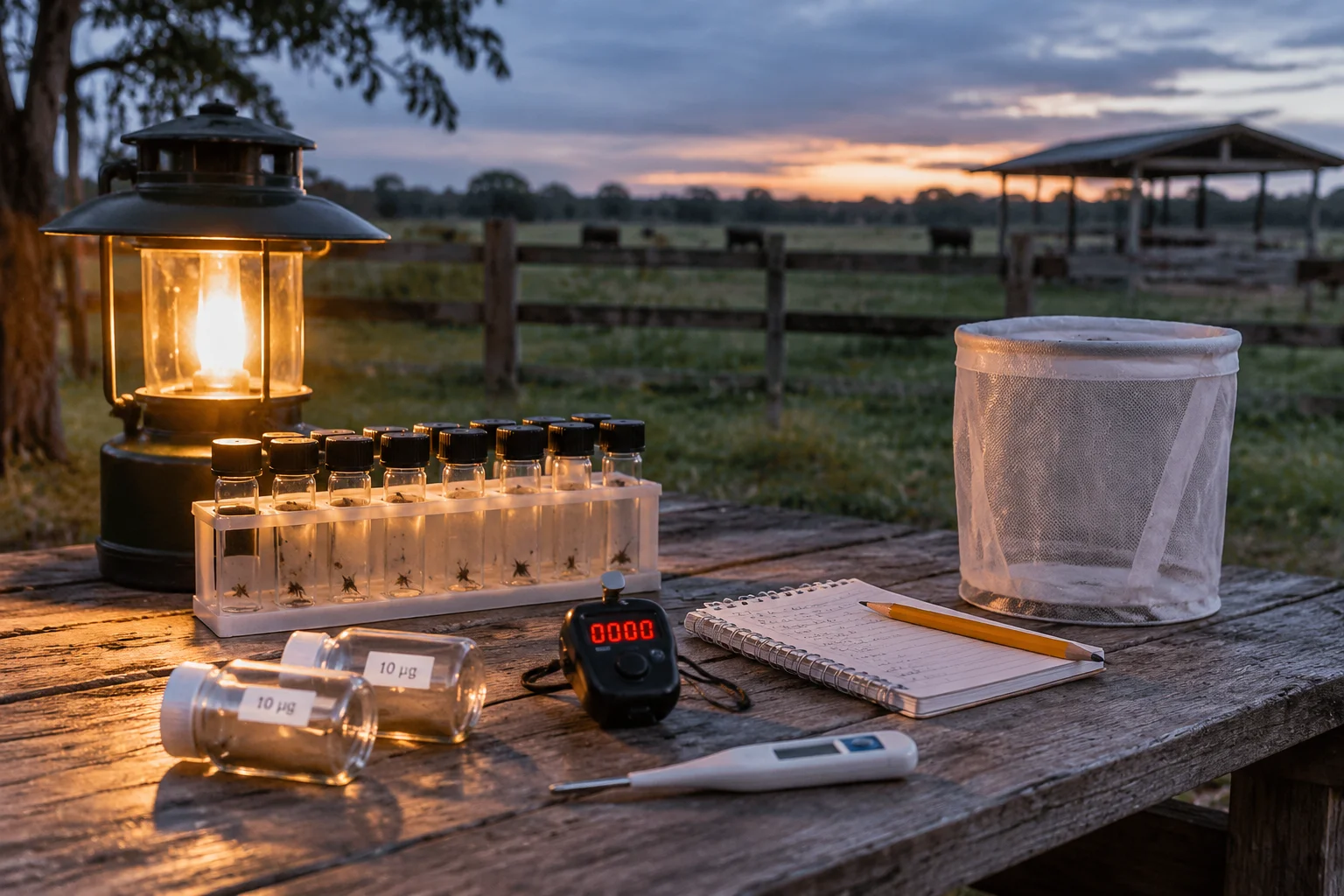
A CDC bottle bioassay is a glass vial coated inside with a measured deposit of a formulated product, into which a known number of insects is introduced. The number that matters is the deposit. In the Florida work on Culicoides furens, the authors report: “We identified a diagnostic dose (10.75 ug) and time (30 min) that resulted in 100% mortality in CDC bottle bioassays”.
A diagnostic dose is the operational version of a kill claim, and it is worth pausing on, because it is what a resistance programme actually runs. You expose insects to a dose known to kill every susceptible individual, so a survivor is not a partially killed insect but a piece of evidence, and the finding is a claim about a population rather than about a product.
The third device is the cage. Laboratory doses do not translate themselves into sprayers, wind, and a wet hedge, so the Florida team built the middle step: “Additionally, we determined that no-see-um netting is an effective mesh for field cage trials, allowing for the accurate assessment of Culicoides susceptibility to ultra-low volume applications of formulated adulticides like Permanone 30-30, a widely used adulticide”.
Those three layers, tube, coated bottle, field cage, are also the reason a laboratory result and a field result can both be true and still disagree. Each layer changes one variable and holds the others still. Most consumer advice collapses all three into a single sentence about a product, which is where the confusion lives.
What the 2025 Midge Assays Found
Start with the result that surprises people who have read midge forums: on the specimens tested, the standard chemical still works completely. From the same Florida group, for wild midges collected on five deer farms: “Centers for Disease Control and Prevention bottle bioassays using 10.75 ug permethrin per bottle resulted in 100% mortality within 30 min across all Culicoides spp”.
And at the field layer, with a sprayer and a label rate rather than a coated vial: “Similarly, semifield cage trials with ultra-low volume permethrin-based space sprays applied at maximum label rate caused 100% mortality of all Culicoides spp. and susceptible Ae. aegypti within 1 h after exposure”.
The parallel study on the beach species reached the same endpoint in a sentence: “Permethrin caused 100% mortality in C. furens in field and laboratory assays”. That is the strongest form the claim can take, and it is worth knowing how narrow the ground underneath it is.
The narrowness is geographic and occupational. Both studies were done in Florida, on deer farms and coastal sites, against the species those sites produce. The context the authors give for the practice they were measuring: “Permethrin-based insecticides are the primary control tool against biting midges, with 86% of Florida deer farmers reporting regular use”.
| Test | Exposure | Measured result | Reading |
|---|---|---|---|
| Wild Florida Culicoides, coated bottle | 10.75 micrograms of permethrin per bottle | 100% mortality in 30 minutes | No resistance detected at the deposit tested |
| Same midges, field cage | ULV permethrin, maximum label rate | 100% mortality in 1 hour | The label rate was still the right rate |
| C. furens, field and laboratory | Formulated permethrin | 100% mortality in both | A diagnostic dose now exists for a no-see-um |
| Wild midges versus lab mosquitoes | ULV permethrin under field conditions | Wild midges more susceptible than wild mosquitoes | Do not borrow mosquito failure for midges |
| Laboratory C. sonorensis colony | Same comparison | Colony significantly less susceptible than wild midges | The reference animal can point the wrong way |
| C. sonorensis colony under selection | Repeated permethrin exposure | Resistance development indicated | The tool is spendable, not permanent |
Read as a set, those rows say something more useful than either a blanket claim that sprays work or a blanket claim that they fail. They say the number exists now, on the right insect, at the right dose, in the right places, and that it is a small number of places. A claim of competence for a no see um killer is a claim about a measured population, and the honest seller states which one.
Three Ways a Midge Number Does Not Transfer
A measured kill is not a portable quantity. Three separate transfers fail in the midge literature, and each one is documented with a number rather than an opinion.
Route: the same compound, three answers
Fluralaner is an isoxazoline, better known as a dog and cat parasite treatment than as a midge control agent. The 2023 study that exposed adult Culicoides to it by three routes produced results far enough apart to settle the argument on its own.
Same compound, same insect, three ways of meeting it. The gap between the answers is wider than most product labels suggest.
- Contact. Let a midge walk on a treated surface and almost nothing happens. The authors report: “Even the highest concentration tested (100 mg/ml) resulted in an average of only 24.3% mortality at 24 h, and mortality did not significantly differ between exposed and control midges at any concentration”.
- Topical. Put a drop on the insect and the ranking inverts. “One hundred percent mortality was consistently achieved at concentrations of 1 mg/ml when fluralaner was applied topically”. The potency figure attached to that route is stark: “The LC 50 for topical exposure to fluralaner at 24 h was estimated to be 0.011 mg/ml”.
- Oral. Feed it to the midge inside a blood meal and the compound is fastest of all. “Oral exposure to fluralaner through ingestion of a spiked blood meal proved to be the most effective exposure method, significantly increasing mortality in a dose-dependent manner at 1 h post-exposure”.
A hundred milligrams per millilitre by contact performs worse than one milligram per millilitre by touch, and the oral route beats both on speed. That is why a no see um killer sold on an active ingredient alone is being described at the wrong level of detail, and why a product name plus a concentration does not predict what happens in a hedge.
Species: one treatment, four outcomes on four midges
The deer-farm barrier study is the cleanest demonstration that a treatment is a species claim. Its headline is genuinely strong: the treated fence and the pour-on “reduced landings of three Culicoides species, including Culicoides insignis Lutz, a key bluetongue virus vector, by 175-fold and 7-fold, respectively”.
The next sentence is the one that matters for anyone buying a programme: “it had no measurable effect on Culex spp., Psorophora spp., or Culicoides floridensis Beck and appeared to attract Culicoides pusillus Lutz (8-fold increase).”
A treatment that cut one vector 175-fold increased a second species eight-fold and did nothing to three others. Any honest account of a no see um killer has to survive that sentence, including the ones written for a property with several species on it. Site history is the local version of the same problem, which is why the species map for your region belongs in front of the product shortlist, as the Florida grow-site record and the Texas livestock and vector record both show.
Height and hour: the spray is aimed where the midge is not
The vertical dimension has only recently been measured properly, and the finding is awkward for anyone who buys dusk spraying. From a two-season study using an hourly light trap at two heights: “Both C. insignis and C. stellifer exhibited strong vertical stratification, with significantly more midges collected in the canopy than at ground level, up to 7.4-fold and 11.5-fold differences, respectively”.
The consequence is stated by the authors rather than inferred: “This suggests that the current timing of ultra-low volume insecticide applications on deer farms (typically dusk) is not aligned with peak Culicoides activity (2200 h-0200 h), reducing efficacy of control measures”.
Ground-level adulticiding fights an animal that is partly up in the trees, at an hour that is not its peak. That is a scheduling result, not a product failure, and it explains a pattern many buyers have noticed: the same tank, applied two hours later, is a different treatment. The weather and timing side is developed on this site in spraying for no-see-ums, and the evening-by-evening flight gates in the Florida hourly gates.
Netting: a knockdown number is not a kill number
Fine mesh is the intervention most readers can actually install, and the treated-netting literature is where the endpoint field does its quiet work. A 2026 trial of two products on barrier netting was explicit about what it measured: “This study evaluated the knockdown efficacy of two commercially available insecticides, the pyrethroid esfenvalerate and the neonicotinoid dinotefuran, applied to high-blockage (80%) barrier netting against laboratory-reared Phlebotomus papatasi”.
The comparison inside that trial is also worth reading carefully, because it is a laboratory colony of a different nematan family, exposed for three to fifteen minutes: “Both insecticides produced significantly greater knockdown than controls, with no significant difference in overall mean knockdown between esfenvalerate and dinotefuran ( P = 0.89).”
Two things follow for a buyer. Knockdown is a weaker endpoint than mortality, and a netting result generated on sand flies in a laboratory is a starting hypothesis for a midge on a patio rather than a specification for one. The mesh-size arithmetic that applies to a physical barrier is on this site at noseeum netting and no-see-um size.
Resistance: What Has Been Measured, and What Has Not
Two facts have to be held together, and most summaries keep only one of them. The chemical situation is a monoculture. The evidence that the monoculture has already failed in midges is thin.
The monoculture is stated plainly in the fluralaner paper’s introduction: “Current chemical control options are predominately pyrethroids, and few are labeled specifically for Culicoides”. The same authors draw the conclusion the industry does not like: “The absence of alternatives to pyrethroids fosters the development of resistant biting midge populations through overexposure and lack of proper chemical rotation”.
Against that, the 2025 and 2026 susceptibility work found no field failure to report. The authors of the first selection experiment say so in their own summary: “This is the first account of the potential for insecticide resistance development in Culicoides”. Potential, in a colony, under selection, is a precise claim. It is not a field survey and it does not say a treated population has escaped control.
The same paper is blunt about the measurement gap that a buyer runs into. Research on biting midge insecticide efficacy, they write, “largely has been focused on animal and barrier treatments using formulated commercial products, with little effort to identify local endemic species level susceptibility to specific active ingredients”.
That gap is the practical headline. If nobody has run your local population against a diagnostic dose, a resistance claim in either direction is an extrapolation from somewhere else.
The machinery people mean when they say resistance
A kill claim that survives one season and fails the next usually has an enzyme behind it, and the vocabulary is worth learning because it is what a technical data sheet should use. Insecticides are detoxified by three enzyme families, and the target site can simply stop responding.
Target-site resistance is the version with a name. In the mosquito literature the classic is a change in the voltage-gated sodium channel, described by the Indian study that found several of them in one population: “The alleles F1534C and F1534L are genetically associated with permethrin resistance”. The same genotyping run is a good illustration of what monitoring data looks like: “Genotyping of Ae. aegypti samples revealed a moderate frequency of S989P/V1016G (18.27%) and F1534L (17.48%), a relatively high frequency of F1534C (50.61%) and absence of T1520I in the population”.
Metabolic resistance is the enzyme version, and it is the one a midge buyer is most likely to be sold around. The European survey of the common house mosquito keeps the categories straight: “Adult-targeting insecticides belong to the chemical classes pyrethroids, organochlorines, organophosphates and carbamates”. It also notes that the list is not closed: “Epigenetic resistance has recently been discussed as the sixth insecticide resistance mechanism”.
Here the midge record gets interesting, and slightly comic. The paper most often cited as proof that glutathione S-transferases matter for no-see-ums is a genome-wide study of GSTs in a midge, and the animal is not a biting one. The authors say which insect they used: “we selected the non-biting midge, Propsilocerus akamusi, widespread in Asian aquatic ecosystems, to uncover the gene location, structure, and phylogenetics relationship of GSTs at genome scale first time”.
The exposure result is real and it is a chironomid result: “The RNA-Seq analyses and RT-qPCR validation showed that the expression of PaGSTt2 gene is significantly elevated, with deltamethrin concentration increasing”. The authors then extend it themselves, which is the sentence that travels: the framework “provide valuable resources to understand their role in insecticide resistance of this species, as well as those of other biting midges”.
That is a hypothesis handed to the next reader, not a measurement on a biting midge, and the difference is exactly the kind of thing a citation chain loses in one retelling. A non-biting midge in an Asian river is the correct surrogate for questions about chironomid ecology. For a pyrethroid decision on a cattle yard, it is a lead worth following rather than a result worth quoting on a label. The wider point about lookalike names is on this site in why huge swarms over water never bite.
When the Dose Only Wounds
A kill claim has a hidden third outcome between dead and untouched, and it is the one with consequences. The midge stands up, flies off, and still needs to lay eggs, which means it still has to bite.
The feeding-behaviour study states the stakes in its opening logic: “The efficacy of insecticide treatments can wane over time as insects either develop resistance or the active ingredient is degraded in the environment”. Its design is the honest version of the question: midges were exposed “to permethrin and coumaphos at lethal concentrations (LC) ranging from LC10 to LC30”, concentrations chosen to leave most of them alive.
What happened next is not a simple improvement. The authors “identified a significant inhibition of engorgement by permethrin up to 12 h post-exposure as well as by fluralaner up to 6 h post-exposure”. Sublethal exposure can therefore reduce feeding for part of a day, which is a real effect on transmission and a very different effect from a kill.
Then the result turns: “Engorgement after coumaphos exposure was paradoxically higher in the LC30 group after 18 and 24 h post-exposure, but decreased at the same timepoints for the LC20 group”. Their explanation is deliberately modest: “The different modes of action of each of these insecticides may account for their differing effects on Culicoides feeding”.
The 2026 larval-exposure work is worse for anyone who assumes a partial dose is a harmless dose. Midges that met insecticides as larvae were not merely damaged adults; several outcomes moved upward. The report is specific: “Exposure to three different pesticides resulted in significantly increased BTV titers, particularly at 7 days post-infection (YME fluralaner and methoprene) and 14 days post-infection (permethrin).”
Two of the words in that sentence need translating before anything can be decided from it.
- Bluetongue virus titre is the amount of virus measured inside the insect, not a measure of disease in an animal.
- YME is the paper’s label for yeast microencapsulated fluralaner, a delivery form prepared for the trial rather than a product name on a shelf.
- The exposure level was the concentration expected to kill one midge in ten, chosen so that most insects survived to be tested as adults.
Infection and spread inside the insect also moved: “Infection and dissemination rates at 7 days post-infection were also significantly higher in midges exposed to YME fluralaner and methoprene.” The permethrin group moved on the same measure one week later: “Midges exposed to permethrin had significantly higher dissemination rates at 14 days post-infection.”
| Exposure | What moved | Decision consequence |
|---|---|---|
| Permethrin, adult, sublethal | Feeding inhibited up to 12 hours | Reduced biting for part of a night, not a reduced population |
| Coumaphos, adult, LC30 | Engorgement higher at 18 and 24 hours | A dose that misses can be followed by more feeding, not less |
| Fluralaner and methoprene, larvae | Higher virus levels and dissemination at 7 days | Larval exposure is not a neutral event for a vector population |
| Permethrin, larvae | Higher dissemination at 14 days | Residual deposits in a nursery deserve their own risk case |
None of this argues that untreated midges are safer. An untreated population transmits efficiently too, and the papers measure exposure effects rather than a comparison against ideal husbandry. What the sublethal record does do is break the assumption sitting under most no see um killer marketing: that the only interesting outcome of a spray is mortality.
What to Ask Anyone Selling You a No See Um Killer
The previous sections are the argument. This one is the shortlist, written so that it can be pasted into an email to a supplier, a pest control firm, or a county vector district. Each question exists because a published midge study made the difference measurable.
| Ask | Why the answer matters |
|---|---|
| Which species was tested? | One pour-on cut three species and raised a fourth eight-fold. |
| Which life stage was exposed? | Adult mortality says nothing about the nursery producing next week. |
| Contact, topical, or oral? | Fluralaner ran from 24.3% to 100% mortality on route alone. |
| What dose, in what formulation? | A diagnostic dose is stated in micrograms per bottle, not in fluid ounces per acre. |
| Knockdown or mortality, at how many hours? | Recovery is the difference between a quiet evening and a smaller population. |
| Colony or wild insects? | A long-reared colony was significantly less susceptible than wild midges. |
| Has your local population been run against a diagnostic dose? | If not, both the success claim and the failure claim are borrowed. |
| How often is susceptibility re-tested? | Monitoring is the only way a spend on chemistry is detected before it is discovered by the animals. |
Two of those questions change what a programme looks like on the ground. Timing is the first. If peak activity sits between ten at night and two in the morning, a dusk application is fighting the calendar rather than the insect, and a service that cannot state its hour is worth questioning before its chemical.
Larvicides are the second, because the nursery is where a population is actually made, and persistence there is weather-dependent rather than label-dependent. The semi-field trial put it plainly: “All tested larvicide products resulted in larval mortality in bioassays, but efficacy declined significantly with days post-treatment across all products”. Their conclusion is a site-management instruction: “These findings indicate that environmental factors, particularly precipitation and larval habitat substrate disturbance may have played a role in limiting larvicide efficacy against Culicoides midges”.
Which is to say that a larvicide plan is a rainfall plan. Anyone quoting a residual period from a data sheet without asking about drainage, irrigation, and how often the ground in question is disturbed is quoting the wrong document. The substrate conditions that make a nursery a nursery are covered in where no-see-ums live.
Season decides what a result means. In the German stable survey, “November and March accounted for 95% of captures, while mid-winter months (December to February) yielded only 5%, with January and February each contributing 1% of total captures”. A comparison built from one month of trapping is a comparison with the weather, not with the treatment. Counting properly, including what a low reading can and cannot prove, is the subject of no-see bugs and the arithmetic of detection and how many is too many.
Where a carbon dioxide trap belongs in this argument
A carbon dioxide suction trap is not a no see um killer, and Pittar does not sell it as one. The device attracts host-seeking insects with a CO2 plume, moves them into a net with an airflow column, and the captured insects die of desiccation, a mechanism described in how a CO2 trap kills. Its honest role in a midge programme is the role of anything that samples the air layer: it removes and it counts.
Two consequences follow. A catch is a measurement of what was flying at that hour in that place, which makes a running count the cheapest form of the monitoring the previous sections keep asking for. And because the device is placed outdoors across areas from 50 to 4,000 m2, it can sit between a nursery and the part of the property where people sit, which is an interception argument rather than a kill claim. What the equipment has and has not been shown to do is stated in are CO2 mosquito traps effective and before you buy.
What Could Not Be Verified
No published case of field-evolved insecticide resistance in a biting midge population was found in this retrieval. The strongest statement on the record is the selection experiment quoted above, and its own authors describe it as the first account of the potential.
No resistance monitoring programme for Culicoides comparable to the mosquito schemes was found, which is a claim about the literature searched rather than about the world. Species-level susceptibility data exist for Florida, for a small number of German and Dutch livestock situations, and for laboratory colonies; nothing here establishes a baseline for a specific county, ranch, or resort.
The metabolic mechanism story rests on insects other than biting midges. The glutathione S-transferase work quoted in this article was performed on a non-biting chironomid midge, and no enzyme assay or target-site mutation has been confirmed in a field population of a biting Culicoides here.
The sublethal results are laboratory measurements on one vector species and one virus, at defined concentrations. They do not translate into a predicted effect on an outbreak, on a herd, or on a reservation calendar, and no field trial in this retrieval measured virus transmission after a sublethal field application.
Finally, year-to-year variation swamps most before-and-after claims. Trap records from a Florida island fell 88.3% between two seasons with no intervention attached, a number handled in the arithmetic of natural agents. Any reduction claim that does not survive a comparison with that kind of swing should be treated as unproven.
Frequently Asked Questions
Is there a no see um killer that acts immediately?
At the maximum label rate, in a cage, on the Florida populations tested, permethrin gave complete mortality inside an hour. That is the closest thing to an instant answer the literature currently offers, and the conditions attached to it are the point. The endpoint detail is in the 24-hour answer.
Does permethrin still kill biting midges?
Yes, in every population it has actually been run against in the 2025 and 2026 studies cited here: 100% mortality at a 10.75 microgram bottle deposit within thirty minutes, and at the maximum label rate in a field cage within an hour. Absence of detected resistance is not a promise about your site, because your site has almost certainly never been tested.
Why did a product stop working after one season?
There are three candidates and only one of them is resistance. Application hour and height can miss the population entirely, the species mix on a property can change between seasons, and a genuine shift in susceptibility is possible but rarely measured. They are separated in the six gates between a tank and a result.
Can I use mosquito numbers for no-see-ums?
Not in either direction. In one field comparison wild biting midges were significantly more susceptible to an ultra-low volume permethrin application than wild mosquitoes, while a laboratory midge colony was significantly less susceptible than wild midges of the same kind. A borrowed number is usually a wrong number, and the identity question comes first, as the plain-English guide to biting midges explains.
What is the first thing to change?
Find out what you have and when it is flying, before changing chemicals. Identification at the stage you can actually collect is covered in no-see-ums under the microscope, and the life cycle that decides your calendar is in the biting midge life cycle.
Sources Consulted
- Cooper VM et al. (2025). “Laboratory and semifield data indicate that vector Culicoides spp. in Florida are susceptible to permethrin.”. Journal of Medical Entomology 62(5): 1235-1242; doi.org/10.1093/jme/tjaf077
- Cooper VM et al. (2025). “Laboratory and field assays indicate that a widespread no-see-um, Culicoides furens (Poey) is susceptible to permethrin.”. Scientific Reports 15(1): 4698; doi.org/10.1038/s41598-025-89520-0
- Lawson BE et al. (2023). “Topical, contact, and oral susceptibility of adult Culicoides biting midges (Diptera: Ceratopogonidae) to fluralaner.”. Parasites & Vectors 16(1): 281; doi.org/10.1186/s13071-023-05899-7
- Cooper VM et al. (2025). “Effectiveness of a permethrin-treated barrier and pour-on applications against Culicoides spp. (Diptera: Ceratopogonidae) and mosquitoes (Diptera: Culicidae) on a deer farm.”. Journal of Medical Entomology 62(6): 1626-1631; doi.org/10.1093/jme/tjaf104
- Cooper VM et al. (2026). “Culicoides insignis Lutz and Culicoides stellifer (Coquillett) (Diptera: Ceratopogonidae) are more active at canopy height than ground level throughout the night in Florida.”. Journal of Medical Entomology 63(1): tjag002; doi.org/10.1093/jme/tjag002
- Pitzer JB et al. (2026). “Assessing permethrin susceptibility of field-collected biting midges in Florida and evidence for resistance evolution using laboratory selections.”. Medical and Veterinary Entomology 40(4): 859-868; doi.org/10.1111/mve.70070
- Sun X et al. (2023). “Genome-wide analyses of Glutathione S-transferase gene family and expression profiling under deltamethrin exposure in non-biting midge Propsilocerus akamusi.”. Comparative Biochemistry and Physiology Part D: Genomics and Proteomics 46: 101081; doi.org/10.1016/j.cbd.2023.101081
- Kushwah RBS et al. (2020). “A new knockdown resistance (kdr) mutation, F1534L, in the voltage-gated sodium channel of Aedes aegypti, co-occurring with F1534C, S989P and V1016G.”. Parasites & Vectors 13(1): 327; doi.org/10.1186/s13071-020-04201-3
- Vereecken S et al. (2022). “Phenotypic insecticide resistance status of the Culex pipiens complex: a European perspective.”. Parasites & Vectors 15(1): 423; doi.org/10.1186/s13071-022-05542-x
- Mullins PA et al. (2025). “Changes in Culicoides sonorensis feeding behaviour following sublethal insecticide exposure.”. Medical and Veterinary Entomology 39(4): 794-801; doi.org/10.1111/mve.70000
- Bunkers BE et al. (2026). “Larval exposure to insecticides increases adult susceptibility to bluetongue virus in Culicoides sonorensis Wirth and Jones (Diptera: Ceratopogonidae).”. Ecotoxicology 35(10): 200; doi.org/10.1007/s10646-026-03183-9
- Cuellar D et al. (2026). “Evaluating larvicide performance against Culicoides sonorensis in semi-field conditions.”. Pest Management Science doi.org/10.1002/ps.71298
- Voigt A et al. (2026). “Winter activity and virus infection of Culicoides biting midges (Diptera: Ceratopogonidae) in German livestock housing before and during the 2024 BTV-3 outbreak.”. Parasites & Vectors 19(1): 382; doi.org/10.1186/s13071-026-07620-w
- Lloyd AM et al. (2026). “Can Trapping Abundance Data Be Used to Identify Persistent Target Areas for Culicoides Biting Midge Control Efforts?”. Insects 17(6): 653; doi.org/10.3390/insects17060653
- Agbajelola VI et al. (2026). “Knockdown effects of pyrethroid- and neonicotinoid-treated netting against the sand fly Phlebotomus papatasi (Diptera: Psychodidae).”. Parasites & Vectors 19(1): 243; doi.org/10.1186/s13071-026-07412-2