
People who search for biting midges California usually want one of three answers. When are they here? What do they carry? What can I do about them tonight?
Only the third has ever been answered by anyone in authority, and it is answered with exposure management rather than a date. The first has no official answer, because California has never declared a midge season, a vector season or a vector-free period.
That absence is the most useful thing to understand about biting midges California ground, and it explains why the advice you find is so inconsistent.
There is, however, a jurisdiction that has written the date into law, specified the trap that establishes it, set the count a trap must stay below, and priced the exercise. The European Union defines a vector-free period and hangs animal movements on it. That definition, its arithmetic, its cost and the field data now straining it are the most transferable things a Californian reader can borrow, provided the borrowing is done honestly. That is what this page does.
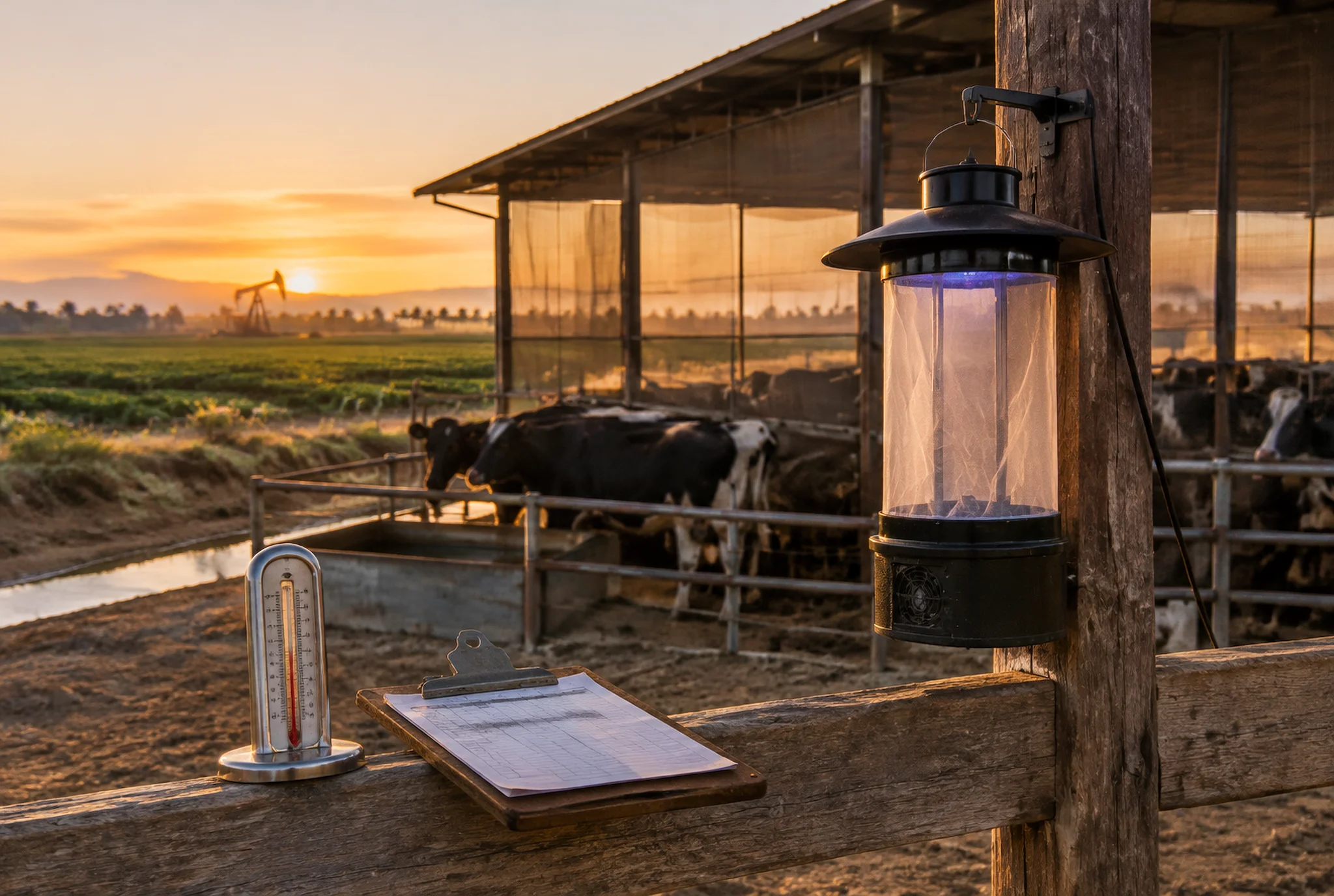
Biting midges California: the short answer
| Question | Answer available today | Where the answer comes from |
|---|---|---|
| When is the season? | No published date for California | No state or federal instrument defines one |
| Are the vectors here? | Yes, and the main western one is common | The published vector distribution in the United States |
| Is the virus here? | Present and stable, seven serotypes listed as established | USDA APHIS bluetongue status page, July 2025 |
| What reduces contact? | Housing at the biting hours, screening, source work | Trap series and field trials, most of them European |
| What can a device decide? | Measurement and interception, not control | Stated plainly on the pages linked below |
The rest of this article earns those five rows. It starts with why the question is three questions, then borrows the one legal definition that exists, and ends with what a property owner in California can do about biting midges California conditions while no such definition is on the books.
Three clocks hiding inside biting midges California searches
The disagreement in every California forum is not about insects. It is about which clock a speaker is using. Biting midges California residents encounter sit under three separate timing systems, with different owners, different endpoints and different rules of evidence.
| Clock | What it measures | Who operates it | What a date is used for |
|---|---|---|---|
| Nuisance clock | When host-seeking midges land on people at dusk | Nobody, in California | Whether to plan an evening outdoors; where to site equipment |
| Production clock | When larval substrate is producing adults | Researchers, on individual properties | Source work, drainage, the timing of a bank or lot intervention |
| Regulatory clock | When transmission of an animal virus is not expected | Competent authorities, in the European Union | Releasing movement and trade restrictions on ruminants |
Most biting midges California content, including some of it written by us, lives on the first two clocks. The production side is treated in detail on the California page on breeding ground, which works through banks, manure, pond shape and the drying clock. The hour-by-hour nuisance side is on the activity-gate page. This page is about the third clock, because that is the one that has been made explicit enough to be checked, and because California property owners with animals are increasingly the people being asked for dates they do not have.
What a vector-free period actually is
The term is defined in European Union law, and the definition is deliberately mechanical. A vector-free period means, in a defined area, “the period of inactivity of Culicoides determined in accordance with Section 5 of Chapter 1 of Part II of Annex V to Delegated Regulation (EU) 2020/689” (Delegated Regulation (EU) 2020/688, Article 3). It is not a season named by an official. It is a result produced by traps, and the traps are specified.
The reason a government would bother is commercial rather than entomological. The Austrian monitoring team that ran the method for five years put it plainly: “In accordance with the EU regulation 1266/2007, veterinary authorities are requested to determine vector-free periods for loosing trade and movement restrictions of susceptible livestock.” Their own conclusion, after five seasons of trapping, was a number rather than a feeling: “Based on our Culicoides monitoring, a vector-free period of approximately 150 days per season can be defined.”
The instrument is therefore a key. It opens a movement window. The animal-health condition that has to be satisfied alongside it is equally mechanical: a seasonally free area also requires “the absence of new cases of infection with any of the serotypes 1-24 of BTV since the end of the vector activity season” (Regulation (EU) 2020/689, Annex V, Part II, Chapter 5). The insect side and the virus side are separate tests, and a trap reading alone does not buy the date.
What the date then permits is also written down. Animals moving between Member States must satisfy one of several conditions, among them that “the animals are unloaded in a vector-protected establishment or during the vector-free period”.
The companion concept matters for anyone who reads equipment marketing. A vector-protected establishment is defined as “part or all facilities of an establishment that are protected against attacks from Culicoides by appropriate physical and management means”, and the status is granted, and withdrawn, by a competent authority.
It is a legal description of a building and its management. It is not a product specification, and no device confers it.
The number behind the word
Section 5 of the annex is two pages long and reads like a field protocol. Surveillance “must consist of at least an active annual programme of vector catching by means of permanently sited aspiration traps intended to determine the population dynamics of the vector and, where relevant, the vector-free period”. The traps are ultraviolet-equipped and run through the whole night. Their duty cycle is asymmetric on purpose: “one night per week during the month before the expected beginning and during the month before the expected end of the vector-free period”, and then “one night per month during the vector-free period”.
The shoulder months get the effort because that is where the boundary is.
The density is fixed too. “The geographical units referred to in point (a) of Article 40(1) must be based on a grid of 45 km by 45 km”, one station per unit, and a proportion of the catch must go to “a specialised laboratory capable of counting and identifying the suspected vector species or complexes”. And then the number itself, which is what anyone who wants to argue about a season has to argue about: “In the absence of sound evidence supporting the determination of the maximum threshold, total absence of Culicoides imicola specimens and less than five parous Culicoides per trap must be used as maximum threshold.”
| Component of the definition | What the regulation specifies | Why a lawyer would care |
|---|---|---|
| The count | Fewer than five parous Culicoides per trap; zero Culicoides imicola | It is a maximum, so exceedance ends the period immediately |
| The grid | One station per 45 km by 45 km unit, about 2,025 km2 | No property can produce this alone; it is a national installation |
| The duty cycle | Nightly in the shoulder months, monthly inside the period | A single trap-week proves nothing at the boundary |
| The reading | Species identification and parity, in a laboratory | The count is a human judgment on a sub-two-millimetre insect |
| The price | EUR 48 to EUR 164 per trap sample, published actuals | A defensible date is a budget line, not a forecast |
Five. Per trap, per night, with the qualifying word being parous: a female that has already completed at least one gonotrophic cycle, and so has lived long enough to have finished a virus incubation if she acquired one. That is why the legal count is not simply five midges. A female that has never laid is, by definition, younger than the virus needs.
It is also why no equivalent count exists on the nuisance side, where the finding was that no published action threshold for biting midges has ever been proposed.
The Austrian team that operated the scheme found the qualifying word inconvenient, and said so. Their records did not let them separate parous from nulliparous females reliably, so they tightened the rule instead of loosening it: “five Culicoides specimens were assumed instead of five parous females”, done “to avoid uncertainties concerning the determination of parous females”. A German group that revisited the question across four winters records where the figure comes from: “The numeric threshold of Regulation (EU) 2020/689 of less than five parous female Culicoides collected per trap and night to suspend trade restrictions for ruminants can be traced back to Meiswinkel et al.” The same paper notes that scoring parity takes experience and is of only moderate reliability.
Hold that against how the count is made. The legal boundary of an animal-movement window is drawn at a count of five, made on a colour judgment, by a person, on an insect a couple of millimetres long. The instrument is not a thermometer or a calendar. It is a laboratory, and the weakest component in it is the eye reading the abdomen.
If a supplier in California quotes you a threshold, ask the four questions the European rule answers: the count, the trap, the night, and who decided parity.
What a legally usable season costs to establish
The European rule is not free, and its price is one of the most useful numbers a Californian reader can carry away from this page. Pinior and colleagues performed a retrospective cost analysis of the Austrian and Swiss vector monitoring programmes for 2006 to 2010. The total net cost of the Austrian programme was EUR 1,415,000 and the Swiss programme EUR 94,000. Normalised for sampling frequency and the number of trap sites, the resulting figure was EUR 164 per trap sample in Austria and EUR 48 in Switzerland.
Two details make those numbers legible. First, the sampling areas were comparable: 1,600 to 2,100 km2 per trap, which is essentially the regulatory grid being executed. Second, roughly half of the money was invisible: “In both countries, around 50 per cent of the total costs can be attributed to payments in-kind.” Trap maintenance, sample collection and preparation were carried by institutions and by the farms that hosted the equipment, not by a line in a programme budget.
Read as a unit price, EUR 48 to EUR 164 per trap sample is the marginal cost of one defensible data point in a programme somebody is legally entitled to rely on. Nothing in California buys that data point for biting midges California ground today. A property that wants to know whether its own ground is quiet in February is, in regulatory terms, unsampled. The honest substitute is a personal record kept on the same principle: a fixed station, a fixed hour, a repeated count, held long enough for the noise to average out.
That is the method argued on the property-scale exposure page, and it is what a permanently running device is genuinely good at.
Why temperature was allowed to replace the traps
Running a national trap grid indefinitely is expensive, so the law provides an exit. Having demonstrated the boundary three times is enough to be allowed a proxy. “By way of derogation from point 1(a), if the seasonally BTV-free period has been successfully demonstrated for a period of 3 consecutive years, additional criteria such as temperature may replace entomological surveillance to substantiate the beginning and the end of the seasonally BTV-free period on the basis of scientific evidence.”
The derogation is conditional in a way that marketing copy usually drops. The proxy is permitted only where trapping has already been done, in the same place, three times, and the status remains disposable: “The seasonally BTV-free Member State or zone must immediately stop when there is evidence of the end of the vector-free period or of circulation of the virus.” A cold snap is not evidence of a closed season. It is a hypothesis that previous years’ traps supported.
What the Austrian traps actually recorded gives the temperature rule its content. “Less than five specimens were trapped inside the stable on approximately 100 days per season”, while “outdoors the vector-free period lasted for around 150 days”. Outdoors, “vector activity decreased markedly in the autumn months and occurred mainly outdoors to a standstill after six consecutive freezing days” with minimum temperatures below zero. Across neighbouring countries, “vector-free periods of about 120 days (range 72-152 days) per season were reported by the Czech Republic, Hungary, Italy, Slovakia, and Switzerland”.
Range is the operative word. Seventy-two days to one hundred and fifty-two, between neighbouring countries, in a climate with far less variation than California’s. A borrowed calendar for biting midges California ground would have to survive that spread. A spread of that size is precisely what a measurement is for.
The clock the threshold is standing on
A count of five parous midges is arbitrary only in appearance. It rests on a biological constraint that is the single most useful thing a property owner can learn about these insects: the virus has a schedule, the midge has a lifespan, and transmission happens only if the first fits inside the second.
A female acquires virus with a blood meal from a viraemic animal. The virus must then replicate and reach her salivary glands before she bites again. The North American ecological review states the interval plainly: “The time required to achieve this cycle is called the extrinsic incubation period (EIP), and lasts, on average, between 1 and 2 weeks, but the range can vary substantially depending on environmental conditions (primarily temperature)”. Because virogenesis runs faster in warmth, the same review concludes that transmission is optimised during warm weather, above a threshold band of roughly 9 to 15 C.
The mathematics of that arrangement is unforgiving. As the Danish modelling team put it: “The EIP has a very strong impact on the VC of a disease, as the VC is proportional to the survival rate raised to the power of EIP.” A daily survival rate of 0.9 is unremarkable on its own. Raised to the fourteenth power it is 0.23. Warmth pulls in two directions at once, which is why the season is never a straight line: the North American review notes that the higher reproductive output at warm temperatures is offset by lower daily survival above roughly 20 C.
The Danish numbers show what happens when the clock and the trap network are combined rather than guessed. They estimated infectious bites per infectious host across every combination of their parameter equations, and reported that “more than 82% combinations of the parameter values predicted > 1 IBs per host”, with a mean of 59 infectious bites per infectious host. The spread was enormous: “We estimated a maximum of 14,954 IBs per infectious host at some farms, while a best-case scenario suggested transmission was never possible at some farms.” Confining the model to the coolest temperature quantile cut the transmission window from almost six months to “around 3 months of transmission (mid-May to mid-August)”.
One methodological warning from that study matters more than any of its outputs. The researchers used microclimatic temperature rather than weather-station temperature, noting that insects “are instead exposed to changing temperatures varying day by day and throughout the day”, and because “models relying on meteorological temperature may underestimate development rates”. A shaded cattle house, a dairy loafing area and an irrigation bank are three climates a few hundred metres apart. The flight mechanics behind that are on the flight and wind page.
The narrower point is this: whatever thermometer you are reading, it is probably not the one the midge is standing on.
Where the definition meets the insect
The European rule has now run long enough to be tested against itself, and the test is uncomfortable. Voigt and colleagues operated ultraviolet traps at twelve to fifty-five locations across Germany for four consecutive winters, 1 November to 31 March, and screened 1,581 pools containing 46,358 females for bluetongue, Schmallenberg and epizootic hemorrhagic disease viruses.
| Field result | What was measured | What it did to the definition |
|---|---|---|
| Austria, five seasons of continuous trapping | About 100 vector-free days indoors, about 150 outdoors | Showed the period is a building variable as well as a weather one |
| Five neighbouring countries | Reported periods of about 120 days, ranging 72 to 152 | Proved the same rule yields different calendars a few hundred kilometres apart |
| Germany, four winters, up to 55 sites | Threshold exceedances in mid-winter; one positive pool in 1,581 | Prompted the proposal to rename the period vector-low |
| Denmark, modelled across 22,004 farms | Mean 59 infectious bites per infectious host, range 0 to 73 | Showed a count and a risk can be far apart on the same farm |
Their headline is reassuring about virus and damaging about the rule. On virus, detection inside livestock housing “was extremely rare in this study: only one single, BTV-3 PCR-positive pool was identified among the 1,581 pools tested”, and the authors conclude that “the risk of virus transmission by biting midges is considered negligible in Germany from December to March”. On the rule, however, “their abundance often exceeded the EU threshold for parous Culicoides to define a vector-free period”, with feeding records above the trigger at three locations, and November and March taking 95 per cent of all winter captures.
The authors then propose the change practitioners had already made informally: “Rather than ‘vector-free’, which implies complete absence of vectors, alternative terminology such as ‘vector-low period'”. They go further and suggest that “the term ‘replication-free period’ would emphasize the temperature-dependent inhibition of virus replication in vectors”. The United Kingdom has begun publishing a seasonally vector-low period for bluetongue. The legal instrument is being renamed to match what the traps show, while the underlying number stays where it is.
That is the part a Californian should keep. A threshold is not a discovery about insects. It is a decision about how much residual risk a movement official will accept, expressed in midges. When the count is exceeded and the virus is still absent, the honest reading is that the count was conservative, not that the season was open.
Both readings are defensible, and the difference between them is invisible in a season summary.
What biting midges California ground has instead of a calendar
California has no declared vector-free period, no published trap density standard for biting midges California properties, and no state calendar a movement official can invoke. What it has is an unusually well-studied insect and an unusually explicit virus situation, and the two do not point at the same date.
On the insect, California is one of two places on earth where the vector has been measured properly. The seventy-year review of North American hemorrhagic disease research records that vector research “was limited in distribution, with most field studies conducted in California and Florida”. The governing concept for the western United States is a boundary drawn in the ecological review: “Culicoides sonorensis is the predominant, if not exclusive, vector of BTV serotypes 10, 11, 13, and 17 across most of the US, south and west of the so-called” line it names the Sonorensis Line, which “extends from approximately Washington State to Maryland”. California sits well inside that line.
The corollary explains the American map better than any surveillance report: “The absence of BTV in the northeast US appears to be due to a lack of a competent vector species.” The United States does not have a midge problem that varies with the weather. It has a vector distribution that varies with geography, and the virus follows it.
On the virus, the state’s record is long and not reassuring. The wildlife-interface review dates its beginning in the West: epizootics of bluetongue in sheep in western Texas by the end of the 1940s, and then, in 1952, the first isolation of BTV in California, serotype 10, from sheep. Much later, “BTV-2 was recently (2010) isolated in California, representing trans-continental dissemination of this virus serotype first described in the US in Florida in 1982”, and the isolate “is a reassortant of BTV-2 and BTV-6, the latter a previously exotic serotype to North America”. The ecological review’s summary of California dairying is the phrase worth stealing: human activity has reshaped the spatial hierarchy of infection into “ecotones within ecotones”, running from “enzootic California dairies” to the northern European epizootic.
The federal position fits on one line, on USDA APHIS’s bluetongue page, last modified 30 July 2025: “Bluetongue is present and stable in the United States.”
| Status listed by USDA, as of September 2022 | Serotypes | What the status means |
|---|---|---|
| Established | 3, 6, 10, 11, 12, 13, 17 | Reported annually for two consecutive years where weather-driven vector incursions would not be expected, or phylogenetic evidence of reassortment with established strains |
| Reported | 1, 2, 5, 9, 14, 15, 18, 19, 22, 24 | Detected, but not in the past five years, or in regions where incursions are expected |
| Not reported | 4, 7, 8, 16, 20, 21, 23, 25, 26 | Serotype 8 is flagged as of particular concern given competent vectors already in the country |
Two consequences follow, and they cut against each other. Bluetongue and epizootic hemorrhagic disease are both on the National List of Reportable Animal Diseases, so a suspected case goes to an accredited veterinarian, then to the Area Veterinarian in Charge and the state animal health official. And because presence is the standing condition rather than an incursion, there is no freedom to lose, which also means there is no window to declare. For biting midges California ground, the risk calendar is not missing through oversight.
It is missing because the virus is already here, which is also why the agency’s own advice to producers is about the insect rather than the date: “Producers should use insecticides to reduce biting midge (Culicoides spp.) populations, the insect that spreads bluetongue.”
The toolkit, read against what it was measured against
Everything above is diagnostic. The therapeutic side is where a Californian reader with animals, guests or clients most needs discipline, because the products available are advertised against insects rather than against outcomes. The published record is blunt about which measures have ever been measured at all, and the honest summary is uncomfortable for the insecticide industry in particular.
USDA’s advice to producers, quoted above, is a single instruction aimed at the insect. The veterinary literature on the same insects reaches a weaker verdict about the chemistry. Writing after the 2023 to 2025 European epizootics, Salat and colleagues state that “their abundance continues to increase, and they are only minimally susceptible to the insecticides commonly used in ruminants”, and that in one outbreak analysis “the use of insecticides was not associated with serological prevalence”. On the pour-on and spray chemistry used on cattle specifically, they cite a study showing that “the effectiveness of permethrins applied to animals is very limited, not to mention their ecotoxicity”.
The same authors record that the European Food Safety Authority’s animal-health panel had already confirmed “the limited effectiveness of insecticides”. This site has made a parallel argument about resistance on other ground, set out on the Texas livestock ledger and on the page about what actually kills them.
Two measures do better in the published record, and neither is a product you can buy in a bag. Keeping animals inside at the biting hours works because it removes the contact rather than the insect: “There is a clear benefit in reducing exposure to vectors by keeping herds indoors.” Screening works, with conditions: “installing insecticide-impregnated screens on stable doors can reduce their entry”. The aperture arithmetic behind that qualification is on the netting page, and the animal-premises sequence is on the midge and gnat page for livestock ground and in the Iowa animal-ground analysis.
For the viruses themselves, the practitioner literature converges on one instrument and it is not a trap: “Vaccination therefore remains the only truly effective means of controlling these infections.” The same review records the constraint on that instrument’s usefulness, which is uptake rather than chemistry, noting that “only 57% of Dutch sheep farmers implemented vaccination” after emergency inactivated vaccines were licensed in the Netherlands. Barua and colleagues place that licensing in context: a new inactivated bluetongue vaccine “has been licensed in the Netherlands for emergency use to prevent clinical signs and mortality”, while for the related epizootic hemorrhagic disease virus they note that “there is lack of widely used commercial vaccine for EHDV except in Japan”. Hirst and colleagues, reviewing seventy years of North American hemorrhagic disease research, describe the regional toolkit in the same two categories: “Control methods included protocols to reduce midges or midge biting, vaccinate animals against HD, and prevent spread of HD through trade regulations.”
What none of that record supports is a claim that any device, spray or plant stops a bite from becoming an infection on a neighbouring property. Virus moves with animals and with wind before it moves with anything else. Long-distance wind dispersion of the midge itself has been argued as the explanation for incursions on several occasions, as Durr and colleagues reassessed for the historical bluetongue and African horse sickness outbreaks, and USDA’s own serotype definitions anticipate “vector incursions due to weather events”. Movement pathways are equally documented: Hoar and colleagues modelled the importation question for California specifically, and their framing of the variables is worth keeping in view whatever your conclusion: “The risk of introducing a new strain of bluetongue virus into a region depends on the number of viremic animals that enter and the competency of local vectors to transmit the virus.”
| Measure | What has been measured | What it can decide for you |
|---|---|---|
| Insecticide on the animal | Susceptibility of field populations; association with seroprevalence in outbreaks | Weakly, at best. Ask which species and which compound were tested |
| Stabling or housing at the biting hours | Indoor and outdoor trap series over five seasons in Austria | Real exposure reduction, and the most controllable variable you own |
| Screening and treated screens | Entry reduction at stable doors; aperture tests on mesh | Good, provided the openings, not the mesh, are the limiting factor |
| Vaccination of the animals | Viraemia, clinical signs and mortality after emergency licensing | The strongest instrument in the published record, where a vaccine for the circulating serotype exists |
| Source work on your own ground | Larval substrate, drying and emergence studies | Addresses the production clock, not the movement clock |
| Carbon dioxide suction devices | Mosquito performance; incidental midge capture | Measurement and interception, not control of midges |
Where a carbon dioxide device fits in California, and where it does not
Pittar builds airflow-suction carbon dioxide traps for outdoor ground. The machine mimics the exhaled-carbon-dioxide cue that host-seeking insects follow, draws them in on an airflow, and lets them desiccate. Its published effective range is 4,000 square metres, it is an outdoor device, and it is not intended for indoor use or for a small paved area. The M3000 starts on battery and runs on gas, for ground where the unit has to stand where the animals or the guests are rather than where the nearest outlet happens to be; the MM4200 runs on mains where mains exist.
Pricing is by enquiry, so no figure appears on this page.
Against the subject of this article, the device has one honest role and three limits. Its role is the one the European rule implies: a permanently sited machine running the same night after night is the cheapest fixed station a property can own, and fixed stations are what a date has to be built from. That is the same reasoning behind placement guidance and the effectiveness statement.
For biting midges California questions the machine is evidence rather than remedy, and its limits are equally specific. It is a mosquito device, and this site says without hedging that it is not a biting-midge control programme. It confers no legal status: a vector-protected establishment is a building and a management regime approved by an animal-health authority, not a trap in a paddock. And it cannot produce a regulatory date, because the date requires species-level identification, parity scoring and a laboratory reading a count against a grid it does not sit on.
A count from a suction device tells you about your ground, which is worth having, and nothing about your eligibility to move cattle.
What the missing calendar means for four kinds of reader
A household with a yard. There is no date to wait for and no agency that will give you one. The nuisance clock is local, so build your own record: the same evening, the same spot, a fixed number of minutes, for eight weeks. Read your bank and irrigation ground first, because the production clock is the one your neighbours can genuinely change, and take the evening decisions from the activity gates rather than from the calendar.
An estate, camp or resort with animals or guests. You sit on both sides of the gap. Exposure management at the biting hours is the only measure with a published record of reducing contact, and it is also the cheapest thing to schedule. If you are asked to state a midge period in a leasing or concession document, write down what you measured, where and on which nights, rather than a month range you cannot support.
A pest-control or vector-management firm. Bidding on a midge job means bidding on a measurement you may not own. Ask the client which clock their specification is on. If the specification mentions bluetongue, epizootic hemorrhagic disease, movement or a show date, it is not a nuisance job and your insecticide licence is not the relevant qualification.
An importer, distributor or buyer. The regulatory clock is where a supplier conversation becomes testable. Four questions settle most of it: which species was tested, in which setting, against which endpoint, and against which comparison. Any vendor quoting a season should be asked which of the three clocks it belongs to. Our own pages state the answers we can support, including where a device belongs on the ground, what these devices are effective against and how to read a count.
What this page does not establish
- There is no published vector-free period, trap density or parous threshold for California or for the United States. Every hard number in this article is European or is a federal status statement, and each is attributed at the point of use.
- No date, month or week is offered for biting midges California ground, and none can be derived from the material here. The European analogue varies from 72 to 152 days between neighbouring countries with a far more uniform climate than California’s.
- The claim that winter counts exceeding the legal threshold coexisted with essentially no detectable virus is a result from central European livestock housing in one country. It is not a statement that California winters are safe, and it is not a statement about nuisance biting, which is a different question with a different denominator.
- Nothing here is veterinary advice. Suspected bluetongue or epizootic hemorrhagic disease is a matter for an accredited veterinarian and, because both are reportable, for state and federal animal-health officials.
- No device claim is made against any orbivirus, and none is made against biting midges as a population. The published midge literature uses carbon dioxide traps as instruments for finding out what is present.
Frequently asked questions
Is there a midge season in California I can plan around?
There is a pattern, and there are local records, but there is no published season for biting midges California properties, and no body is obliged to declare one. Warm-season nuisance peaks are described elsewhere on this site; what does not exist is a date with any standing beyond the property that observed it. That is why the practical advice everywhere on these pages is to measure your own ground rather than adopt somebody else’s month.
Why does Europe have a legal definition and the United States does not?
Because the two are protecting different things. The European instrument exists to release movement and trade restrictions once freedom has been demonstrated, so it needs a defensible start and end. In the United States, bluetongue virus is already classified as present and stable, so there is no freedom to demonstrate. Bluetongue and epizootic hemorrhagic disease remain reportable, but reporting a disease is a different administrative act from certifying its absence.
Does that mean the biting midges California keeps are not a risk to my animals?
The opposite. The main western vector sits inside the state, seven serotypes are listed as established federally, and the state’s own dairy ground is described in the published literature as enzootic. What is absent is a calendar. Risk without a calendar is managed by exposure, vaccination decisions taken with a veterinarian, and movement paperwork, not by waiting for a month when the insects supposedly stop.
Can I create a vector-protected barn in California?
You can build the physical and management arrangement that phrase describes, and it is a sensible thing to want. You cannot obtain the status, because the status is granted and withdrawn by an animal-health authority under a specific regulation. Where the concept is worth borrowing is as a design brief: openings screened, animals inside at the biting hours, and the arrangement documented well enough that a veterinarian or buyer could inspect it.
What would a usable local record look like?
Start with the counting discipline argued on the page about how many is too many, which is where the same-night, same-station method is set out. Then know exactly where your record stops. The European definition needs four things a property cannot supply alone: species identification to complex level, a parity read on each female, a laboratory willing to count them, and a grid of neighbouring stations so that a low number means a quiet landscape rather than a wind shadow. What you can supply is the trend on your own ground, which is enough to run an exposure plan and nowhere near enough to certify a movement window.
Sources Consulted
- Brugger K et al. (2016). “Outdoor and indoor monitoring of livestock-associated Culicoides spp. to assess vector-free periods and disease risks.”. BMC Veterinary Research 12(1): 88; doi.org/10.1186/s12917-016-0710-z
- Haider N et al. (2019). “Quantifying the potential for bluetongue virus transmission in Danish cattle farms.”. Scientific Reports 9(1): 13466; doi.org/10.1038/s41598-019-49866-8
- Mayo C et al. (2020). “Ecological Dynamics Impacting Bluetongue Virus Transmission in North America.”. Frontiers in Veterinary Science 7: 186; doi.org/10.3389/fvets.2020.00186
- Rivera NA et al. (2021). “Bluetongue and Epizootic Hemorrhagic Disease in the United States of America at the Wildlife-Livestock Interface.”. Pathogens 10(8): 915; doi.org/10.3390/pathogens10080915
- Hirst K et al. (2026). “Seventy years of hemorrhagic disease research in North America.”. Journal of Medical Entomology 63(3): tjag066; doi.org/10.1093/jme/tjag066
- Voigt A et al. (2026). “Winter activity and virus infection of Culicoides biting midges (Diptera: Ceratopogonidae) in German livestock housing before and during the 2024 BTV-3 outbreak.”. Parasites & Vectors 19(1): 382; doi.org/10.1186/s13071-026-07620-w
- Salat O (2026). “Management of Bluetongue Outbreaks: The Practitioner’s Perspective.”. Viruses 18(10): 1163; doi.org/10.3390/v18101163
- Barua S et al. (2024). “The Global Burden of Emerging and Re-Emerging Orbiviruses in Livestock: An Emphasis on Bluetongue Virus and Epizootic Hemorrhagic Disease Virus.”. Viruses 17(1): 20; doi.org/10.3390/v17010020
- Durr PA et al. (2017). “Sellers’ Revisited: A Big Data Reassessment of Historical Outbreaks of Bluetongue and African Horse Sickness due to the Long-Distance Wind Dispersion of Culicoides Midges.”. Frontiers in Veterinary Science 4: 98; doi.org/10.3389/fvets.2017.00098
- Catania AM et al. (2025). “Silent circulation of Bluetongue and Schmallenberg viruses in Culicoides biting midges in northwestern Italy: implications for the 2024 BTV outbreak.”. Journal of Medical Entomology 62(6): 1582-1589; doi.org/10.1093/jme/tjaf128
- Pinior B et al. (2015). “Economic comparison of the monitoring programmes for bluetongue vectors in Austria and Switzerland.”. Veterinary Record 176(18): 464-464; doi.org/10.1136/vr.102979
- Newbrook K et al. (2026). “Infection Dynamics and Clinical Signs of Bluetongue Virus Serotype 3 in Cattle and Transmission to Culicoides Vectors.”. Transboundary and Emerging Diseases 2026(1): e9342380; doi.org/10.1155/tbed/9342380
- Hoar BR et al. (2004). “Probability of introduction of exotic strains of bluetongue virus into the US and into California through importation of infected cattle.”. Preventive Veterinary Medicine 66(1-4): 79-91; doi.org/10.1016/j.prevetmed.2004.08.006
- Commission Delegated Regulation (EU) 2020/688, consolidated text 22.04.2026. EUR-Lex. https://eur-lex.europa.eu/legal-content/EN/TXT/HTML/?uri=CELEX:02020R0688-20260422
- Commission Delegated Regulation (EU) 2020/689, consolidated text 22.04.2026. EUR-Lex. https://eur-lex.europa.eu/legal-content/EN/TXT/HTML/?uri=CELEX:02020R0689-20260422
- USDA Animal and Plant Health Inspection Service. Bluetongue, last modified 30 July 2025. https://www.aphis.usda.gov/livestock-poultry-disease/cattle/bluetongue